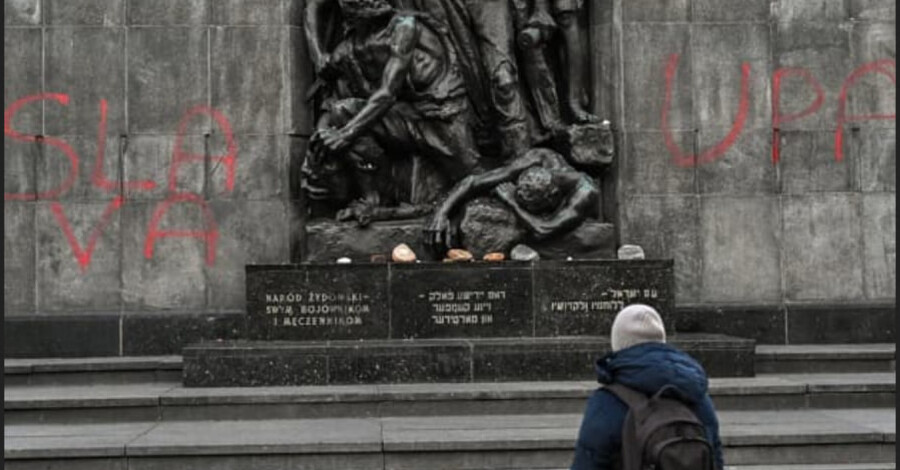
The smell of turpentine often lingers in old cities, but in the quiet streets of Warsaw’s Muranów district, the scent of fresh red paint told a story no one had planned to read. On a crisp day in November 2026, residents and passersby discovered two significant monuments defaced with the words 'Slava UPA'. This was not a casual tag; it was a deliberate intrusion into the public sphere of memory. The targets were the monument to the Soldier of the 1st Army of the Polish Army and the Monument to the Heroes of the Warsaw Ghetto. These are not just statues; they are anchors for national identity and historical reconciliation, making the act feel less like a crime and more like an attack on the social fabric itself. To understand why this specific phrase caused such a ripple effect, one must look back at the complex history between Poland and Ukraine. 'Slava UPA' refers to the 'Glory of the UPA', or the Ukrainian Insurgent Army. For many Ukrainians, the UPA is a symbol of the fight for independence during World War II. For many Poles, however, it is a dark reminder of the Volhynia massacres, where Ukrainian nationalists and Polish civilians were victims of brutal violence. The UPA remains a deeply contested and painful chapter in bilateral relations. By spraying these words on monuments dedicated to Polish heroes, the vandals were not just committing graffiti; they were weaponizing historical trauma. The choice of location in Muranów, a district heavily associated with the legacy of the Warsaw Ghetto, added a layer of irony and provocation that went beyond simple vandalism. As news spread, it became clear that this was not an isolated incident in the capital. Reports surfaced from Poznań and Gdynia, revealing a pattern of similar acts across the country. In Gdynia alone, three monuments were vandalized with the same red inscription. The geographic spread suggested a coordinated campaign rather than the work of a single local agitator. Authorities in Poland found themselves in the position of neutral observers to a crime that had profound political undertones. The police began their standard investigations, documenting the scene and seeking clues, but the international dimension of the act quickly overshadowed the procedural details. The most significant twist in the narrative came from Warsaw. The Ukrainian Embassy in Poland released a statement that transformed the local crime into a matter of strategic security. They did not merely condemn the acts as illegal; they contextualized them as part of a larger design. In a widely shared post on their Telegram channel, the embassy argued that these violations were not random. They suggested a foreign hand was pulling the strings, aiming to exploit the historical frictions between the two nations. The logic was straightforward: by fomenting hatred against Ukrainian symbols, an adversary could weaken the bond between Poland and Ukraine, two neighbors who had found rare unity during the recent war. The embassy explicitly identified the architect of this strategy, pointing to the Kremlin. The claim was that this was a manifestation of Russian hybrid warfare. Hybrid warfare is a term used to describe a blend of conventional and unconventional tactics, including cyberattacks, disinformation, and covert sabotage, designed to destabilize a target without triggering a full-scale military response. The embassy argued that Russia was trying to implement this strategy in European states, with Poland as the primary target. 'In our belief, this unlawful act is a manifestation of the hybrid war that Russia is trying to implement in European states, first and foremost in Poland, by all means,' the embassy stated. This accusation added a layer of suspicion to the physical evidence. Why would someone risk imprisonment for such a simple act of graffiti? The answer, according to Kyiv, lay in the incentive. Reports indicated that anonymous individuals had been offering 500 dollars to anyone willing to perform the vandalism. This bounty suggests a decentralized recruitment effort, where the physical act is farmed out to local opportunists or agents who can easily be discarded. The money makes the act transactional, turning patriotic or political symbolism into a commodity for criminal enterprise. It also complicates the forensic investigation. If the actors are paid, they are likely unconnected to the central command, making it difficult to trace the chain of orders back to a state actor. The use of 500 dollars as a reward is a small number, but it is enough to attract individuals who might not otherwise engage in political violence. It turns a symbolic statement into a job, blurring the lines between ideology and crime. As the dust settles on the painted monuments, the situation remains charged. The red letters have been removed or covered in some cases, but the diplomatic fallout is harder to erase. Poland and Ukraine, historically entangled in conflict, are currently allies against a common foe. The vandalized monuments served as a stark reminder that this alliance is not immune to internal sabotage. The Ukrainian Embassy's stance has put the ball in Poland's court. While the police continue to treat it as a criminal matter, the diplomatic channel has become the primary arena for the dispute. The incident highlights the vulnerability of shared historical memory to external manipulation. In a world where borders are porous to digital influence and physical probes, the safety of a nation's symbols can be tested by an adversary thousands of miles away. The red paint on the stone of Warsaw is not just a stain; it is a test of resilience for the Polish-Ukrainian partnership.