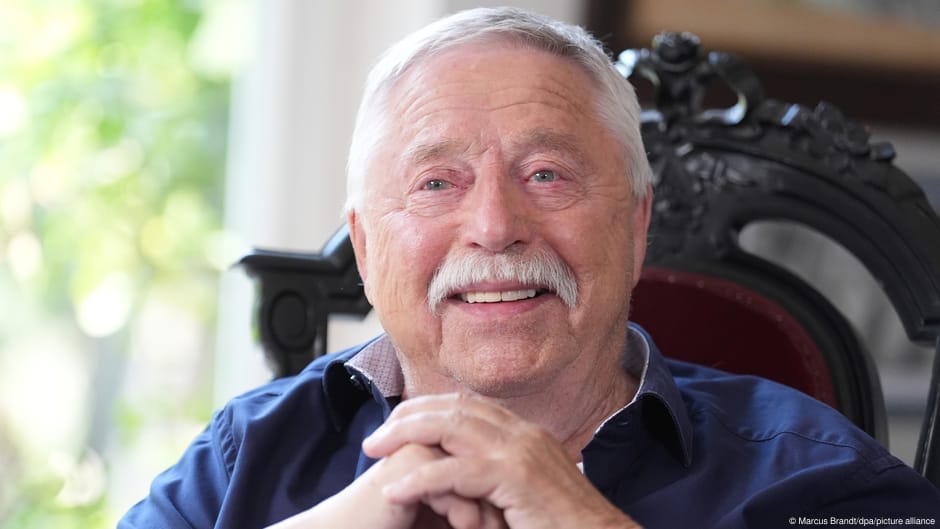
For most people, the idea of being 90 years old and yet releasing a new musical statement is almost conceptually impossible. But for Wolf Biermann, Germany's most enduring dissident singer-songwriter, age is not a retirement plan; it is a backdrop. As he marks his 90th birthday, the release of his latest album, 'Unterm Haar nur Himmel' ('Beneath Hair, Only Sky'), signals that his voice has not merely survived the decades—it has sharpened. The album title itself is a metaphor for the central tension of his life: the restrictive, earthly boundaries of political oppression and the infinite, open space of the free spirit that he has spent nine decades trying to protect. It is a work that explores themes of freedom, serving as both a memoir and a manifesto.

To understand the weight of Biermann's current work, one must look to the very beginning of his life in Hamburg. Born in 1936, Biermann entered the world into a state of escalating violence. His father, a Jewish communist and active resistance fighter against the Nazi regime, was arrested when the infant Biermann was just three months old. The father's journey ended in a prison cell, only to be cut short by his murder at the Auschwitz concentration camp in early 1943. Biermann was only an infant when the war reached its industrial horror, but he was an old enough child to remember the other great trauma of his youth: the Allied firebombing of Hamburg in 1943. He has described that moment with visceral clarity: "I pressed my face into my mother's soft coat so I could breathe. A sense of security in the midst of the end of the world." He notes, "Nothing in my life has shaped me more." These dual traumas—the loss of his father to the Nazis and the destruction of his home by the Allies—created a psychological landscape where freedom was the only viable alternative to chaos.
From this fractured foundation, Biermann built a career that would make him a thorn in the side of the German Democratic Republic. Often described as Germany's answer to Bob Dylan, he did not just sing about the times; he sang against them. In East Germany, where artistic expression was tightly controlled by the state, Biermann's poetic approach to themes of freedom and personal responsibility was a form of resistance. His music became a vessel for the voices that the GDR attempted to silence. When he was eventually forced into exile, his status as a dissident was cemented, but it was the music itself that carried his reputation far beyond the Iron Curtain. He remained a vocal and independent artistic voice, proving that a single artist could hold a mirror up to a system that preferred to look away. His work was not just entertainment; it was a political act that challenged the narrative of a stable, socialist society.
In the album, he criticizes global leaders like Vladimir Putin and denounces the conflict in the Palestinian territories.
Ninety years old, Biermann has not softened his edge. The themes of 'Unterm Haar nur Himmel' are not abstract; they are a direct response to the contemporary global landscape. He continues to use his music to criticize global leaders who embody the kind of authoritarianism that destroyed his childhood. In the album, he criticizes global leaders like Vladimir Putin and denounces the conflict in the Palestinian territories. This is not a nostalgia piece; it is a warning. Biermann sees the current world as chaotic and dangerous, and he responds with a call for individual agency in a time of collective uncertainty.
Central to this new work is a specific track titled 'Moritat von den Liebespaaren' (Ballad of Lovers). While the title might suggest a romantic focus, the content is a call for personal responsibility in a world that feels increasingly out of control. Biermann argues that in the face of chaotic global politics, the only thing an individual can control is their own moral compass. This is the 'sky' beneath the 'hair' of the album's title: the open space of individual conscience that remains even when the world is closing in. He suggests that while we cannot control the actions of leaders, we are responsible for how we interpret and react to their words and deeds. It is a theme that has run through his work for decades, but one that resonates with particular urgency in the current political climate.
As Biermann continues to perform, he defies the natural order of artistic careers that usually wind down with age. He remains politically outspoken, using his status as a cultural figure to keep the conversation about freedom and responsibility alive. His story is one of survival against the odds of the 20th century's worst conflicts, and he has chosen to keep that survival visible. The release of 'Unterm Haar nur Himmel' is not just a birthday present to himself; it is a statement that the fight for the free human spirit is not over. It is a declaration that even after 90 years, after losing his father, after surviving the firebombing of Hamburg, and after defying an entire state, he still has something to say. And he says it with the same fire that has characterized his life since that infant