
The crisp November air in Arlington, Virginia, carried the solemn cadence of a Veterans Day ceremony. Flags rippled, families stood at attention, and a hushed reverence settled over the assembled service members. Into that setting stepped a familiar figure, his hair as unmistakable as his cadence: Donald Trump. The former commander‑in‑chief, who has spent the past two years oscillating between private ventures and political commentary, seized the microphone and turned a moment of remembrance into a platform for a stark geopolitical warning.
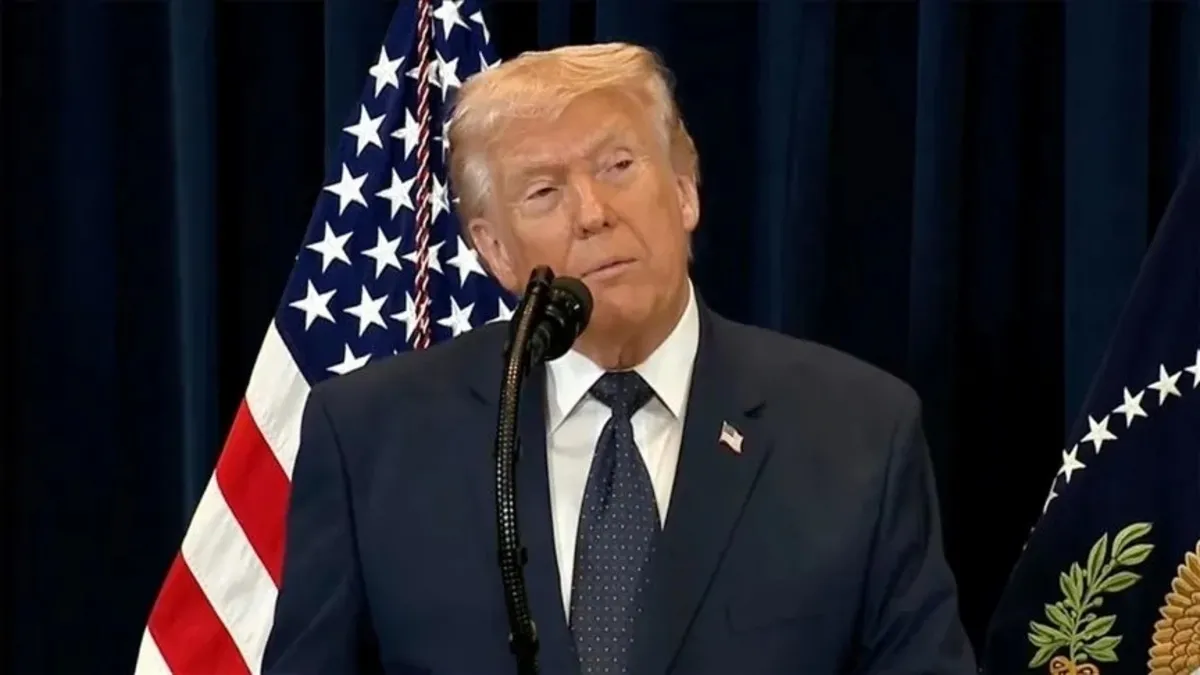
“I want to talk about something that’s been going on for a very long time,” Trump began, his voice rising over the murmurs of the crowd. “Iran has been at war with America since 1979.” The assertion hung in the air, a claim that reframed a complex history of diplomatic spats, proxy battles, and occasional open hostility into a single, unbroken conflict.
The year Trump cited is not arbitrary.
The reference to a 25‑year rebuilding timeline is a rhetorical device, designed to convey the magnitude of force that would be required.
By collapsing this mosaic of incidents into a single, continuous war, Trump invoked a narrative that resonates with a veteran audience accustomed to clear battle lines. “This should have been taken care of a long time ago,” he said, implying that the United States has been tolerating an unfinished fight for nearly half a century.
The rhetoric escalated quickly. “We want to make sure we have a total victory. Not a 93 percent victory. It’s going to be total,” Trump declared, his emphasis on the word total echoing the language of decisive military campaigns. The figure “93 percent” was not explained, but its inclusion suggested a benchmark short of complete dominance—perhaps a nod to the incomplete nature of past U.S. actions in the region.
In the context of a Veterans Day audience, the call for an unequivocal triumph carried an emotional weight. For many who have faced ambiguous outcomes on distant battlefields, the promise of a clean, unambiguous win can be both comforting and unsettling. It also raises practical questions: what does a “total victory” against a sovereign nation entail, and at what cost?
Trump’s vision of victory was paired with a stark projection of destruction and reconstruction. “It’ll take them 25 years to rebuild what we have destroyed, and hopefully, we won’t have to destroy any more of that country,” he warned. The statement implied that any future U.S. action would be so extensive that Iran would need a quarter‑century to recover.
The reference to a 25‑year rebuilding timeline is a rhetorical device, designed to convey the magnitude of force that would be required. It also subtly shifts responsibility: if the United States were to inflict such damage, the onus of recovery would fall on Iran, reinforcing the notion of a punitive, rather than restorative, war.

Mr. Vice-President, Please allow me to present a different perspective. The problem was not the Iran War. It was the cease fire. If you start a war, you need to win it and finish it – otherwise don’t start it. This war should have been over six months ago, with the Strait of Hormuz wide open and oil flowing. The second and third tiers of Iranian leadership should have been destroyed, and we should have supported the pro-western forces who could have taken leadership. We stood on the brink of a new, more peaceful Middle East - and then we blinked. We had a chance not only to deny Iran nuclear weapons, but to get rid of the world’s biggest supporter of terrorism. Instead, we had a cease fire, which was followed by months of will we or won’t we finish the job. Every day was a different message. There still is. Is the war over? Is it about to begin? No one knows. There is confusion and inconsistency. In June 2025, America was not involved. This was an Israel vs Iran issue. No one forced the United States to attack Iran then, or in February of 2026. It was a decision made by President Trump. In my opinion, it was the right decision. Once the decision was made, we should not have stopped until the regime fell. But instead, you negotiated a cease fire that didn’t last, didn’t work and left us in no man’s land, with higher prices and our troops still deployed. Our troops could have been home, the Navy returned to its bases, a peaceful regime in place , new alliances forged, and gas prices below $3.00 a gallon. No, Mr. Vice President. It’s not the war. It’s the so-called cease fire.
Trump’s remarks, while delivered at a ceremonial event, echo a broader strand of American political discourse that treats Iran not merely as a strategic rival but as an existential adversary. By framing the relationship as a war that began in 1979, he sidesteps the nuances of diplomatic engagement, sanctions regimes, and multilateral negotiations that have defined U.S. policy for decades.
The call for “total victory” also signals a preference for decisive, perhaps kinetic, solutions over incremental pressure. In a policy environment where the United States has increasingly relied on sanctions, cyber operations, and covert actions, such a declaration could be read as an invitation to reconsider the balance between soft power and hard power.
Moreover, the emphasis on destruction and reconstruction dovetails with a broader political narrative that equates American strength with the capacity to inflict irreversible damage on adversaries. For a veteran audience, that narrative may resonate with memories of clear‑cut victories, yet it also raises ethical and strategic dilemmas about proportionality and long‑term regional stability.
The Veterans Day speech did not introduce new diplomatic initiatives, nor did it announce concrete military plans. Instead, it offered a stark, unfiltered perspective on a relationship that has long been defined by ambiguity. As the ceremony concluded and the crowd dispersed, the lingering question was not whether Iran and the United States are technically at war, but how such rhetoric shapes public perception and, ultimately, policy choices.
In the months ahead, analysts will watch for any shift in the tone of U.S. statements toward Tehran, especially as the United States navigates a complex geopolitical landscape that includes rival powers, energy markets, and domestic political calculations. For now, Trump’s Veterans Day proclamation stands as a reminder that, in American politics, the line between remembrance and rallying cry can be razor‑thin, and that the language of war continues to echo long after the battlefield has faded.
Key Facts - Date of remarks: November 8 2026 - Location: Veterans Day event, Arlington, Virginia - Primary claim: Iran has been at war with the United States since 1979 - Policy stance: The United States must achieve a “total victory” over Iran, not a partial one - Destruction estimate: Trump suggested it would take Iran 25 years to rebuild after U.S. destruction - Quotes: - “This should have been taken care of a long time ago.” - “We want to make sure we have a total victory. Not a 93 percent victory. It’s going to be total.” - “It’ll take them 25 years to rebuild what we have destroyed, and hopefully, we won’t have to destroy any more of that country.”