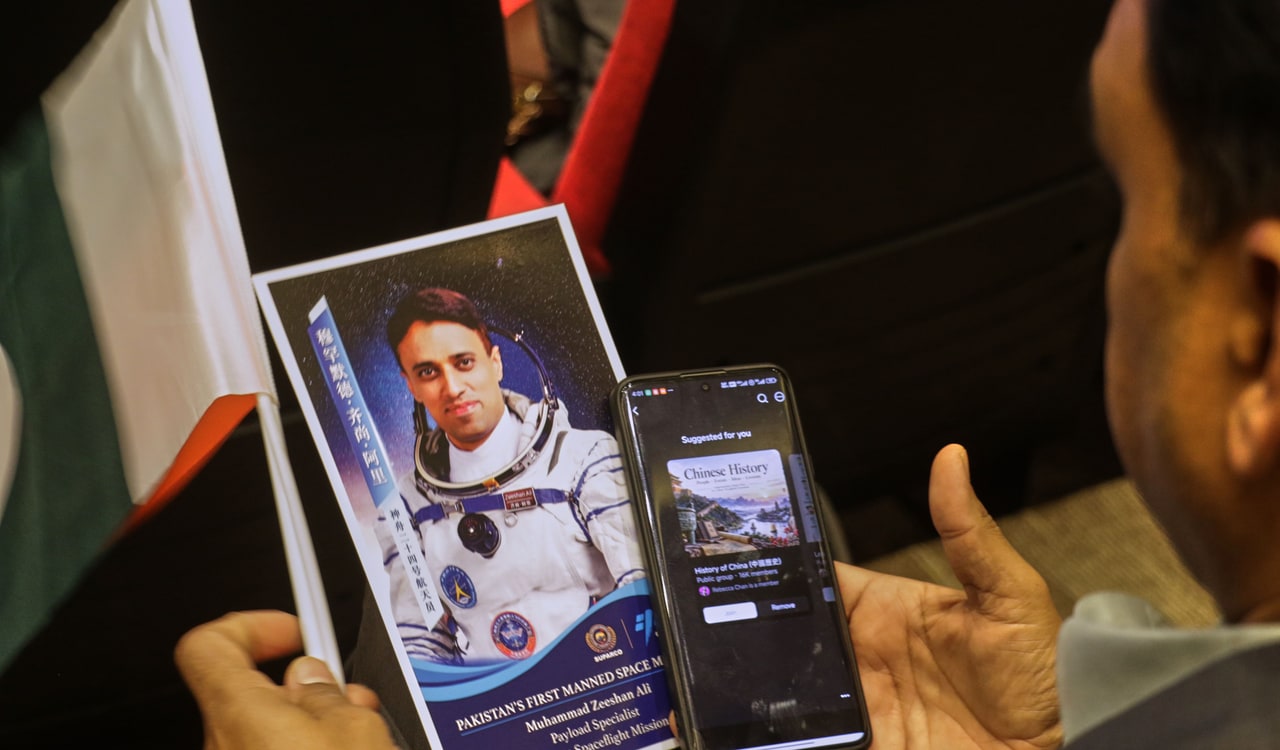
In a moment that transcends national boundaries, China successfully launched the Shenzhou-24 crewed spaceship from the Jiuquan Satellite Launch Centre in northwest China. The mission marked a historic first: the inclusion of a foreign national in its crewed space program. This unprecedented collaboration occurred against the backdrop of celebrations for the 75th anniversary of China-Pakistan diplomatic ties, symbolizing the deepening relationship between the two nations.

Aboard the Shenzhou-24 were three astronauts: mission commander Tang Hongbo, flight engineer Wu Yi, and Pakistani Air Force pilot Muhammad Zeeshan Ali. Ali's presence aboard the spacecraft carries particular significance, as he is the first foreign national to participate in China's crewed space programme and the first to visit the Tiangong space station. His designation as a payload specialist reflects specialized scientific objectives for his time aboard the orbital laboratory.
The launch, propelled by a Long March-2F carrier rocket, demonstrated China's reliable space launch capabilities. Within just 10 minutes of liftoff, the spaceship had successfully separated from the rocket and entered orbit, showcasing the precision and efficiency of China's space technology. This rapid transition from launch to orbital insertion is a testament to the maturity of China's human spaceflight program.
The seamless docking operation further demonstrated China's advancing capabilities in space station operations.
Just hours after launch, the Shenzhou-24 completed its journey to the Tiangong space station, successfully docking with the orbital outpost. This rendezvous marked the beginning of a new phase for the mission, as the crew prepared to join three other astronauts who have been manning the station for the past six months. The seamless docking operation further demonstrated China's advancing capabilities in space station operations.
The significance of this mission extended beyond technical achievements, serving as a symbol of the strong relationship between China and Pakistan. Chinese President Xi Jinping and Pakistani President Asif Ali Zardari exchanged congratulations on the joint mission, underscoring the political importance of this space collaboration. The timing of the launch, coinciding with the 75th anniversary of diplomatic ties, was no coincidence but rather a deliberate demonstration of bilateral cooperation.
In a statement that captured the essence of this historic mission, Chinese President Xi Jinping remarked: "The joint space exploration of astronauts from China and Pakistan is a vivid embodiment of the deep-rooted friendship between the two countries, as well as another important achievement in bilateral cooperation." This quote encapsulates how space exploration has become a new frontier for diplomatic relations between nations.
As Muhammad Zeeshan Ali begins his work aboard the Tiangong space station, the mission represents a potential model for future international space collaborations. The inclusion of foreign astronauts in China's space program could open new opportunities for scientific exchange and diplomatic partnerships in the final frontier.
The Tiangong space station, now hosting international crew members, continues to evolve as a platform for scientific research and international cooperation. With China's space station becoming increasingly operational, missions like Shenzhou-24 demonstrate the growing maturity of China's human spaceflight program and its potential contributions to global space exploration efforts.