
On a Thursday night in Milan, the air held the weight of expectation for the French national team. As they stepped onto the pitch for their Nations League match on November 12, there was a sense that the squad was ready to assert its dominance. For a brief period, it seemed as though that dominance was within reach. Led by the early momentum of Olise, France began the encounter with a rhythm that suggested they might control the tempo and dictate the terms of the engagement.
But in the high-stakes theater of international football, a strong start is often a fragile thing. The early energy that propelled the French side forward proved to be a fleeting grace period, a momentary reprieve before a structural failure began to manifest in the most punishing way possible.
As the match progressed, the narrative shifted from French initiative to Italian opportunism. The primary culprit was not a lack of intent from the attackers, but a profound absence of stability in the backline. The French defense, which had appeared capable in the opening minutes, began to unravel, lacking the solidity required to withstand the pressure of an Italian side playing on home soil.
While the collective failure of the defense was the headline, the individual struggle of Mike Maignan cannot be overlooked.
This was not merely a series of tactical errors; it was a systemic abandonment. The Bleus found themselves adrift, their defensive structure dissolving under the heat of the contest. When a defense loses its cohesion, the rest of the team is left to navigate a landscape of constant vulnerability, and on this night in Milan, that vulnerability was exploited with clinical precision.
By the 75th minute, the tension had reached a breaking point. The match, which had been a battle of shifting momentum, swung decisively toward Italy when a penalty was awarded. Esposito stepped up to the spot, the eyes of the stadium fixed on the goal.
Mike Maignan, the French goalkeeper, stood as the final line of defense. In moments like these, a goalkeeper is tasked with being the anchor for a team that is otherwise adrift. However, the pressure of the match and the lack of defensive support meant that Maignan was often left isolated. When the penalty was struck, the attempt was unsuccessful in preventing the shift in momentum, leaving the French side to grapple with a deficit that felt increasingly insurmountable.
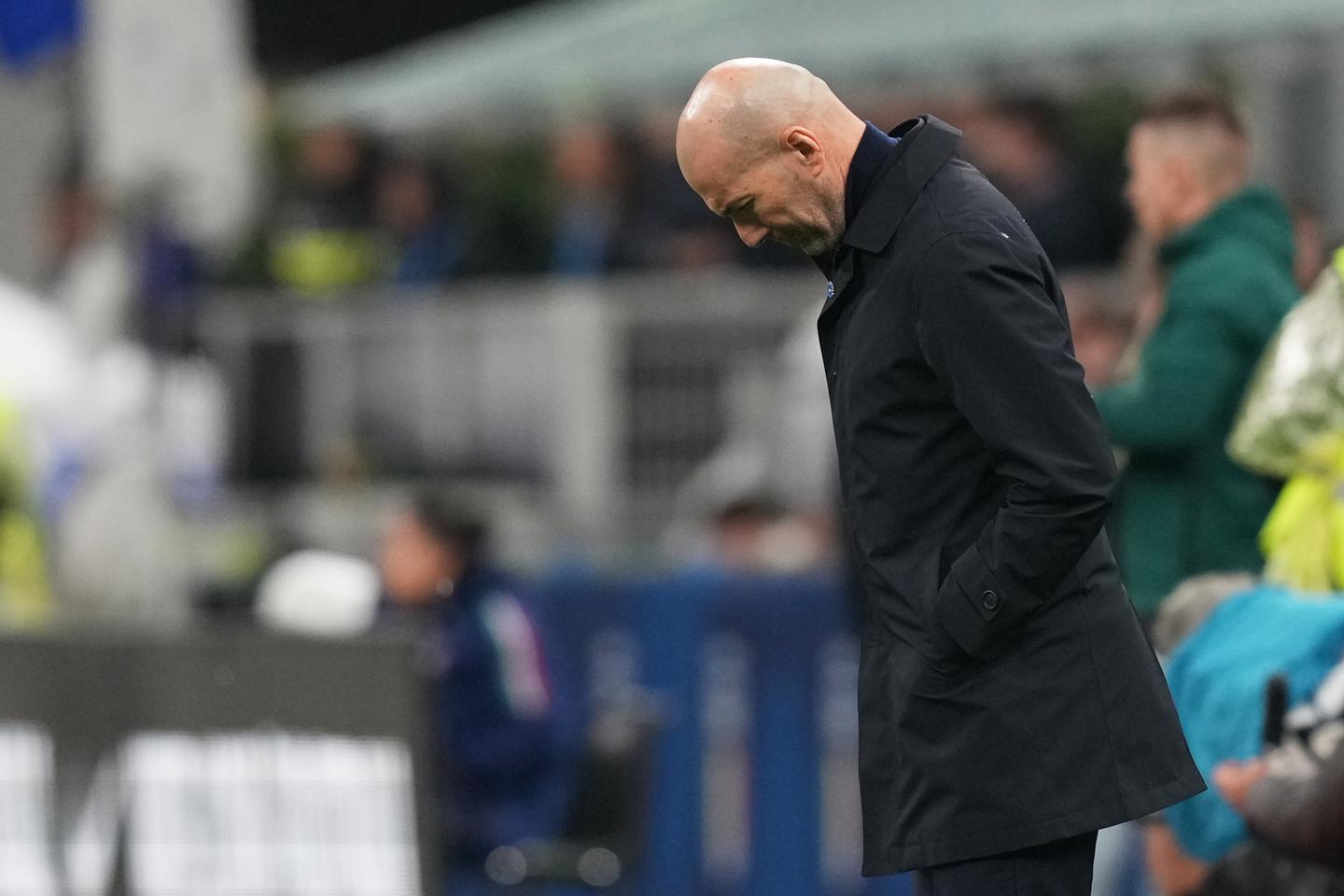
For manager Zidane, the result served as a harsh introduction to the difficulties of navigating the Nations League. This defeat marked his first loss in charge of the national team, a milestone that carries the heavy weight of scrutiny. In international management, the first loss is often a diagnostic tool, revealing the underlying tensions between tactical instruction and on-field execution.

Zidane’s tenure has been defined by the attempt to instill a new sense of order, but the 3-1 scoreline in Milan suggests that the transition is far from complete. The gap between the attacking promise shown by players like Olise and the defensive lapses that allowed Italy to pull away highlights a team still searching for its equilibrium.
While the collective failure of the defense was the headline, the individual struggle of Mike Maignan cannot be overlooked. In the aftermath of the match, Maignan’s performance was met with a low rating of 4. This critique was not necessarily a reflection of a lack of skill, but rather a symptom of a larger malaise.
A goalkeeper’s effectiveness is inextricably linked to the protection provided by the players in front of him. Without a solid defensive block to absorb the initial waves of an attack, a keeper is forced into a reactive mode, constantly chasing the game rather than controlling it. Maignan’s struggle in Milan was, in many ways, the struggle of a man trying to hold back a tide with a broken levee.
The implications of this 3-1 defeat extend far beyond a single loss in the 5e journée of the competition. For France, the math of the Nations League has suddenly become much more complicated. The defeat has placed their qualification for the quarter-finals at significant risk, turning what should have been a routine progression into a fight for survival.
Every point lost in the group stages creates a compounding difficulty for the knockout rounds. The Bleus now find themselves in a position where they can no longer afford lapses in concentration or structural instability. The margin for error has vanished.
As the dust settles on the Milanese night, the French camp is left to dissect a performance that was as frustrating as it was uneven. They showed they could compete, they showed they could threaten, but they also showed they could collapse.
Moving forward, the focus must shift from the flashes of brilliance in the attack to the fundamental necessity of defensive discipline. Whether Zidane can shore up these cracks before the quarter-final race concludes remains the defining question for the French national team.