
In the high reaches of the Peruvian Andes, the air does not merely feel thin; it feels precious. For Pope Leo XIV, a man who only one month ago was undergoing surgery for lung cancer, every breath in the ancient city of Cusco is a testament to physical endurance. On November 15, 2026, the 71-year-old leader of 1.4 billion Catholics arrived in the city, situated at an altitude of 3,400 meters, to conclude a grueling 12-day tour of South America.

This journey was more than a pastoral visit; it was a test of vitality. Having traveled through Uruguay and Argentina, the Pope’s arrival in the Peruvian highlands marked the final, most physically demanding chapter of his mission. For a man recovering from a major pulmonary operation, the ascent to the 'navel of the world' presented a profound challenge to his health, yet he arrived to a reception that transformed his physical struggle into a spiritual spectacle.
The crowds that gathered to meet him were not merely spectators; they were a sea of color and tradition. Many arrived in traditional attire, carrying banners that bridged the gap between ancient heritage and modern devotion. One banner, written in Quechua, read "Bienvenido, Tayta León!"—a greeting that signaled the deep, localized connection the Pope holds with this region.
Despite the physical toll of the heat and the altitude, the Pope appeared determined to address the social fractures of the modern era.
While the Vatican estimated that roughly 100,000 people were waiting, other estimates suggested the turnout was even more massive, reaching as many as half a million people. These pilgrims had traveled from remote areas, some traversing vast distances to catch a glimpse of the man who, though born in the United States, has held Peruvian nationality since 2015. This dual identity has shaped his mission: a desire to revitalize a declining faith, defend the marginalized and the poor, and address the regional anxieties of rising violence and declining birth rates.

The world: we're worried for Pope Leo travelling high altitude on a helicopter to Peruvian Andes after his lung surgery. Pope Leo: Let me have my Tom Cruise moment. Video: Peruvian Air Force. Watch till the end! https://t.co/ujzkcXCgAg
As the Pope moved through the city, he visited the Plaza de Armes to lead a prayer, but it was his visit to the Saqsaywaman archaeological site that provided the most striking backdrop for his message. Perched at 3,700 meters, the Saqsaywaman fortress is a marvel of Inca engineering, a place where the stones themselves seem to hold the weight of history.
Standing amidst the massive megaliths, the Pope reflected on the intersection of the sacred and the historical. "The beauty of this place is undeniable," he remarked, noting how the site serves as a bridge between eras. "Saqsaywaman, like a stone altar, rises toward the Andean sky, where the ancients ascended in search of the divine."
In this space, the convergence of Inca and Spanish cultures is not just a historical fact but a living reality. For the people of Cusco, Catholicism has become an integral part of an identity that remains deeply rooted in the Andean landscape. The site serves as a physical manifestation of how two worlds, once in conflict, have merged into a singular cultural tapestry.
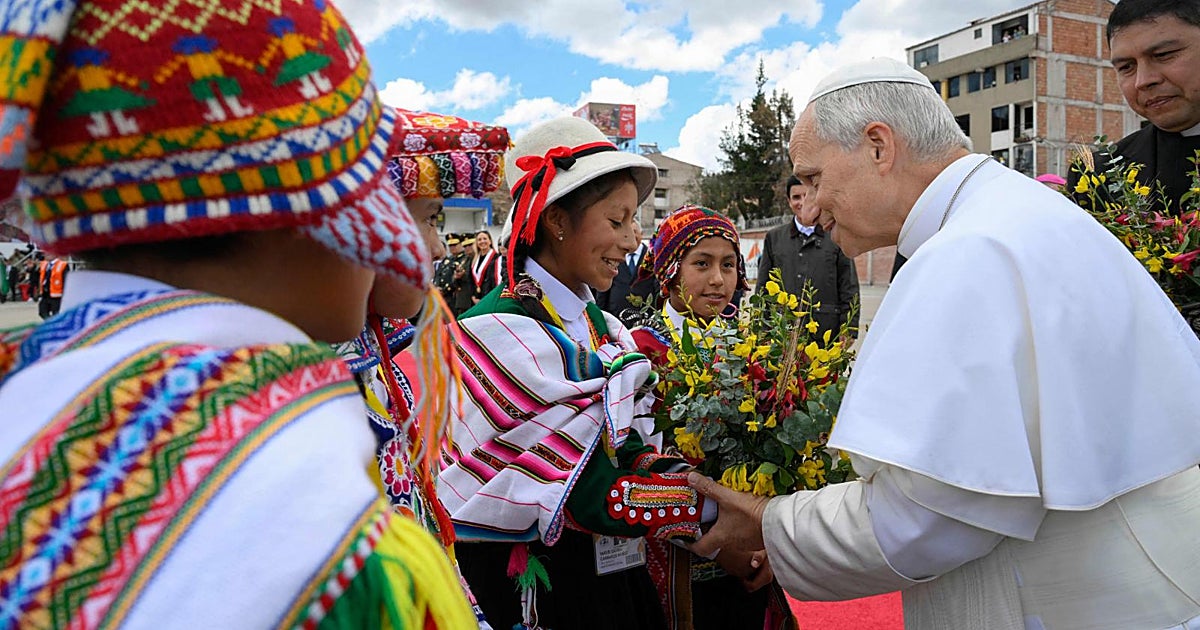
Despite the physical toll of the heat and the altitude, the Pope appeared determined to address the social fractures of the modern era. His message at the archaeological site was one of reconciliation, a theme he felt was urgently needed in a world increasingly defined by conflict. He spoke of the Catholic faith as a force capable of mending the social fabric, noting that it "reconciles in an era marked by wounds and divisions."
This call for unity comes at a time when the region faces significant social pressures. By positioning the Church as a mediator and a source of stability, Leo XIV sought to offer a sense of hope to a population navigating the complexities of modern South American life. His presence was seen by many as a direct response to the hardships faced by the poor and the marginalized.

Chiclayo Peru was home to Pope Leo XIV, formally Robert Francis Prevost, for two decades. Pope-mania has hit the city, with images of the pontiff everywhere, even popsicles. https://t.co/g1q4v1N0BD
For the faithful watching from the edges of the crowd, the Pope's presence was nothing short of miraculous. The sheer difficulty of his journey—coming so soon after a life-threatening surgery to stand in the thin, cold air of the Andes—lent a weight to his words. One observer noted, "It is a miracle that he has come from Rome."
Even as he faced the physical limitations of his recovery, the Pope found strength in the communal support of the pilgrims. He did not shy away from his vulnerability, acknowledging the difficulty of the moment. "I thank you for your affection, your support, and your prayers, especially for my health, in these moments of trial that I am currently overcoming," he told the assembly.
As the 12-day tour draws to a close, the Pope leaves behind a landscape of profound devotion. The visit to Cusco served as a powerful coda to his travels through Uruguay and Argentina, reinforcing his commitment to a mission of social defense and spiritual renewal. While the physical challenges of the high Andes remain, the message delivered at the feet of the Inca ruins—one of reconciliation and presence—remains etched in the hearts of the half-million people who gathered to welcome him.

On the penultimate day of his visit to Peru, Pope Leo channeled Pope Francis by emphasizing Catholic teaching that links care for the vulnerable with care for God’s creation. https://t.co/UUtghsqNAv