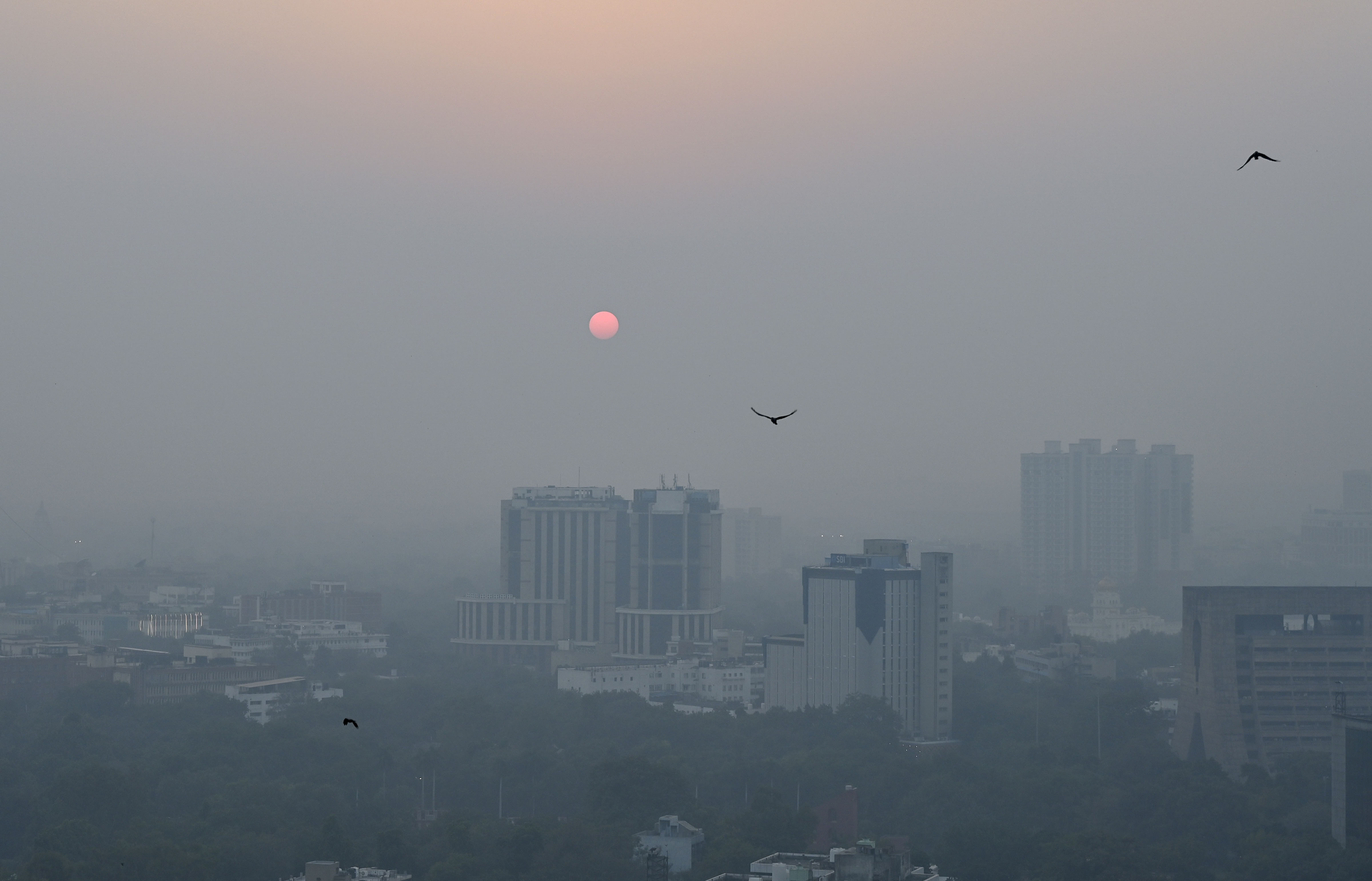
For the residents of New Delhi, the morning following Diwali celebrations brought a stark and suffocating reality. The city did not wake up to a clear sky, but rather to a heavy, toxic smog that clung to the streets and obscured the horizon. The air, thick with the remnants of firecracker emissions and the persistent weight of urban pollution, had shifted decisively. By the early hours, the city’s overall Air Quality Index (AQI) had climbed to 406, firmly planting the capital in the 'severe' category of air pollution, a threshold that signals a significant health risk for all inhabitants.

This crisis was not evenly distributed, but rather manifested in pockets of extreme toxicity across the metropolitan area. While the city-wide average sat at 406, specific monitoring stations told a more harrowing story. Several monitoring stations recorded levels above 400, including Burari Crossing at 441 and Vivek Vihar at 437. In the heart of the city, areas recorded severe readings. The Central Pollution Control Board reported severe levels in places like Ghazipur, while other parts remained in the 'very poor' category. The disparity highlights the complex, localized nature of Delhi’s air quality, where traffic congestion and industrial emissions collide with seasonal atmospheric conditions.

#WATCH | Chandigarh: On BJP's allegations over incidents of stubble burning in Punjab and Delhi Minister Kapil Mishra's statement, Punjab Minister Harpal Singh Cheema says, "Punjab farmers do not indulge in any illegal activity. In last 5 years, AAP Govt has distributed equipment and new machinery among farmers. Incidents of stubble burning have reduced. But people of BJP leave no stone unturned in defaming farmers of Punjab and Punjab state. There is Haryana between Punjab and Delhi. But they forget Haryana because there is a BJP Govt there. They forget UP too because there is a BJP Govt there. They see only the farmers of Punjab. Farmers of Punjab had fought against the three farm laws of the BJP. So, they are taking revenge from farmers of Punjab."
Long before the festival, authorities had anticipated the spike. The Commission for Air Quality Management had invoked Stage III of the Graded Response Action Plan (GRAP) across Delhi-NCR, a set of emergency measures designed to curb pollution when air quality trends downward. Despite these interventions, the post-festival surge proved difficult to contain. The Supreme Court has been vocal in its criticism of the current approach, pointing to a systemic failure to adequately control primary pollution sources, specifically vehicular emissions and the relentless traffic congestion that defines daily life in the capital. The frustration is palpable: despite the existence of a structured response plan, the city remains vulnerable to these predictable seasonal spikes.
Authorities issued a directive for schools up to Class 5 to shift to a hybrid learning model.
As the smog intensified, the impact on daily life became unavoidable, particularly for the city's youngest residents. Authorities issued a directive for schools up to Class 5 to shift to a hybrid learning model. This decision, aimed at shielding children from the worst of the outdoor air, reflects the gravity of the situation. The transition to hybrid learning is a recognition that when the air itself becomes a hazard, the traditional classroom is no longer a safe space. This measure, combined with the ongoing GRAP-3 restrictions, represents the current frontline of the city's defense against a deteriorating environment.
Delhi’s struggle is not an isolated phenomenon, though its severity is unique. Across the country, the hazy conditions have been felt in other major urban centers. In Mumbai, for instance, residents have also contended with smog and varying AQI readings across its suburbs. While the readings in the capital remain significantly higher, the broader trend of declining air quality during this period suggests a challenge that extends far beyond the borders of Delhi. As the city navigates the aftermath of the festival, the focus remains on the efficacy of the GRAP-3 measures and the long-term viability of current pollution control strategies in the face of persistent, severe air quality.