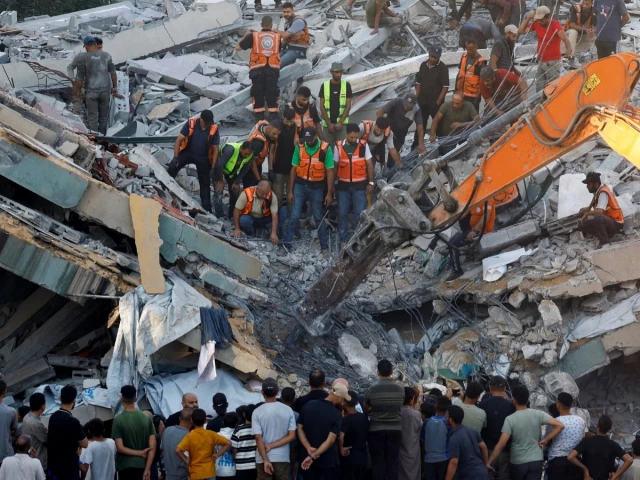
To walk through Gaza today is to navigate a landscape that has been fundamentally rewritten. It is no longer a place of streets, gardens, and homes, but a topography of debris. According to the Palestinian Environment Quality Authority, the scale of this transformation is measured in a number so vast it defies easy comprehension: 68 million tons of rubble. This is not merely the byproduct of conflict; it is a massive, accumulating weight that threatens to bury the future of the territory under a layer of environmental and humanitarian catastrophe.

The destruction is not limited to the vertical structures of buildings. The very foundation of Gaza’s ability to sustain life—its soil—has been systematically dismantled. The authority reports that 82% of the region's agricultural land has been destroyed. For a territory that has long relied on its ability to grow food, this loss represents a severance of the connection between the people and the earth. Where orchards once stood, there is now only the scarred remains of a productive ecosystem, rendered unusable by the sheer violence of the impact.
This loss extends to the most iconic symbols of Palestinian heritage and economy: the olive trees. An olive tree is more than a crop; it is a generational anchor, requiring years of care to reach maturity and decades of patience to harvest. To lose nearly every tree is to lose a biological and cultural legacy that cannot be replanted overnight.
When sewage systems fail, the consequences are immediate and visceral.
Beneath the surface of the rubble, a more invisible but equally lethal crisis is unfolding. Modern civilization relies on a complex, often hidden network of pipes, pumps, and treatment plants to manage the most basic necessity: water. In Gaza, that network has been almost entirely severed. The Palestinian Environment Quality Authority has documented that 84% of the water and sewage infrastructure has been destroyed.
When sewage systems fail, the consequences are immediate and visceral. Without the ability to manage waste or distribute clean water, the risk of disease and the contamination of what little groundwater remains becomes an existential threat. The destruction of this infrastructure means that the basic mechanics of hygiene and survival have been stripped away, leaving a population to navigate a landscape where the very elements required for life have become vectors for illness.

🚨 This map shows a comprehensive satellite imagery-based assessment of damage and destruction in Gaza, Occupied Palestinian Territory, as of 3 May 2024. #UNOSAT #Gaza https://t.co/1Z7N15GR5t
Perhaps most concerning is what lies within the mountains of debris itself. Rubble is rarely just concrete and rebar; in a modern urban environment, it is a cocktail of dangerous materials. This is not a static problem that will simply sit in place; hazardous waste can leach into the soil and water, creating a long-term ecological debt that will take decades to settle.
Among the most insidious of these materials is asbestos. Asbestos is a known carcinogen, and when it is pulverized by explosions and subsequent collapses, it becomes airborne. The inhalation of these microscopic fibers poses a silent, long-term health crisis for anyone moving through or attempting to clear the wreckage. The rubble is not just a physical obstacle to reconstruction; it is a chemical one.
The sheer volume of the material makes the prospect of recovery seem almost impossible. While estimates vary, the authority places the minimum amount of rubble at 61 million tons, with the maximum reaching as high as 68 million tons. To visualize this is to imagine a mountain range of broken stone and twisted metal covering the territory. This mass of material creates a logistical nightmare for any future attempt at rebuilding, as every cubic meter of debris must be managed, moved, and treated to prevent further environmental degradation.

More than half of ALLL buildings in #Gaza damaged or destroyed since October 7. With an estimate of at least 37 millions tons of rubble, containing at least 800k of asbestos, and many others hazardous substaces that will pose additional health and environmental risks
The environmental toll is not contained solely within the borders of Gaza. The Palestinian Environment Quality Authority has also documented 760 environmental attacks occurring in the occupied West Bank. This suggests a broader pattern of ecological disruption that extends across the Palestinian territories, indicating that the degradation of the land and its resources is a widespread phenomenon rather than an isolated incident.
While the immediate violence of such attacks is often the focus of international attention, the environmental aftermath represents a secondary, perhaps more permanent, wave of destruction. The 68 million tons of rubble represent a physical manifestation of a crisis that will persist long after the kinetic conflict has ceased, leaving behind a landscape that is not only broken in its architecture but poisoned in its very essence.