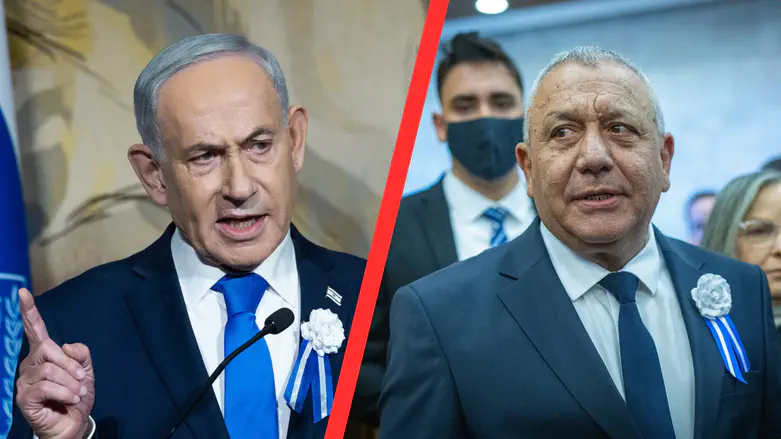
In the delicate architecture of governance, there is a profound difference between a leader who commands a nation and a leader who merely holds an office. On November 11, 2026, that distinction became the center of a brewing political storm in Israel. Gadi Eisenkot, the leader of the Change Camp, sent a formal letter to Prime Minister Benjamin Netanyahu that functioned as much as a constitutional alarm than a mere political disagreement. The core of the message was a plea for restraint: a demand that the Prime Minister refrain from making wide-ranging military decisions during what Eisenkot identifies as a critical transitional period of power.

To understand why a letter about military strategy carries such weight, one must look at the math of the Knesset. Power in a parliamentary system is not just about the title one holds, but the number of hands raised in support when a decision is made. Eisenkot pointed to a sobering reality that defines Netanyahu’s current standing: the Prime Minister is currently supported by only 46 deputies. This narrow base of support creates a landscape where the traditional levers of political consensus are fraying, making every major executive move a potential flashpoint for instability.

Israel’s elections could influence events far beyond the Middle East. Voting is underway, and the latest polls put the new Yashar party, led by Gadi Eisenkot, in the lead. But finishing first does not guarantee taking power. Everything will depend on who can reach an agreement with whom and form a government. Even a change of prime minister, however, offers little reason to expect a rapid shift towards peace in the Israeli–Palestinian conflict. Eisenkot and Netanyahu both support tough security policies and oppose an independent Palestinian state. They differ significantly on other issues: judicial independence, military conscription for the ultra-Orthodox, and settlements in Palestinian territories. Eisenkot may be more open to certain compromises, but he remains willing to use force. The prospects for peace depend in part on what Israeli politicians are prepared to call a victory. For some, weakening their adversaries and securing reliable security guarantees might be enough. For religious nationalists, territorial expansion is a goal in itself. They may therefore see abandoning annexation as a defeat, even if attacks cease. Netanyahu has to accommodate such partners to remain in power. Reducing their influence could matter at least as much as replacing the prime minister. Better relations with the West could help Eisenkot both negotiate and wage war. He has already supported US–Israeli strikes on Iran and proposed a US-led regional security alliance. His government might find it easier to secure Western support for a limited military operation if it also curbed settler violence and agreed to negotiations over Gaza. Diplomatic flexibility would therefore not necessarily mean a less forceful military policy. The next 6–12 months are likely to bring renewed attempts to use force to extract concessions, followed by a return to negotiations. One possible scenario is another US–Israeli campaign against Iran. Trump may be hoping for a short operation after which he can declare victory, strike a deal, and bring down energy prices. Israeli leaders may seek to use American support while it remains available. CNN reports that military options have been drawn up, although no final decision has yet been made. Iran will find it difficult to make concessions as long as its leaders fear being overthrown. If Tehran believes that meeting the demands would leave it more vulnerable to attack, continued resistance will seem safer. A limited operation could escalate into a major war despite the participants’ initial intentions. The trigger could be heavy American casualties, the destruction of energy infrastructure, or strikes that Tehran interprets as the beginning of an attempt to eliminate its leadership. Iran could respond by attacking more countries and targets, seeking to make the war too costly for its adversaries. The parties would then become increasingly embroiled in an exchange of strikes. The war could intensify the very threats it was launched to eliminate. If conventional weapons and diplomacy fail to protect Iran from attack, advocates of acquiring nuclear weapons will gain another argument in their favour. Overthrowing the current leadership would not guarantee democracy either: military leaders could take its place, and the struggle for power could drag on for years. Even if a major war is avoided, without an agreement the region could remain trapped between strikes and fragile ceasefires for a long time. Under this scenario, the US would avoid large-scale intervention, Iran would reject its demands, and Israel would continue conducting individual military operations. A similar pattern is already evident in Gaza and Lebanon: the intensity of fighting has declined, but disputes over disarmament, territorial control, and troop withdrawal remain unresolved. An agreement between the US and Iran could offer both sides an acceptable way out of the confrontation. Tehran would agree to verifiable restrictions on its nuclear pro
Eisenkot’s warning is not merely about the logistics of governance, but about the very soul of the state. He argued that making sweeping military decisions during this specific window of transition could have dangerous consequences for what he describes as Israeli democracy. When a leader’s parliamentary mandate is thin, the temptation to bypass political deliberation in favor of unilateral executive action grows. For Eisenkot, the risk is that the mechanisms meant to check power are being bypassed at a moment when they are needed most.
For Eisenkot, the risk is that the mechanisms meant to check power are being bypassed at a moment when they are needed most.
The most pointed part of the correspondence dealt with the intersection of military might and political survival. Eisenkot raised the specter of using the state's most potent tools—its security and military capacities—to navigate domestic or transitional complexities. He argued that deploying these resources without the existence of a direct and immediate threat to the security of the regime would be an act of profound consequence. It is a distinction between defense and something far more volatile.

Eisenkot demands Netanyahu refrain from unnecessary military operations Eisenkot demands Netanyahu avoid nonessential military operations during the transition, while the PMO accuses him of politicizing national security. https://t.co/V2vaCxiCB4 https://t.co/1eDJnjE6LO
Beyond the halls of the Knesset, the implications of these decisions reach into the streets and the homes of the citizenry. Eisenkot suggested that using military capacity in the absence of an immediate threat would result in actions with destructive consequences for both the political structure and the society of the regime. The logic is clear: when the line between national security and political maneuvering blurs, the stability of the entire social contract begins to erode. A military used to bolster a weakened political position risks damaging the very society it is sworn to protect.
As of November 11, 2026, the tension remains high. The letter from the Change Camp leader serves as a formal documentation of the friction between a Prime Minister struggling with a limited legislative base and an opposition wary of how that weakness might be compensated for through military action. The standoff highlights a fundamental question facing the country: how does a democracy maintain its stability when its leadership is in a state of transition and its parliamentary support is at a historic low?