On November 25, 2026, the quiet expanse of Earth's orbit was punctuated by a moment of profound historical weight. Muhammad Zeeshan Ali, a man carrying the aspirations of an entire nation, arrived at the Tiangong space station. He was not merely a passenger on the Shenzhou-24 mission; he was a pioneer, marking the first time a Pakistani citizen has traveled into the reaches of space. For a country often defined by its terrestrial challenges, the sight of an astronaut floating above the atmosphere represents a sudden, vertical shift in perspective.

This ascent was not a matter of chance, but the culmination of a deliberate, calculated diplomatic and scientific architecture. The path to the Tiangong station was paved in February 2025, when a formal cooperation agreement was signed between Pakistan’s Space and Upper Atmosphere Research Commission (SUPARCO) and the China Manned Space Agency. This agreement served as the foundational bridge, linking the scientific ambitions of Islamabad with the sophisticated orbital infrastructure of Beijing. It transformed a theoretical partnership into a practical, high-stakes mission of exploration.
While the achievement is often viewed through the lens of national pride, the mission itself is grounded in the rigorous, quiet work of laboratory science conducted in microgravity. Aboard the Shenzhou-24 mission, Zeeshan Ali is tasked with conducting a series of complex scientific experiments that cannot be replicated on the surface of the Earth. The research focuses on the behavior of microalgae, the growth patterns of quinoa, and the properties of various materials in a weightless environment. These studies aim to unlock understanding of how life and matter behave when the constant pull of gravity is removed, potentially offering insights that could eventually benefit agricultural and material sciences back home.
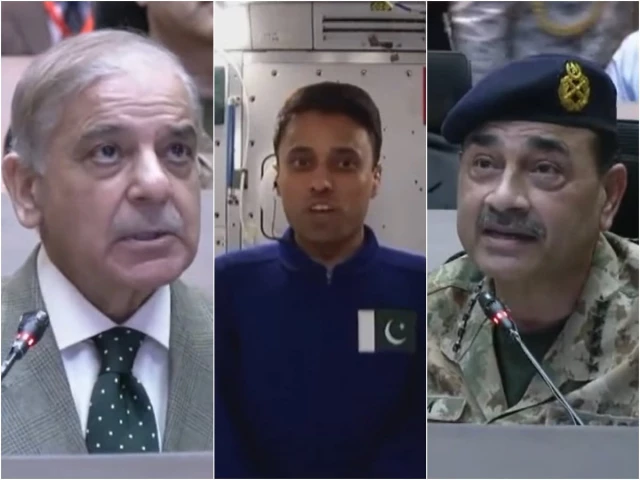
By November 28, 2026, the distance between the ground and the stars felt momentarily bridged.
By November 28, 2026, the distance between the ground and the stars felt momentarily bridged. In a live video call that spanned the vacuum of space, Prime Minister Shehbaz Sharif and Field Marshal Syed Asim Munir spoke directly with Ali. The communication served as a rare, real-time link between the highest levels of Pakistani leadership and the frontier of human exploration. For those watching, the call was more than a mere greeting; it was a verification of a milestone reached, a moment where the terrestrial administration acknowledged the successful deployment of its first cosmic voyager.
As Ali continues his work within the modules of the Tiangong station, the mission stands as a living testament to the deepening space collaboration between Pakistan and China. What began as a signed document in early 2025 has evolved into a tangible presence in low Earth orbit. The Shenzhou-24 mission is not just a journey of one man, but a demonstration of how bilateral scientific agreements can propel a nation into a domain previously reserved for a select few global powers. For now, the eyes of the nation remain fixed upward, watching a pioneer navigate the silent, shimmering frontier.