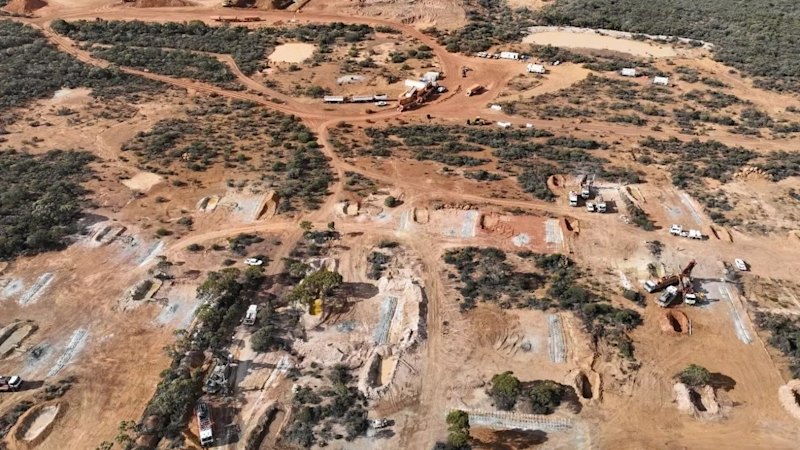
In the vast, arid expanse of Western Australia, gold is rarely found in gentle, uniform sheets. Instead, it tends to hide in high-grade bands that can transform a project’s economics overnight. For Forrestania Resources, the recent discovery at its British Hill project is precisely such a band. On November 9, 2026, the company revealed that its latest drilling campaign did not just find more gold; it found gold that is unusually rich. This discovery has pushed the project from a speculative prospect to a potential near-term development asset, a distinction that matters significantly in the volatile world of junior mining companies.

To understand why these results are significant, one must look past the headlines into the technical data. Forrestania’s latest 19-hole drill program returned a thick, high-grade intersection of 16 meters assaying 5.77 grams per tonne gold, starting from just 12 meters downhole. In mining terms, this is a dense pocket of ore. When you drill into a rock face and find a concentration of gold that high, in such a continuous block, it suggests the mineralization is not just a random anomaly but part of a broader, systematic deposit. This specific result is the engine driving the broader narrative of the company's success.

Forrestania Resources (ASX: FRS) Grows British Hill Gold Resource 35%. Can Its Two-Plant Strategy Deliver? via @StockScopeAU https://t.co/zzrMxfyLo6
The cumulative effect of these drill results is a substantial upgrade in the company’s known resource. Forrestania reported that the mineral resource estimate at British Hill has increased by 35 percent. This figure represents a jump from an initial estimate of 212,400 ounces to a new total of 286,000 ounces. In the context of gold mining, where resources are measured in the thousands or millions of ounces, a single-digit percentage increase is often the result of years of steady work. A 35 percent surge in a single reporting period indicates that the geological model has been significantly refined, likely revealing that the deposit is larger and richer than previously understood. This upgrade is not just a statistical adjustment; it is a re-evaluation of the project’s long-term value.
It is no longer a question of whether the gold exists, but rather how extensive the system is.
Beyond the raw numbers, Forrestania is taking steps to ensure this new resource can be processed efficiently. The company entered into an ore purchase agreement with Dundas Minerals to supply 750,000 tonnes of ore to the latter’s Lake Johnson processing hub. The agreement has a duration of 24 months. This partnership is a critical piece of the puzzle. For a junior miner, building a standalone processing facility is often prohibitively expensive and risky. By offloading ore to an existing hub operated by a partner like Dundas, Forrestania can lower its operational costs and shorten the timeline to cash flow. It transforms the British Hill resource from a static deposit into a dynamic production plan.

Forrestania Resources has boosted its British Hill gold resource by 131 per cent to 126,290 ounces, with ore already being trucked to its nearby Lake Johnston processing facility. #BULLSNBEARSWA https://t.co/yD8EoLfyFw https://t.co/5M3udKmyMF
Drilling is not just about proving what is there; it is about understanding how it formed. David Geraghty, a key figure at Forrestania, noted that the drilling process is improving the company's understanding of the geological system. As the drill cores come back with consistent high-grade results, the uncertainty that plagues early-stage exploration projects begins to shrink. Geraghty emphasized that these results reinforce the company's confidence in British Hill. It is no longer a question of whether the gold exists, but rather how extensive the system is. This shift from exploration to definition is what investors and industry analysts look for when evaluating a junior miner’s maturity.
The phrase “potentially valuable near-term gold development asset” appears frequently in Forrestania’s communications, and it carries specific weight. In the mining sector, “near-term” suggests that the company is close to the production phase, where ore is actually mined, processed, and sold. This is the stage where a mining company begins to generate revenue rather than spending capital. British Hill is increasingly demonstrating that it has the attributes to cross this threshold. The combination of high-grade ore, a growing resource estimate, and a secured processing agreement positions the project for a swift transition from exploration to production.

Forrestania Resources has commenced its first mining activities, with ore from stockpiles at the British Hill Gold Project now being hauled to the Lake Johnston Processing Facility in Western Australia. This marks another key milestone in Forrestania’s transition toward gold production, ahead of the planned commissioning of the Lake Johnston plant later this year. #Gold #Drilling #Exploration #ASXNews #FRS $FRS #GoldProduction
Forrestania’s executives describe the latest drill batch as “demonstrably strong.” This language is deliberate. In a market saturated with mining claims, distinguishing oneself requires evidence. The 35 percent resource increase is that evidence. It shows that the geological model is responding positively to the data collected on the ground. The high-grade mineralization is being encountered across the deposit, not just in isolated pockets, which suggests a robust and predictable resource base. This consistency is what builds trust with stakeholders and provides a solid foundation for future growth.

As of November 2026, Forrestania stands at a pivotal moment. The company has successfully upgraded its resource base and secured a processing pathway. The next steps will likely involve continued drilling to expand the resource further and moving toward finalizing the development plan for British Hill. The story of Forrestania’s British Hill project is one of a company using targeted exploration to unlock value. It is a narrative that appeals to those who follow the junior mining space, where high-grade discoveries can lead to rapid growth and significant returns. The 35 percent surge is not just a number; it is a signal that British Hill is on the map, not as a long-distant prospect, but as a viable, near-term asset.