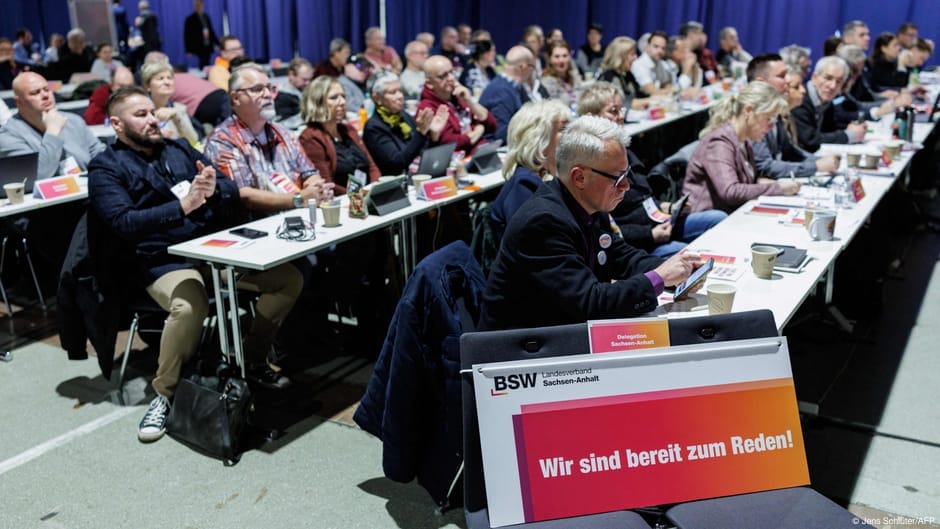
In the shifting landscape of German politics, the lines between the traditional left and the rising far-right are beginning to blur, not through shared ideology, but through a calculated, cold-eyed pursuit of legislative power. At a recent party conference in Dresden, the Alliance for Social Justice and Economic Reason (BSW), a left-wing populist party, made a decision that has sent ripples through the country's political establishment: they voted against a motion that would have strictly limited their cooperation with the far-right Alternative for Germany (AfD).

The decision was not a foregone conclusion. Within the BSW, founding members had proposed a motion intended to create a clearer, more definitive distinction between their left-wing populist platform and the far-right rhetoric of the AfD. It was an attempt to build a political firewall, ensuring that the party's identity remained untainted by its potential partners. However, when the moment of truth arrived, approximately 600 delegates rejected the proposal. By voting down the motion to limit cooperation, the BSW signaled that it is willing to engage with the far right if the math of governance demands it.
This tactical pivot is not merely academic; it is driven by the stark reality of the current parliamentary makeup in Saxony-Anhalt. Following the state election in September, the AfD emerged as a dominant force, securing 39 seats in the 83-seat legislature. This surge in support led to a historic shift in the state's leadership: Tobias Rausch of the AfD became the first far-right state parliament speaker since World War II.
Under the Magdeburg Model, the BSW does not become an appendage of the AfD, nor does it commit to a long-term alliance.
In this environment, the BSW holds five seats. While five seats may seem modest, they carry disproportionate weight in a legislature where the AfD's 39 seats represent a massive bloc. If the BSW and the AfD were to align their votes, they could combine to form a majority in the 83-seat body. This mathematical reality has forced the BSW to weigh the cost of political isolation against the potential for legislative influence.
To navigate this tension, BSW founder Sahra Wagenknecht and party leader Fabio De Masi have championed what is being called the 'Magdeburg Model.' It is a sophisticated, if controversial, approach to political engagement. The model explicitly rejects the traditional structures of German governance; it eschews formal coalitions and the appointment of a premiere supported by a specific bloc. Instead, it envisions a more fluid form of cooperation based on joint motions and voting on a case-by-case basis.
Under the Magdeburg Model, the BSW does not become an appendage of the AfD, nor does it commit to a long-term alliance. Rather, it seeks to use the far-right's presence as a lever to achieve specific policy goals. It is a strategy of tactical alignment rather than ideological merger.
Sahra Wagenknecht has been careful to frame this not as an embrace of far-right ideology, but as a pursuit of specific outcomes. On November 28, she clarified the party's stance, asserting that the AfD is not a long-term strategic partner for the BSW. The cooperation, she argued, would be strictly conditional.

According to Wagenknecht, the BSW will only engage in such cooperation if it leads to 'reasonable majorities for peace, social improvement, and a reform of public broadcasting.' The goal is to find common ground on specific issues that can bypass the traditional gridlock of the German political system. It is a gamble that the BSW can extract concessions from the far right without being swallowed by its influence.
Despite this pragmatic framing, the internal friction within the BSW remains palpable. The rejection of the founding members' proposal suggests a party divided between those who fear the reputational damage of working with the AfD and those who believe that political relevance is found in the ability to move the needle of power.
"None of us wants to cozy up to the AfD," Wagenknecht has noted, acknowledging the inherent discomfort of the strategy. The party is attempting a difficult balancing act: maintaining its identity as a champion of social justice and economic reason while simultaneously acting as a potential kingmaker in a legislature dominated by the far right.
As the BSW settles into this new strategic posture, the broader German economic and social landscape remains volatile. While the party focuses on legislative maneuvering, the Federal Employment Agency chief has signaled that the job market is unlikely to see a recovery before the summer. This economic backdrop adds a layer of urgency to the BSW's mission, as the party seeks to address social improvements in a period of stagnation.
Even as political alignments shift, other sectors show signs of movement; German trade associations are currently predicting over 1 million electric vehicle sales. But for the BSW, the immediate battle is not in the automotive market, but in the halls of the Saxony-Anhalt legislature, where the 'Magdeburg Model' will be tested against the realities of a fractured and polarized democracy.