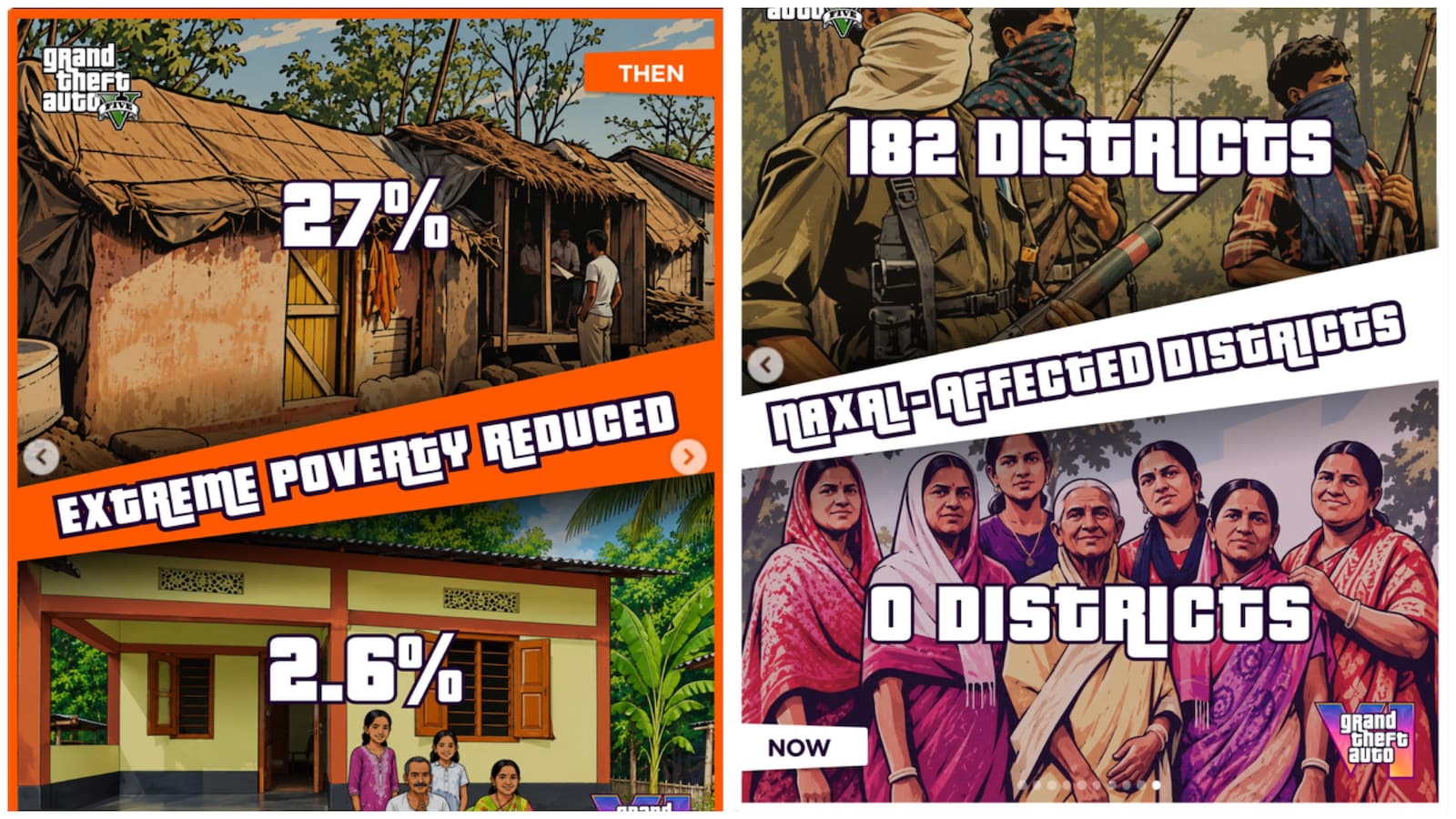
It is a rare intersection where global pop culture collides head-on with national political narrative. When the digital landscape began buzzing with anticipation for the arrival of a massive entertainment phenomenon, Prime Minister Narendra Modi found an unconventional entry point to speak directly to the nation's youth and gaming community. Utilizing a viral aesthetic styled after the distinctive fonts of those iconic video game posters, a social media post shared on his official Instagram account did not just join a trending global conversation; it seized upon it to execute a sweeping review of India's progress over the past 13 years.

To understand the narrative the post sought to build, one must look backward to the coordinates of the past. Thirteen years had elapsed between the launch of GTA 5 and the arrival of GTA 6. That exact temporal span became the canvas for a deliberate political and economic contrast. In the telling of the current administration, the baseline year of 2013 represented a period of immense economic vulnerability under the Congress-led UPA government. It was a time when the machinery of the state felt sluggish, and the horizon appeared clouded by financial instability.
The anchor for that critique dates precisely to August 2013, when a Morgan Stanley analyst penned a classification that would sting policymakers for years. The analyst included India in the 'Fragile 5' group of economically unstable nations, a precarious cluster that also featured Brazil, Indonesia, South Africa, and Turkey. By invoking this historical designation, the Instagram post aimed a sharp, indirect critique at the previous regime, framing their stewardship as an era of fragility from which the country has had to laboriously claw its way out.
In its place stands a nation that has successfully exited the Fragile 5 grouping to become firmly established as one of the world's fastest-growing major economies.
Yet the core of the message was not merely retrospective; it was an assertion of dramatic metamorphosis. Pointing to the vast gulf between the landscape of 2013 and the reality of the present, the post boldly declared that "India is playing a whole new game." Gone, the administration argues, is the label of economic fragility. In its place stands a nation that has successfully exited the Fragile 5 grouping to become firmly established as one of the world's fastest-growing major economies.
This transformation, presented through the vibrant, high-contrast visual cues of a video game promotional campaign, sought to translate complex macroeconomic shifts into a language immediately accessible to younger citizens. The government's performance was mapped out not through dry bureaucratic white papers, but through a cultural touchstone that millions understood instantly, blending political communication with digital savvy.

India is playing a whole new game! https://t.co/CMkMbK6vII
Nothing illustrates this claimed economic leap quite as starkly as the democratization of connectivity. In the early part of the decade, high-speed internet was a luxury carrying a hefty price tag, hovering at approximately 308 rupees per GB in 2013. Over the ensuing years, a massive infrastructural push reshaped the digital marketplace, driving the current cost of high-speed internet down to a mere 7.51 rupees per GB.
This plummet in data costs did more than just ease household budgets; it fueled an explosion in digital consumption, entrepreneurship, and innovation. It laid the groundwork for a tech-savvy generation capable of participating in modern global markets, turning the smartphone into an essential tool for everyday life across every stratum of society.
Beyond the digital realm, the sweeping 13-year audit marshaled a broad array of metrics to substantiate the narrative of national renewal. The post highlighted monumental achievements in public health and sanitation through major cleanliness initiatives, alongside a massive expansion in solar energy generation that pushed the country toward renewable targets. Electricity delivery was extended to previously underserved areas, while internal security measures worked to substantially reduce Naxalite influence in affected regions.
At the same time, India's industrial and strategic capabilities underwent a quiet revolution. The nation transitioned from a net importer of defense equipment to emerging as a notable defense material exporter. In the skies and beyond, ambition reached new heights as the country fostered a thriving ecosystem of innovation in various technological sectors.

Just hours after the launch of GTA 6 in India, Prime Minister Narendra Modi joined the conversation around the much-awaited video game, taking to X to highlight how India has upgraded as compared to its predecessor. “India is playing a whole new game!” Modi wrote in his post. 🧵
By packaging these heavy developmental milestones into a sleek, viral social media format, the political establishment has demonstrated an evolving mastery of modern public engagement. The message is clear: whether viewed through the lens of economic resilience, technological accessibility, or infrastructural output, the country that exists today bears little resemblance to the one trapped in the anxieties of 2013. As the digital campaign continues to ripple across feeds and spark nationwide discussion, it leaves citizens to ponder a profound question about national trajectory—measuring how far a country can travel when it fundamentally changes the rules by which it plays.