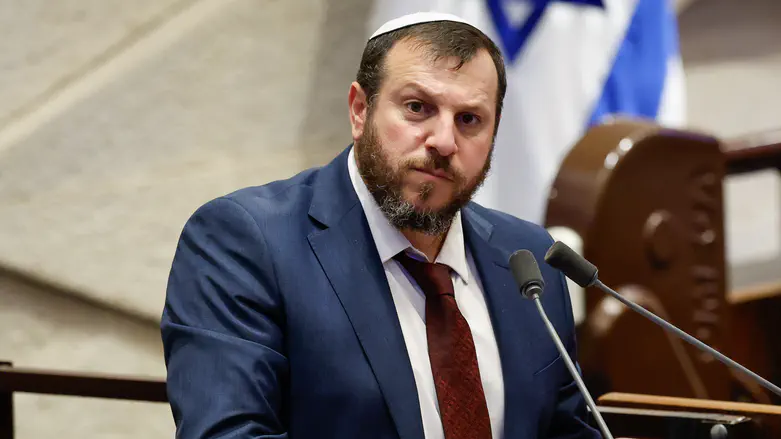
In the hallowed halls of Israel's parliament, the Knesset, words have the power to unite or divide, to build bridges or erect walls. On November 24, 2026, Heritage Minister Amichai Eliyahu chose the latter path, delivering a speech that would reverberate far beyond the chamber's walls. His target: Arab lawmakers, specifically Joint List MK Haitham Zahalka, whom he subjected to a barrage of accusations that went beyond political disagreement into the territory of racial stereotyping and inflammatory rhetoric.
Eliyahu began his diatribe by attempting to frame his argument around education rather than genetics, a claim that quickly unraveled under the weight of his own words. "It is a matter of race, or genetics, it is a matter of education," he stated, attempting to draw a distinction that his subsequent remarks would completely undermine. To illustrate his point about upbringing determining destiny, he invoked the name of Steve Jobs, the Apple founder. "Steve Jobs was the adopted son of a father of Syrian origin, but instead of growing up to be a barbarian, he founded Apple," Eliyahu declared, using the tech icon as a prop in his problematic argument about Arab identity.
As the speech progressed, Eliyahu's claims grew more sweeping and more dangerous. He expanded his criticism beyond Israel's borders, making extraordinary accusations about Arab communities' global impact. "Everywhere in the world, you need to be educated," he told Arab lawmakers. "You brought down the Twin Towers, you are destroying Europe, you cause trouble wherever you go." These extraordinary assertions, linking Arab communities to international terrorism and societal decline, lacked any substantiation yet were delivered with the authority of a government minister.
Wrapping up his controversial speech, Eliyahu shifted to a tone of lecturing condescension.
The minister's rhetoric took an even darker turn as he issued what sounded more like a threat than a policy suggestion. "If you do not change, your children will die, not because of us, but because of you," he declared, connecting the supposed failures of Arab society directly to the wellbeing of children. This statement, delivered in the context of his broader accusations, carried an ominous undertone, suggesting that Arab communities were somehow inherently dangerous to their own offspring.
Eliyahu didn't stop at broad generalizations, instead offering a specific catalog of alleged societal failures attributed to Arab communities. "You are the ones who murder in the name of 'family honor', you are the ones who stockpile illegal weapons, you are the ones who drive like barbarians," he charged, painting a picture of a community defined by violence and lawlessness. These particular accusations tapped into harmful stereotypes about Arab societies, reducing complex social issues to racial caricatures.
Wrapping up his controversial speech, Eliyahu shifted to a tone of lecturing condescension. "Educate yourselves, do not shift responsibility onto anyone else. Take responsibility for your lives," he instructed Arab lawmakers, as if their communities were uniquely lacking in this regard. The final message was clear in its implication: Arab society needed to be saved from itself, with Eliyahu positioning himself as the enlightened instructor.
The minister's remarks left behind more questions than answers. How would such rhetoric affect already tense relations between Jewish and Arab citizens of Israel? What responsibility, if any, would the Israeli government take for a minister promoting such divisive views? And most importantly, how would the Arab community respond to being collectively blamed for global events and societal ills? As the dust settled in the Knesset chamber, one thing remained certain: Eliyahu's words had not just sparked debate—they had deepened divides that would be difficult to bridge.