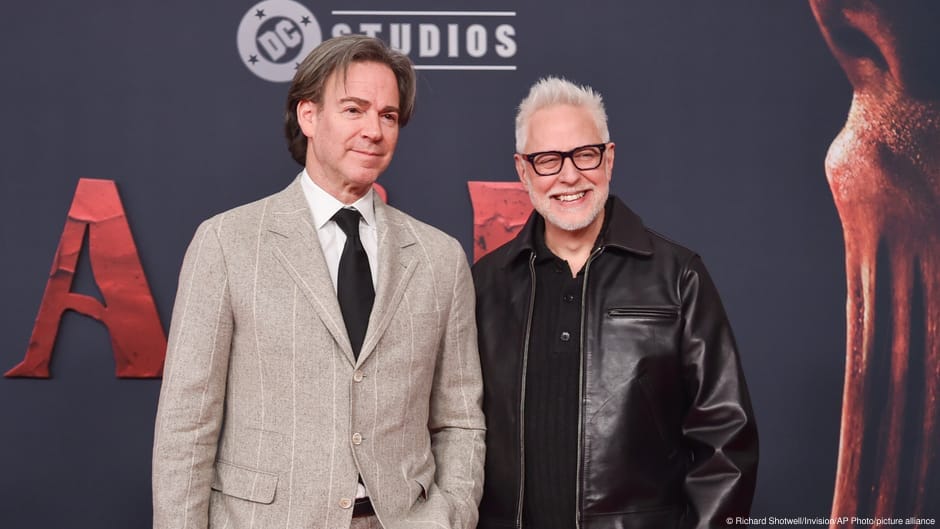
The entertainment industry is currently watching a quiet but consequential shift in power at one of its most storied franchises. James Gunn and Peter Safran, who have held the reins of DC Studios for four years, are stepping down from their positions as co-heads. This decision arrives in the immediate wake of Skydance’s takeover of Warner Bros., signaling that the new ownership group intends to make swift changes to the executive structure that will guide the studio’s future. For newcomers to the world of blockbuster filmmaking, this isn't just about personnel changes; it represents a fundamental reset of the creative ideology that has defined the DC cinematic universe in its most recent chapter.
To understand the gravity of this departure, one must look at the two figures exiting the room. Instead, they sought to bring a lighter, more character-driven approach to the material, a pivot that would eventually lead to the most significant commercial and cultural moments in the franchise’s recent history.

A major point of friction appears to have been James Gunn and Peter Safran’s reluctance to report to Paramount’s studio leadership Their vision was for DC Studios to operate as an independent production entity, separate from both Warner Bros. Pictures and Paramount Pictures, reporting directly to Skydance CEO David Ellison https://t.co/842ytb7ONU
The specific nature of their approach became the defining characteristic of their time in the job. In the early stages of this reboot, Gunn famously positioned his take on the iconic title character not just as a superhero, but as an immigrant. This framing was not merely a narrative choice; it was a way to ground the mythos of Krypton in contemporary political realities, attempting to make the character’s outsider status resonate with a wider, more global audience. It was a bold stroke intended to re-capture the heart of the public and give the franchise a renewed sense of purpose that went beyond simple spectacle.
However, the path to becoming a self-sustaining cinematic universe requires more than one breakout hit.
The gamble that Gunn and Safran took on this new direction was ultimately validated by the box office, which in this industry remains the ultimate arbiter of success. Their lead project, Superman, proved to be a massive hit, earning nearly $619 million in worldwide earnings. This figure stands as a testament to the power of a well-crafted superhero origin, one that manages to balance high-stakes action with genuine human emotion. The success of this flagship title provided the financial cushion that allowed the studio to confidently greenlight a wider slate of interconnected projects, a strategy that was central to Gunn and Safran’s four-year mandate.
However, the path to becoming a self-sustaining cinematic universe requires more than one breakout hit. The reception to this follow-up was more complicated, earning $126 million worldwide against a production budget of $170 million. In the brutal mathematics of blockbuster filmmaking, this result is difficult to classify as a straightforward success, a nuance that likely weighed on the studio's strategic calculus. This financial gap between the lead title and its immediate successor highlights the immense difficulty of sustaining a shared universe's momentum, a challenge that the new leadership will now have to address.
As the old guard exits, the studio is not moving into the unknown. Skydance is appointing Jeremy Latchman as the new head of DC Studios, a figure who brings with him a wealth of experience from Marvel Studios. This is a telling detail for any observer of the industry, as the two major superhero franchises have long been defined by very different executive cultures. Gunn and Safran’s tenure was characterized by a sense of auteur-driven experimentation, whereas Latchman’s background is steeped in the highly organized, committee-driven efficiency of the Marvel model. His arrival suggests that the new owners are looking to impose a level of structural discipline and predictability on the DC brand that the previous leadership did not prioritize.

It sucks that James Gunn and Peter Safran are out at DC Studios, but I'm starting to think David Ellison may have picked the WORST possible guy to replace them. Jeremy Latcham is being sold as a former Marvel executive and Kevin Feige protégé. And that's true! He worked on IRON MAN, THE AVENGERS, GUARDIANS OF THE GALAXY, and more. He's got the résumé. But there are two things about this hiring that really concern me. First, I think Ellison wants DC to become Marvel 2.0, and FAST. Warner Bros. has been chasing Marvel's success ever since BATMAN V SUPERMAN was announced in 2013, and I suspect Gunn's slower, less interconnected approach wasn't delivering the results Skydance wanted. Bringing in someone who helped build the original MCU certainly suggests they're looking to accelerate things. But the second issue is even more interesting. Latcham has become heavily involved in faith-and-values entertainment through Wonder Project and has openly championed uplifting stories rooted in redemption, family, and traditional values. Now, there's nothing inherently wrong with that, but is that really the direction DC Studios needs to go? DC's biggest theatrical successes outside the broader superhero boom have largely come from darker Batman stories. And now we're potentially looking at a studio that could lean even harder into the whole hope, kindness, and inspirational messaging that Gunn was already pushing. I don't know how well that's going to play with audiences, especially if it comes at the expense of the darker material DC has historically done so well. This is Skydance's DCU, not Angel Studios' DCU. And I genuinely worry that Latcham is being brought in to fast-track a more Marvel-like, family-friendly version of DC that audiences haven't necessarily asked for. Part of me also wonders whether he's being positioned to oversee an inevitable reboot once MAN OF TOMORROW and Gunn's remaining projects are finished. If that happens and the new direction fails, Latcham gets to take the heat for another corporate attempt to reinvent DC. I hope I'm wrong about all of this, but I really don't like where I think this is heading.
The transition has not gone without acknowledgment from the top of the new ownership group. David Ellison, a key figure at Skydance, took the time to publicly honor the contributions of the outgoing team. He noted that Gunn and Safran "launched a new era for DC Studios and led it through a period of real transformation, resetting the foundation and building a slate we're incredibly proud of." This supportive stance from the new owners is a strategic move to maintain goodwill with the creative class, but the language of 'reset' also foreshadows that the next phase of DC Studios will be a distinct departure from the one that just ended.
As of now, the studio stands at a precipice. For the audience, this transition represents the next evolution of a franchise that is still trying to find its ultimate footing in a crowded marketplace. The departure of the duo who rebuilt the brand after a period of uncertainty means that the next wave of DC stories will no longer be filtered through their specific lens, and the industry will be watching to see whether the new leadership can maintain the momentum of the $619 million Superman success while navigating the complexities of the Supergirl experience.