
For anyone living through the relentless rhythm of wartime Kyiv, the wail of an air raid alert is a grimly familiar soundtrack. But the sirens that began to echo across the capital on the morning of Thursday, November 12, heralded something far larger than the usual routine of caution. The digital clocks in apartments and command centers alike marked the start of the last major air raid alert at precisely 08:16, a moment that signalized the opening beats of a sweeping and coordinated assault orchestrated by the Russian army.
What followed was not merely a localized skirmish, but a massive aerial offensive that tested the very limits of Ukraine's defensive architecture. According to the Air Force of the Armed Forces of Ukraine, enemy forces unleashed a staggering array of weaponry against Kyiv and the surrounding region. The onslaught involved ballistic missiles, anti-ship missiles, and a formidable swarm of 123 attack drones designed to overwhelm defensive grids through sheer saturation.
While the skies above the broader region erupted with the sounds of interception, the capital itself could not entirely escape the carnage. The most severe and terrifying impact of the morning unfolded in the Solomianskyi district, a heavily populated residential neighborhood where daily life was abruptly upended by a violent concussive shock.
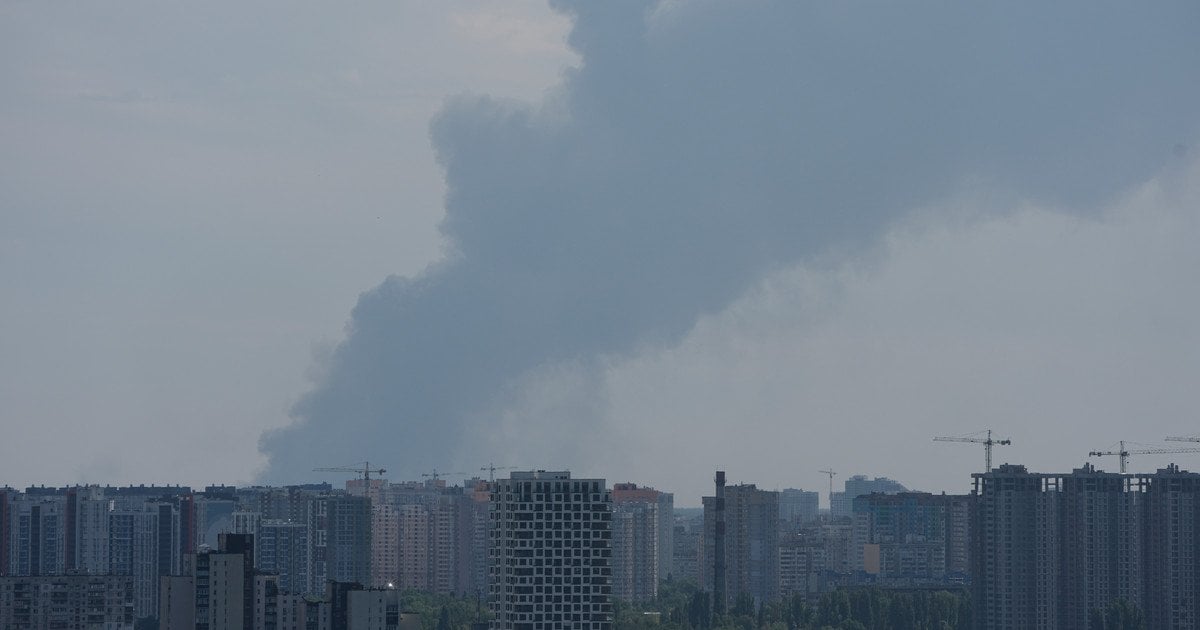
Thick plumes of smoke billowed into the morning sky above the Solomianskyi district, visible from blocks away as residents scrambled for safety.
An enemy drone, part of the larger buzzing armada, breached the urban canopy and struck a nine-story residential building directly. The impact instantly fractured the concrete facade of the towering structure, transforming a quiet apartment block into a scene of immediate chaos and structural devastation.
The physical blow dealt by the drone was immediately compounded by fire. Following the impact, a fierce blaze ignited within the building, rapidly expanding outward and upward through the concrete framework. The flames quickly engulfed multiple tiers of the structure, creating a roaring inferno that spanned entirely from the third to the sixth floors.
Thick plumes of smoke billowed into the morning sky above the Solomianskyi district, visible from blocks away as residents scrambled for safety. The structural integrity of the building was severely compromised in the process, with preliminary assessments confirming partial destruction concentrated heavily at the level of the fifth floor, where the brunt of the kinetic force and subsequent heat was sustained.
As the smoke and flames threatened to spread further, the city's emergency infrastructure swung into immediate action. Emergency services rushed to the scene of the residential tower in the Solomianskyi district, navigating the hazards of ongoing air threats to deploy firefighters, rescue teams, and medical personnel to the smoldering structure.

Kyiv Mayor Vitali Klitschko quickly mobilized to address the unfolding disaster, stepping forward to confirm the grim details of the strike and the extensive damage inflicted upon the residential block. Explaining the reality on the ground to a shaken public, Klitschko noted: "In the Solomianskyi district, as a result of a UAV hit, a fire occurred from the third to the sixth floor of a residential building. Preliminarily, there is partial destruction at the level of the fifth floor."
Amidst the twisted metal, shattered glass, and frantic rescue efforts, the immediate concern centered on the human lives trapped inside or near the impact zone. As the clock ticked past the early hours of the emergency response, the first official casualty reports began to crystallize.
By 09:00, as firefighters continued their grueling battle against the multi-story inferno, authorities confirmed that at least one person had sustained injuries in the attack. While emergency crews combed through smoke-filled stairwells to check for additional victims, this initial casualty figure underscored the narrow margin between survival and tragedy in a city under siege.
The terror of the November 12 assault was not confined solely to the streets of the capital. While the Solomianskyi district absorbed the shock of the residential strike, the wider Kyiv region faced its own punishing wave of ballistic missiles and drone attacks.
Further out in the Obukhiv district, the assault left deep architectural scars on the local economy. The Kyiv Oblast Military Administration subsequently reported that production and warehouse facilities belonging to a local enterprise had suffered significant damage and partial destruction from the falling ordnance, though fortunate circumstances ensured that no casualties were reported at those industrial sites.
Behind the headlines of destruction lay a broader, grinding war of attrition playing out in the upper atmosphere. The sheer scale of the 123-drone onslaught required a massive defensive response from Ukraine's air defense systems, which worked frantically throughout the morning to intercept multiple incoming targets before they could reach their intended vectors.
Yet, even successful interceptions carry a heavy price in an asymmetric war. The aftermath of the aerial battle left a wide trail of localized devastation across the operational zone, leaving behind a tallied total of 17 distinct impact points of enemy air weapons alongside 18 separate points where lethal falling debris rained down onto the ground below, reminding the city that even neutralized threats leave a dangerous footprint.