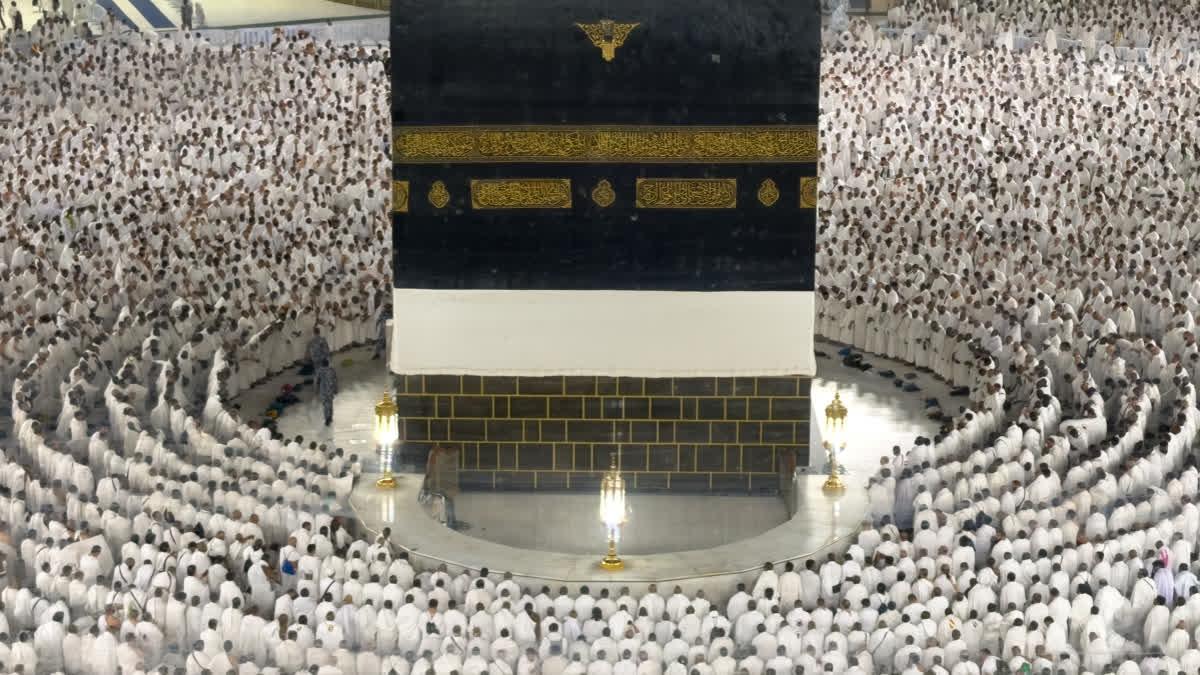
Imagine trying to grasp the scale of two billion people. For decades, that figure has been synonymous with Christianity. But that identity is about to shift. A report released by the Pew Research Center on November 18, 2026, paints a stark picture of a changing world: by the year 2035, Islam is projected to officially overtake Christianity to become the largest religion on Earth. This is not a prediction based on a sudden wave of conversion or a decline in faith, but rather a result of simple arithmetic. The gap between the two groups today is narrow, and the rate at which they are growing is diverging. As of 2020, the global Christian population stood at 2.27 billion, while the Muslim population was 2.02 billion. The projection suggests that by 2035, the Muslim population will surge to 2.57 billion, pulling ahead of the Christian estimate for that same year.

To understand this shift, one must look past the headlines of religious practice and into demographic data. The primary engine of this change is not how many people switch from one faith to another, but how many children they have. Conrad Hackett, a senior demographic specialist at Pew, emphasizes that fertility is a far more significant factor in these projections than religious switching or changing identity. "Fertility rate is a much bigger factor compared to religious conversion or changing religious identity," Hackett notes. This distinction is crucial for understanding why the landscape is shifting. While religious conversion does occur, it does so at a much slower rate than the pace of birth. The report highlights that between 2020 and 2025, the fertility rate among Muslims averaged 3.1 births per woman. In contrast, the fertility rate among Christians during that same period was 2.5 births per woman. That half-birth difference, when applied across billions of people over time, creates a widening gap that eventually flips the hierarchy.

Muslims are projected to outnumber Christians by 2035, according to Pew Research. https://t.co/lTeADtvRIy
The trajectory does not stop at 2035. The Pew report extends its look into the latter half of the century, projecting that if current trends continue, the global Muslim population could exceed 3.6 billion by 2070. This future scenario places a specific geopolitical weight on the demographics. By that point, Pakistan is expected to have the largest Muslim population in the world. Following Pakistan, India, Nigeria, and Indonesia are projected to have the next largest populations of Muslims. These four nations will hold the majority of the world's Muslims, reshaping the cultural and political gravity of the developing world. For India, this projection carries particular weight, as it becomes the second-largest home for the faith, underscoring the religious diversity that defines its national character.
The report identifies the growing number of religiously unaffiliated people as a key driver of this Western decline.
While the global numbers show a rise in the Muslim share of the population, the story in North America is one of contraction for traditional Western faiths. The Pew estimates reveal a declining share for Christianity in its historical heartlands. In the United States, Christians are projected to cease to be the majority religion by 2065. At that point, they will drop below 50% of the total population. The timeline is even shorter for Canada, where Christianity is expected to fall below the 50% mark by 2030. This is not merely a rise in other religions; it is a simultaneous rise in those who claim no religion at all. The report identifies the growing number of religiously unaffiliated people as a key driver of this Western decline.

News Alert! Muslims are projected to outnumber Christians by 2035 and become the world's largest religion, Pew Research Center says, reports AP.
The most powerful force reshaping the North American religious landscape is the expansion of the "unaffiliated"—people who identify as atheist, agnostic, or "nothing in particular." By 2070, this group is projected to reach 41% of the US population. This statistic changes the nature of the demographic competition. It is no longer just a contest between the two major world religions, but a three-way race where a large portion of the Western population is opting out of organized faith entirely. As the unaffiliated sector grows, the percentage point share of any single religion shrinks, even if its absolute numbers remain stable. This explains why Christianity can lose its majority status in the US and Canada even as global Christian numbers continue to grow in other regions.
For a newcomer to the study of demographics, this report highlights a fundamental truth: population growth is a slow-moving vehicle that determines the shape of the world decades in advance. The 2035 crossover is not a sudden event but the culmination of trends set in motion years ago. The 0.6 difference in fertility rates between 2020 and 2025 is the seed of the 2035 result. Understanding this helps explain why political and cultural debates about religious diversity in the West are increasingly tied to global trends. The West is not just losing ground to other faiths but to secularism. Meanwhile, the Muslim world is expanding its demographic weight, with Pakistan, India, Nigeria, and Indonesia becoming the new centers of gravity. The report serves as a forecast of a world where the center of religious population shifts South and East, driven by the simple, powerful act of family formation.

🚨 ISLAM PROJECTED TO OVERTAKE CHRISTIANITY IN 9 YEARS — PEW RESEARCH For the first time in modern demographic projections, Islam is expected to become the world's largest religion within just nine years. According to a new Pew Research Center study, Muslims are projected to outnumber Christians globally by 2035.
The figures provided by the Pew Research Center offer a clear snapshot of this transition. In 2020, Christians numbered 2.27 billion globally, a lead over Muslims, who numbered 2.02 billion. The projected 2035 figures see the Muslim population reaching 2.57 billion, effectively closing the 250-million-person gap in just over a decade. This rapid convergence is a testament to the impact of high fertility rates in regions where Islam is the dominant faith. The data serves as a benchmark for future studies, allowing researchers to measure how closely actual populations track these projections. It also provides a baseline for understanding the shifting balance of power in global institutions, where demographic weight often translates into political influence.
As of late 2026, the world is on the cusp of this historic change. The 2035 date is no longer a distant abstraction but a concrete milestone on the horizon. The data from the Pew Research Center, released on November 18, 2026, confirms that the demographic tide is turning. The implications are vast, touching everything from global policy to cultural norms. The story is not one of conflict, but of change. It is a story of how the most basic aspect of human life—reproduction—drives the most profound shifts in our collective identity. As we move toward 2035, the world will look different, not because of a single dramatic event, but because of the steady, predictable outcome of the numbers. The largest faith on Earth is changing, and the data tells us exactly when it will happen.