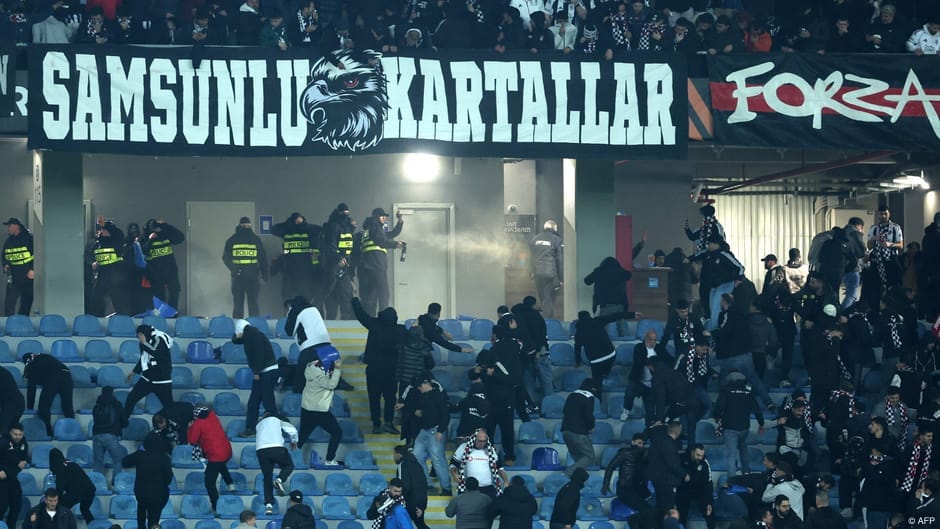
In the coastal city of Batumi, Georgia, the atmosphere was meant to be one of high-stakes European football. The setting was a UEFA Europa League match between Turkey's Besiktas and Israel's Hapoel Be'er Sheva. However, the choice of venue was itself a symptom of a larger, more precarious reality. Batumi had been selected to host the fixture specifically to avoid the safety concerns that would have arisen had the match been played in Turkey. Yet, even on this neutral ground, the shadows of regional conflict proved impossible to outrun.

As the match unfolded, the tension that had been simmering beneath the surface of the stadium erupted into visible unrest. The catalyst was not a foul on the pitch, but a political symbol raised in the stands: a Palestinian flag displayed by Besiktas supporters. The sight of the flag acted as a lightning rod, triggering a sudden and sharp escalation between the fans and the local authorities. In the heat of the moment, the distinction between sporting rivalry and geopolitical protest blurred, setting the stage for a physical confrontation.
What followed was a swift and forceful response from the Georgian police. As the disturbances intensified, officers moved into the crowd, utilizing pepper spray to manage the Besiktas supporters. The intervention was intended to restore order, but it instead contributed to a scene of escalating chaos. The use of chemical deterrents against fans transformed a moment of protest into a moment of direct conflict, leaving the stadium environment fractured and the spectators caught in the crossfire of security measures and political expression.
Following the clashes, police confirmed that at least 16 individuals had been detained.
The violence on the terraces had an immediate and unavoidable impact on the pitch. The match could not continue under such volatile conditions, leading to a suspension of play. For 30 minutes, the stadium fell into a tense, uncertain silence as officials and security forces worked to contain the situation. This pause served as a stark reminder of how quickly the organized spectacle of professional football can be derailed by the unpredictable currents of international tension.
When the dust settled on the immediate violence, the scale of the disruption became clear through the actions of the Georgian authorities. Following the clashes, police confirmed that at least 16 individuals had been detained. These arrests underscore the severity of the disturbances and the legal consequences faced by those caught in the friction between fan expression and state policing. The detentions marked the end of the immediate physical confrontation, but the fallout from the incident began to ripple outward.
The heavy-handed nature of the police response did not go unnoticed. As news of the pepper spray and the subsequent arrests spread, political criticism emerged regarding the methods used to manage the crowd. Omer Celik voiced a sharp rebuke of the authorities, specifically targeting what he described as the "intervention and violence" employed during the incident. This criticism highlights the friction between the necessity of maintaining public order and the perceived overreach of security forces when faced with political symbols.
Despite the thirty-minute suspension and the surrounding turmoil, the sporting contest eventually reached its conclusion. Once play was permitted to resume, the athletes returned to the field to finish what had been interrupted. In the end, Besiktas managed to secure a 2-1 victory over Hapoel Be'er Sheva. While the scoreline will go into the official records of the Europa League, the result remains inextricably linked to the unrest that defined the evening.

The events in Batumi are more than an isolated incident of football hooliganism; they are a reflection of a broader, ongoing risk. The presence of Israeli clubs in European football competitions continues to face significant challenges due to the ongoing war in Gaza. As matches are moved to neutral territories like Georgia to ensure safety, the underlying tensions of the conflict continue to find their way into the stadium, proving that even in the most controlled sporting environments, the world's political fractures remain deeply felt.