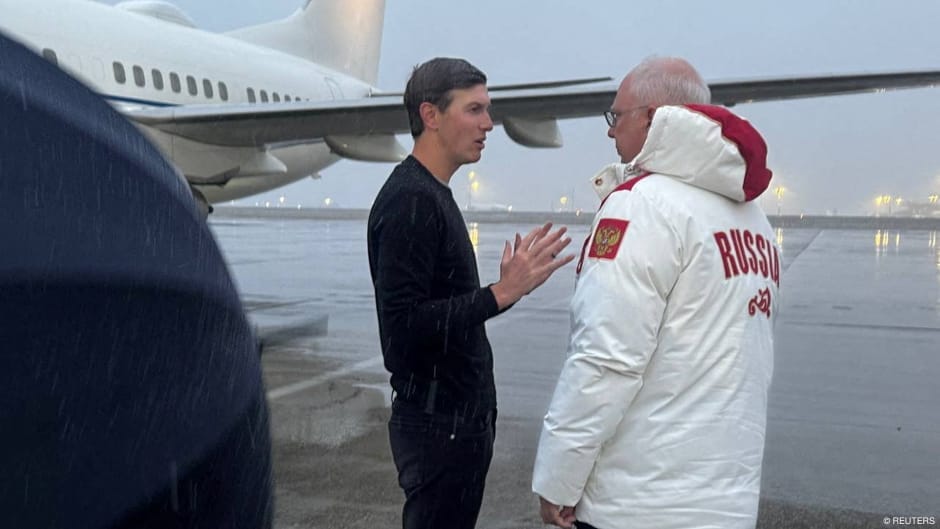
The diplomacy of war and peace often moves in quiet, tightly guarded corridors. For two intense days, international attention centered on the United Arab Emirates, where trilateral peace negotiations unfolded behind closed doors. While these sessions in Abu Dhabi failed to produce an immediate ceasefire or a sweeping diplomatic breakthrough to instantly halt the conflict, they did not end in total deadlock. As the dust settled on the desert talks, American envoys Jared Kushner and Steve Witkoff packed their schedules and headed directly toward Moscow, arriving in the Russian capital to sit down with Russian President Vladimir Putin.

The transition from the Gulf negotiations to the heart of the Russian government marks a critical pivot in an ongoing, complex diplomatic chess match. The arrival in Moscow brings the diplomatic process face-to-face with the Kremlin leadership, testing whether the preliminary discussions can be translated into concrete momentum. Yet, the scope of these discussions extends far beyond a simple bilateral exchange between Washington and Moscow. The diplomatic framework being constructed is deliberately designed to draw in broader international stakeholders, ensuring that any eventual resolution carries the weight of a truly multilateral consensus.
Behind the scenes, the American delegation has been explicit about the long-term architecture required to keep a future peace from unraveling. Speaking on the strategic goals of the mission, Jared Kushner outlined an ambition to broaden the negotiating framework and explicitly secure European participation to establish an enduring multilateral peace format. Washington intends to weave Europe directly into the fabric of the peace architecture, ensuring that the continent most affected by the hostilities shares a permanent hand in shaping security guarantees and a lasting settlement.
Jared Kushner detailed the positive outcome, noting that the parties agreed on executing the largest humanitarian release of prisoners yet.
Even as the grand architecture of a multilateral peace remains under construction, the grinding human cost of the conflict demands immediate, tangible measures. The Abu Dhabi talks may not have delivered a definitive end to the fighting, but they did yield a vital humanitarian breakthrough. According to Ukrainian delegation head Rustem Umerov, framing the diplomatic track as 'the first step — to end the war and ensure security guarantees for Ukraine,' the delegations carved out an agreement on a new exchange of prisoners of war. Jared Kushner detailed the positive outcome, noting that the parties agreed on executing the largest humanitarian release of prisoners yet. For Kushner and Witkoff, who noted that 'We see some openings and some opportunities,' this human element serves as a vital barometer of trust in an otherwise deeply volatile environment.

US envoys Steve Witkoff and Jared Kushner arrived in Russia for talks with President Vladimir Putin on Thursday, seeking to advance a push for a peace deal to end the war in Ukraine. https://t.co/XiKskntERe
While the diplomatic machinery hums between Washington, Abu Dhabi, and Moscow, the wider international stage remains fraught with competing crises and divergent priorities. In the midst of these developments, regional flashpoints continue to cast long shadows across global security. Israel's security cabinet has instructed the military to step up preparations for a possible attack on Iran, prompting sharp warnings from political figures as the Middle East balances on a knife-edge. Meanwhile, far from the immediate theater of active warfare, global leaders are grappling with existential long-term challenges. During the ongoing COP31 proceedings, Turkish President Recep Tayyip Erdogan took to social media to emphasize sustainability and the future of the planet, stating that 'The most precious legacy we can leave to future generations, before the world becomes uninhabitable, will be a cleaner, greener and fairer world' and adding that 'As Türkiye, we are paving the way today and setting a very meaningful goal.'
With the Moscow meetings underway—greeted publicly by figures such as Kirill Dmitriev, who declared himself in welcoming the American envoys—the diplomatic caravan refuses to linger in one place. The immediate itinerary for Kushner and Witkoff includes a crucial journey to Ireland. There, the envoys plan to meet with Ukrainian President Volodymyr Zelenskyy during an informal gathering of European Union leaders. This scheduled stop in Dublin is designed to directly debrief the Ukrainian leadership on the granular progress achieved during the Abu Dhabi negotiations and the subsequent talks with President Putin.
As the envoys prepare to bridge the gap between Moscow and the European leadership gathered in Ireland, the overarching landscape of the talks remains focused on sustaining momentum. While the Abu Dhabi discussions failed to achieve a ceasefire, the agreement for a prisoner of war exchange provides a concrete foundation as envoys seek to broaden participation. The simultaneous pursuit of a massive prisoner exchange and the deliberate effort to stitch together a broader European-backed negotiating format demonstrate that diplomacy, however fragile, continues to grind forward. Where these parallel tracks—spanning the desert of the UAE, the halls of the Kremlin, and the conference rooms of Dublin—will ultimately intersect remains the defining geopolitical question of the moment.

Russia and Ukraine exchanged attacks on each other's capitals early on November 12, a day after peace talks ended and shortly before US envoys arrived in Moscow to meet President Vladimir Putin https://t.co/EWJ5euD373