For decades, the success of global immunization efforts was measured by what was no longer there: the quiet absence of diseases that once decimated childhood populations. That stability is now fracturing. In the United States, a country that once served as a bastion of public health achievement, the silence has been replaced by the rising noise of an outbreak that is as much political as it is biological.

In 2025, the United States recorded 2,289 cases of measles. By the first ten months of 2026, that number had more than doubled, surging to over 5,412 cases. This is not merely a statistical fluctuation; it is a fundamental breakdown of the protective barriers that keep a community safe. The scale of the surge is so significant that the Pan American Health Organisation is set to revoke the United States' status as a country that had eliminated measles.
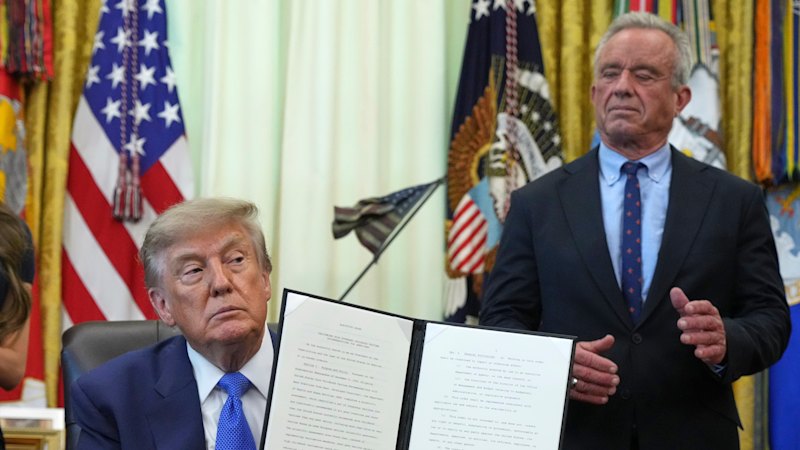
This resurgence is not happening in a vacuum. It is unfolding under the leadership of Health Secretary Robert F. Kennedy Jr., a figure whose influence has coincided with a dramatic shift in how medical science is perceived by the public. The crisis is being fueled by what world-renowned virologist Professor Peter Hotez describes as a deliberate and organized movement.
The Australian Centre for Disease Control has noted a resurgence that mirrors the American trend.
According to Hotez, the rise in cases is not an accident of nature, but the result of an organized, financially motivated ecosystem. This movement does not just exist in the fringes of the internet; it operates with a level of coordination that targets the very foundations of public trust. "It’s organised. It’s deliberate. It’s politically motivated," Hotez warns, characterizing the phenomenon as a "monster" that thrives on the erosion of scientific authority.

🚨 IT'S OFFICIAL: Sec. RFK Jr, Dr. Oz and the Trump admin have LOCKED IN a new policy that PAYS doctors to diagnose, treat, and counsel patients hurt by vaccine side effects LONG OVERDUE and a MAHA win! 🇺🇸 Starting this coming Jan 1, a new billing code pays doctors for every 15 MINUTES spent on a suspected vaccine reaction They don't have to prove the shot caused it. They only have to document the timing and rule out other causes This means Americans who are harmed by vaccines have a better chance at actually being LISTENED TO, not dismissed as "conspiracy theorists," something RFK Jr. has pushed for Thank you, @SecKennedy! Here's RFK Jr. last year: "Under the current system, most vaccine injuries remained invisible!" "Vaccine injuries WILL be reported. They will be STUDIED. And individuals who suffer them will not be denied, or marginalized, or vilified, or gaslit - it will be WELCOMED, and we will learn everything we can about them so we can learn the safety of these products."
Perhaps the most concerning aspect of this domestic crisis is its potential for contagion beyond physical borders. The United States has long been a global leader in cultural exports, from cinema to music. However, Hotez suggests that the country is now exporting something far more dangerous: anti-science influence.
"The US is really good at exporting its music. We export our movies. We’re exporting this stuff," Hotez says, referring to the anti-vaccine sentiment that is now traveling globally. This digital and ideological export is finding fertile ground in other nations, contributing to a pattern where countries like the United Kingdom, Canada, and Spain have also lost their measles-free status. The movement is an ecosystem that knows no borders, using the connectivity of the modern world to spread skepticism as effectively as a virus spreads through a crowd.
While the headlines often focus on the massive numbers coming out of the United States, the tremors of this movement are being felt in Australia. The Australian Centre for Disease Control has noted a resurgence that mirrors the American trend. In the first ten months of 2026, Australia recorded 125 measles cases, a figure that exceeds the national average of 89.

This uptick in Australia serves as a stark reminder that no nation is an island when it comes to infectious disease or the information ecosystems that drive them. As the American outbreak continues to escalate, the risk of these cases globalizing becomes a tangible threat to Australian public health stability. The movement that fuels doubt in the U.S. is part of a global network that makes every resurgence a potential international event.

GOP Sen. Bill Cassidy of Louisiana railed against Robert F. Kennedy Jr. for what he called a "series of failures" at the helm of the Department of Health and Human Services. https://t.co/mpNkIpBw8v
To understand the gravity of the situation, one must look at the data behind the outbreaks. The surge in the United States has already claimed 10 lives over the past two years. While the vast majority of those infected are unvaccinated, the virus is finding ways to navigate even the most protected populations. Data shows that just 2 percent of infected individuals in the United States were confirmed to be vaccinated, illustrating how the sheer volume of susceptible, unvaccinated individuals can overwhelm the protective effects of community immunity.
When vaccination rates drop, the mathematical certainty of an outbreak increases. The virus requires a high threshold of immunity to stop spreading; once that threshold is breached by the influence of anti-science rhetoric, the virus finds its path. The current numbers in both the U.S. and Australia suggest that this threshold is being tested, and in many places, it has already been crossed.
As we move through 2026, the landscape of global health is shifting from one of containment to one of active defense. The revocation of the United States' measles-elimination status marks a significant retreat in the fight against preventable disease. The challenge is no longer just about the biology of the measles virus, but about the political and financial forces that are actively working to dismantle the defenses built by decades of scientific progress. For Australia and the rest of the world, the lesson is clear: the next outbreak may not just be a matter of travel, but a matter of imported ideology.