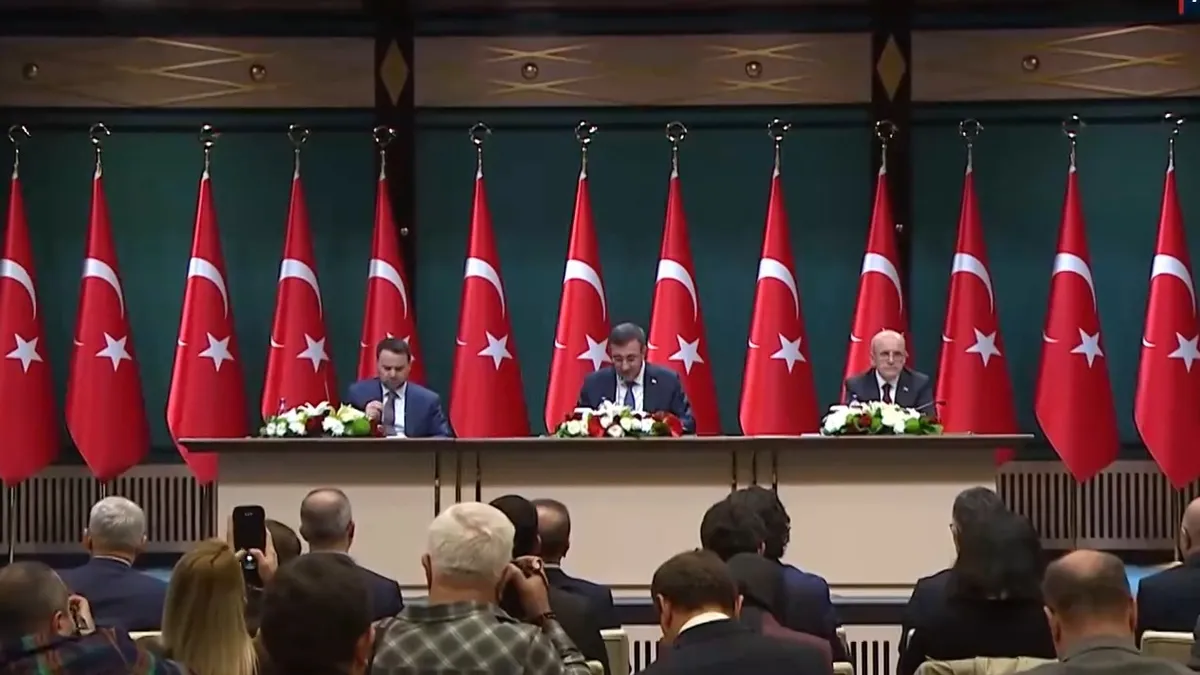
The atmosphere in Ankara had been tense for weeks. For investors, the uncertainty surrounding the fate of their funds was a source of significant anxiety. The financial markets, usually a realm of careful calculation and steady growth, had suddenly become a theater of crisis. But on a recent Tuesday, that tension began to break. The stage was set for a pivotal announcement that would signal a shift from emergency measures to a more stable, predictable future for the country’s financial sector.

The turning point arrived with the convening of the XI. Fund Coordination Council meeting on November 24, 2026. This gathering was not merely administrative; it was the cornerstone of the government's strategy to restore confidence. Vice President Cevdet Yılmaz stood at the helm of these discussions, joined by key figures including Minister of Justice Akın Gürlek and Minister of Treasury and Finance Mehmet Şimşek. The presence of the heads of both the judicial and financial arms of the government in a single room underscored the seriousness of the situation. Yılmaz addressed the nation, making it clear that the government’s approach was one of protection and accountability. "Today, with our valuable Ministers, we will share the developments in the fund markets, the measures we have taken and our approach to protecting our investors' rights with our nation," Yılmaz stated. It was a deliberate move to bring transparency to the process, acknowledging the fears of the 455,758 individual investors who had been affected.
The primary objective of these emergency sessions was to manage the chaotic liquidation of assets. The plan, which had been in motion for some time, was to process payments in an "interim" capacity. This was a stopgap measure, a way to get money back into the hands of investors as quickly as possible without waiting for the full legal and administrative process to conclude. The target was set for Friday, November 27. Yılmaz and his team communicated clearly that this date was not just a milestone, but the line between emergency and normalcy. "We have completed the interim payment process that we announced would be completed on Friday, November 27, and we have now reached a stage where we have moved to the normal process, except for some possible exceptions of extraordinary liquidation," Yılmaz explained. This shift in language was significant. It moved the public discourse away from the panic of the crisis and toward the routine mechanics of financial regulation.
Twenty-one inspectors and experts were deployed to oversee the process, ensuring that every step was carried out with rigor and precision.
To understand the weight of this achievement, one must look at the sheer volume of the operation. The government’s task was to manage the liquidation of 131 distinct funds. It was a logistical puzzle of immense proportions. To pull it off, the authorities had mobilized a dedicated task force. Twenty-one inspectors and experts were deployed to oversee the process, ensuring that every step was carried out with rigor and precision. This was not a passive wait; it was an active, coordinated effort to untangle a complex web of financial instruments. The success of the interim payment process meant that the vast majority of investors would see the fruits of their investments returned in an orderly fashion, mitigating the risk of further market instability.
While the financial mechanics were being finalized, the legal track was running in parallel. The announcement that the interim process was complete came with a stark reminder that the crisis was not just a failure of management, but a violation of the law. The government made it clear that the pursuit of those responsible was just as important as the rescue of the investors. Yılmaz did not leave room for ambiguity on this point. "Sorumlular hukuk önünde hesap verecek," he declared, which translates to "Those responsible will be held accountable before the law." This statement, paired with Yılmaz’s other words about protecting investors, framed the government’s response as a balanced one: immediate economic relief for the public, combined with a firm judicial hand against the perpetrators.
As the market began to stabilize, the focus shifted to the details of the ongoing probe. Minister of Justice Akın Gürlek provided a snapshot of the investigation’s scale. "Fon soruşturması kapsamında 638 şüpheliden 138'i tutuklu bulunmaktadır," he stated, indicating that out of 638 suspects in the fund investigation, 138 were in detention. These are not small numbers. They represent a wide net cast by Turkish authorities, suggesting that the issue had penetrated various layers of the financial ecosystem. The juxtaposition of the financial resolution with the judicial findings served to complete the picture of the government's response: the money is going to the people, and the wrongdoers are facing the consequences.
The declaration that all outstanding payments would be realized by the following day, with the full and ordinary fund liquidation process to be completed, marked the end of an era. It was the final beat of a frantic rhythm that had gripped the Turkish capital markets. For a time, the future had been a question mark. Now, it is a period of restoration. The government's message to its citizens is one of resilience. The crisis has been managed, the payments are flowing, and the system is back on track. While the echoes of the 138 detained suspects and the 455,758 investors remain part of the recent history, the dominant narrative is now one of recovery. Turkey's financial markets have weathered a severe storm, and they are emerging into a calmer sea, guided by a government that has made a promise to its people: the rules are being enforced, and the system is working.