
The silence of the Egyptian landscape near Al-Ayyat was shattered when a routine transit turned into a scene of unimaginable devastation. A train traveling from Giza to Fayoum collided with a stationary train that had been en route from Cairo to Aswan, triggering a disaster that would leave the nation reeling. The impact, occurring roughly 50 kilometers from Cairo, sent shockwaves through the local community as emergency services scrambled to reach the wreckage. The scale of the destruction became immediately apparent: six train cars were forced off the tracks, overturning and tumbling from an embankment in a chaotic display of twisted metal and shattered glass.
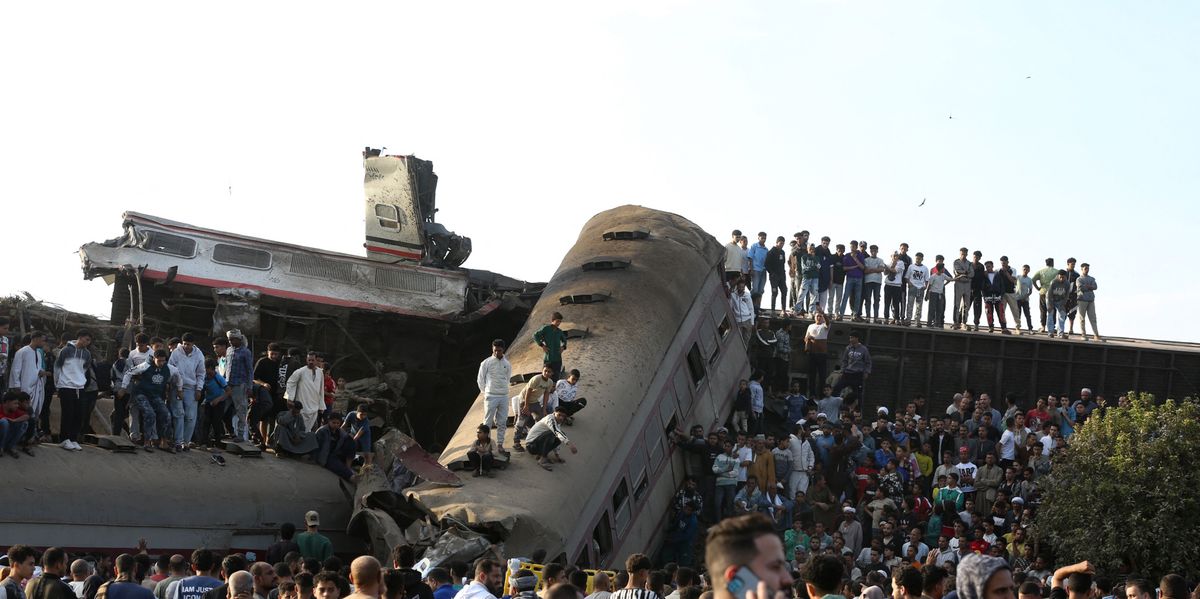
As rescue teams navigated the debris, the grim reality of the collision began to emerge. At least seven people lost their lives in the crash, while 112 others sustained injuries. The nature of the trauma was severe; Khaled Abdel Ghaffar noted that passengers primarily suffered from complex fractures and severe head injuries, a testament to the violent force of the derailment. For those on the ground, the scene was one of frantic activity as responders worked to pull survivors from the wreckage, with railway traffic in the region coming to a complete and paralyzed halt.

Two trains collided south of the Egyptian capital of Cairo on Sunday (November 8, 2026), killing seven people and injuring at least 125, authorities said. The train’s conductor was among those killed. https://t.co/Xb6ehpEaNm
For residents of the El-Ayat area, this catastrophe carries a haunting sense of familiarity. The region has long been plagued by a history of deadly railway accidents, casting a long shadow over the nation’s transport network. The area’s reputation for danger is not new; it was the site of a horrific train fire on February 1, 2002, which claimed 370 lives, and later, in 2009, it saw two separate railway accidents. These recurring incidents have fueled a growing public outcry, with many citizens and observers pointing to a systemic crisis within the railway infrastructure that seems to defy simple solutions.
The region has long been plagued by a history of deadly railway accidents, casting a long shadow over the nation’s transport network.
In the immediate aftermath of the July 16, 2023, collision, the government moved to address the mounting anger. President Abdel Fattah al-Sisi took the situation under his personal control, signaling the gravity of the incident. He issued a directive to investigate the circumstances of the accident, demanding that authorities hold accountable anyone whose negligence is identified as a contributing factor. This push for transparency is intended to address the deep-seated concerns regarding safety protocols and maintenance standards that have dogged the railway system for years.

Two passenger trains collided some 76 km south of Cairo on Sunday, Nov. 8 (Egypt time), killing at least seven people and injuring 112, Egypt’s health ministry said. The state railway authority said a train travelling from Giza to Fayoum hit the back of another heading from Cairo to Aswan, derailing several carriages. Emergency crews were clearing the wreckage to restore services on the Cairo-Upper Egypt line, the railway authority said, without giving any indication of how long this would take. President Abdel Fattah al-Sisi ordered a swift investigation and said anyone found negligent should be held accountable, according to a separate statement. Egypt's public prosecutor's office said investigations were underway to determine the technical reasons behind the crash. Courtesy: Reuters
As investigators begin the painstaking work of determining exactly how a moving train was permitted to collide with a stationary one, the broader implications for Egypt’s infrastructure remain at the forefront of the national conversation. The collision is not merely an isolated event but a flashpoint for a larger debate about the state of the country's rail network. With the investigation now underway, the focus shifts to whether this latest tragedy will finally serve as a catalyst for the systemic reforms that critics argue are long overdue. For now, the nation waits for answers, while the families of the victims are left to grapple with the consequences of a system that has once again failed to protect those it carries.