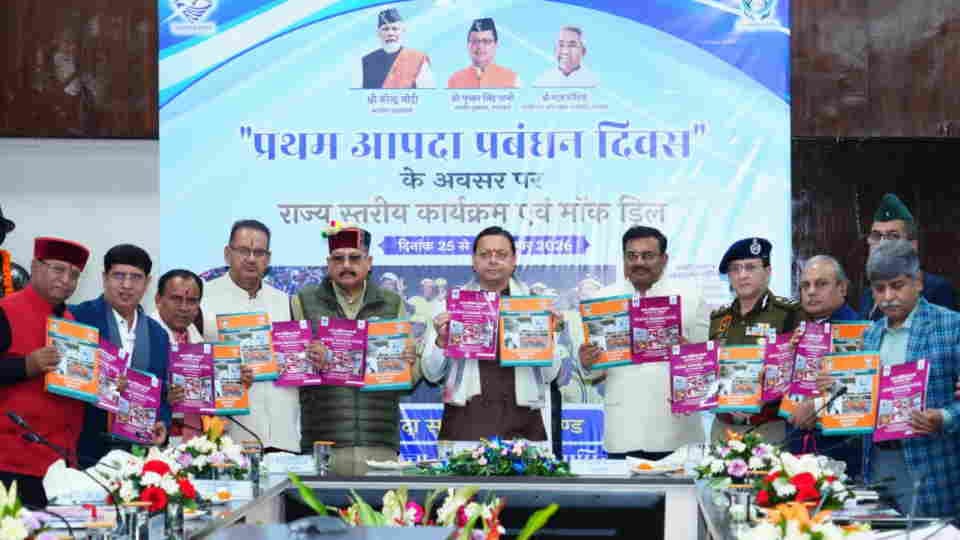
For the residents of Uttarakhand, disaster is not an abstraction; it is the daily reality of living on steep, rain-swollen slopes. On Friday, November 27, 2026, Chief Minister Pushkar Singh Dhami stood in Dehradun to mark the state's first formal Disaster Management Day. The event was not merely ceremonial. It served as the launchpad for a significant overhaul in how the state prepares for the inevitable. The Himalayan region is uniquely vulnerable, and the new policy framework acknowledges that the state's geography dictates its fate. In this environment, where a simple fire can destroy a home or a landslide can bury a village, the government is seeking to build a more robust, coordinated response system that can save lives when seconds matter.

The centerpiece of the announcement was the release of the Uttarakhand State Disaster Management Plan (SDMP) for the period 2026-27. This document is designed to integrate risk mitigation, early warning systems, and rehabilitation measures specifically tailored to the state's geographical weaknesses. Alongside the plan, Dhami launched the Incident Response System (IRS) booklet. This guide clarifies the roles and responsibilities of various officials and departments. In a crisis, confusion is often as deadly as the disaster itself. The IRS aims to eliminate that ambiguity by ensuring that decision-making is rapid and that relief operations are effective. By putting these tools in the hands of local authorities, the state is attempting to bridge the gap between the initial impact of a disaster and the subsequent response.
Perhaps the most significant policy shift came with the decision to categorize fires in residential buildings as disasters. Under the new guidelines, any fire incident in a residential structure will now be accepted as a disaster for the purposes of relief operations. This is a crucial distinction. By redefining a house fire as a state-level disaster, the government is acknowledging the severe financial and physical toll such events take on families. It ensures that those who lose their homes to flames have access to the same rehabilitation measures and relief funds as those affected by earthquakes or floods, expanding the safety net to cover one of the most common, yet often under-supported, forms of disaster.
These individuals possess the discipline and physical capability for high-stress rescue operations.
The new framework also seeks to formalize the role of ordinary citizens and the military. Dhami announced that individuals who cooperate selflessly in relief and rescue operations during disasters or even road accidents will be recognized and rewarded. This move aims to foster a culture of public participation. While professional agencies lead the response, the first responders are often neighbors, volunteers, or local personnel. By institutionalizing the reward for those who aid in relief efforts, the state is incentivizing a broader base of involvement. It signals that disaster management is not solely a government duty but a shared societal responsibility, where courage and cooperation are valued as highly as logistical planning.
To ensure that this broadened approach is practical, the state is focusing on its human resources. A key initiative involves specific training programs for ex-servicemen and uniformed personnel. These individuals possess the discipline and physical capability for high-stress rescue operations. By integrating them into the disaster management apparatus, Uttarakhand is leveraging existing military and paramilitary skill sets to bolster civil response efforts. This collaboration between the state and its security forces is designed to create a more agile and effective workforce, ready to deploy when the early warning systems triggered by the SDMP signal that a crisis is imminent.
Preparedness begins in the classroom. The new initiatives include the introduction of disaster awareness programs in educational institutions across the state. The goal is to create a generation that understands the risks inherent in their geography. By teaching children about mitigation and safety protocols, the state aims to embed disaster literacy into the social fabric. This is a long-term investment in resilience, ensuring that as the population grows, the community's ability to withstand and recover from shocks also grows. It transforms disaster management from a reactive measure into a proactive educational imperative.
In justifying these new measures, Dhami drew a direct parallel to the successful Silkyara tunnel rescue mission. He described the operation as a commitment to saving 41 lives and highlighting the critical role of courage and inter-agency coordination. For the people of Uttarakhand, that rescue was a moment of national pride and a demonstration of what is possible when different agencies work in unison. The new IRS and SDMP are built on that lesson. The rescue mission proved that with proper coordination, even the most difficult scenarios can be managed. Dhami emphasized that for a disaster-sensitive state, effective preparedness, better coordination, and timely action are not optional; they are essential.
As the new planning period begins, Uttarakhand finds itself at a crossroads. The state's unique geographical conditions make it particularly susceptible to natural disasters, but they also foster a culture of resilience and innovation. With the release of the SDMP 2026-27 and the IRS booklet, the government is signaling its commitment to protecting its citizens through better planning, coordination, and community involvement. As CM Dhami noted, disaster management is a continuously challenging subject for Uttarakhand due to its unique geographical conditions. The new initiatives represent a comprehensive approach to addressing these challenges, ensuring that when disaster strikes, the state is ready to respond effectively and save lives.