
The air in Shenzhen likely felt heavy on November 19, 2026, not with the typical humidity of southern China, but with the weight of history. It was a date that would mark a significant shift in the architecture of global power: Donald Trump, Vladimir Putin, and Xi Jinping had gathered for their first joint trilateral summit. For nearly an hour and a half, the leaders of the United States, Russia, and China—three of the five permanent members of the United Nations Security Council—sat in the same room. This was not just another diplomatic courtesy stop on the sidelines of the APEC meeting; it was a moment that redefined the strategic balance of the post-Cold War era.

As the meeting concluded, the three heads of state had signed a joint document they referred to as a 'Declaration on Peace.' The signing of this paper was the tangible outcome of their 90-minute conversation, a framework intended to address the most volatile threats facing the planet. Trump, speaking to the press, captured the mood of the moment with a statement that mixed historical ambition with pragmatic diplomacy. “We are really writing history,” he said. He argued that the three nations, because of their unique position, had the power to significantly reduce the number of nuclear weapons globally. Trump emphasized a core tenet of modern nuclear strategy, stating, “Nuclear wars were futile and should never be fought,” a principle they collectively reaffirmed in the text of the declaration.
The declaration itself was structured around four key points, each designed to stabilize international institutions and energy markets. The first pillar committed the three powers to reforming the United Nations. The leaders agreed that the UN was struggling to keep pace with a complex modern world and pledged to work toward making it a “more effective United Nations” capable of responding to global challenges. This was a notable move, suggesting a shared acknowledgment that the post-1945 international order required a structural update to remain relevant to the 21st century.
They explicitly stated that bodies like the International Criminal Court must not abuse their jurisdiction.
The second point moved from abstract institutions to the tangible realities of global commerce: energy. The leaders committed to expanding the production and delivery of mineral oil products. In an era where energy security is often synonymous with national security, the three nations agreed that stable energy flows were vital for the benefit of all nations. By linking their strategic interests to the global supply of refined oil, they signaled a desire to manage the markets that power the modern economy.
However, the most legally contentious aspect of the declaration was its third point, which dealt with international criminal justice. The three leaders emphasized the principle of state consent and the immunity of state officials. They explicitly stated that bodies like the International Criminal Court must not abuse their jurisdiction. This was a clear pushback against expanding international legal reach into sovereign territories. It was a joint statement that drew a hard line around national autonomy, signaling that the leaders of these three major powers would not submit their officials to external judicial scrutiny without their own explicit agreement.
The fourth point brought the discussion back to the existential threat of nuclear proliferation, specifically mentioning the establishment of a dialogue on 'atomic risks.' While the declaration discussed the Russia-Ukraine war and the conflict between the US, Israel, and Iran, it did so primarily to frame the need for strategic stability. Trump used this framework to make a specific geopolitical promise: “We will not allow Iran to acquire a nuclear weapon.” It was a stark statement that linked the peace declaration directly to the ongoing tensions in the Middle East, presenting the trilateral summit as a tool to manage regional nuclear threats.
Yet, despite the grand titles and the focus on global peace, a glaring omission defined the event. The Russia-Ukraine war was the backdrop against which the summit was held, and it was a topic covered during the discussion. However, the 'Declaration on Peace' itself did not mention Ukraine. The three leaders committed to their own version of peace and strategic stability, but they did not produce a joint framework for ending the war on European soil. The document focused on the macro-level: nuclear weapons, UN reform, and oil markets. The specific, grinding conflict in Ukraine remained absent from the text, a silence that spoke as loudly as the four points that were included.
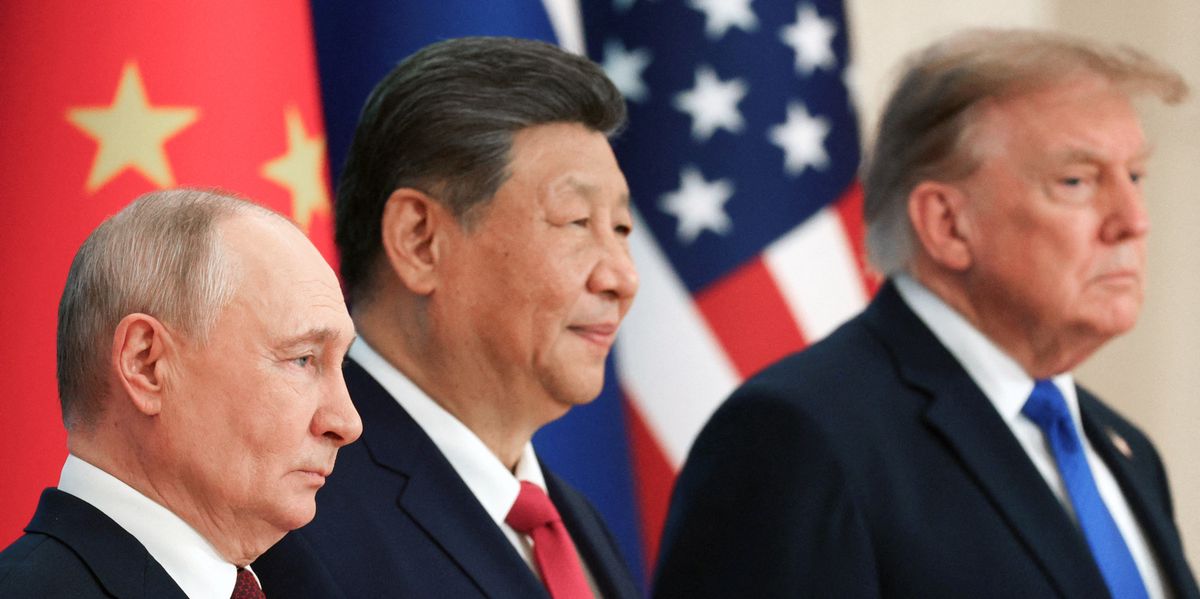
Now, as the dust settles in Shenzhen, the world is left to interpret the implications of this new tripartite understanding. The release of the full text by the Xinhua agency and the Kremlin suggests a coordinated messaging effort, presenting a unified front on issues of state immunity and nuclear restraint. For a world watching the collapse of traditional Western alliances, this new axis of US-Russia-China cooperation presents a complex future. It is a peace that is heavily qualified by sovereign boundaries and strategic interests, offering a framework for global management that prioritizes the stability of the great powers over the specific resolution of the conflicts that divide them.