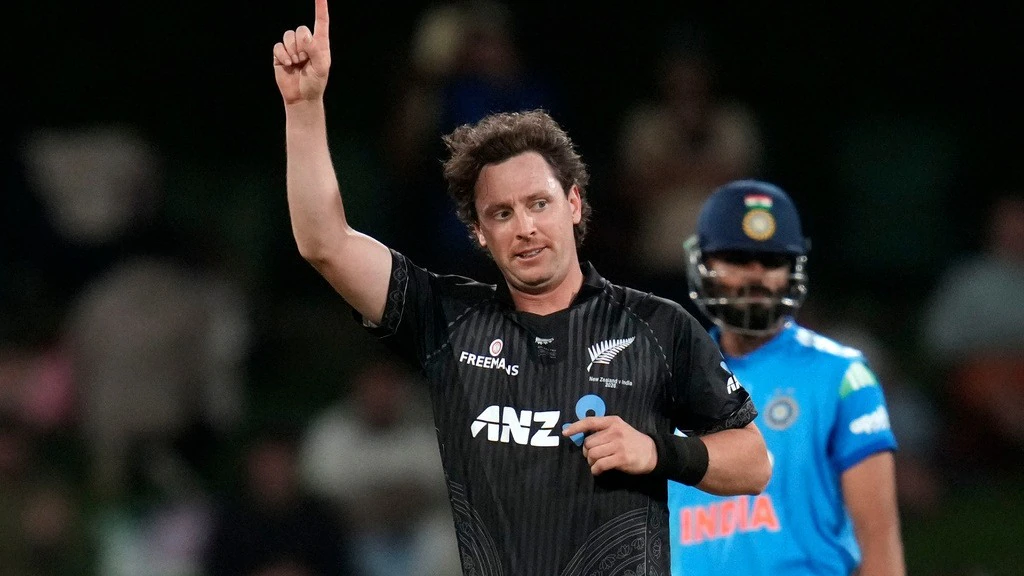
On a bright afternoon at Mount Maunganui, the stage was set for a heavyweight clash between two of cricket's most formidable powers. New Zealand had done their part, posting a formidable 333 runs on the board, anchored by a masterful 125 from Will Young. The target for India was 334—a mountain to climb, certainly, but one that a lineup featuring the likes of Rohit Sharma and Virat Kohli should have been equipped to navigate. Instead, what followed was not a contest, but a demolition.

The match, held on November 13, 2026, began with a sense of déjà vu that felt almost cruel for the Indian side. As the first over commenced, the tension was palpable, but the outcome was instantaneous. In a sequence of events that mirrored the trauma of their 2019 World Cup semifinal loss, the pillars of the Indian batting order crumbled before they could even settle. Rohit Sharma, Virat Kohli, and captain Shreyas Iyer all fell for ducks in that opening over. In the span of mere deliveries, the chase was effectively dead, leaving the middle order to walk out into a storm they were never meant to weather.
While the Indian top order fell to the pressure, it was New Zealand’s Matt Henry who turned a difficult situation into a historic rout. Henry did not merely bowl; he dismantled. Delivering with a precision that left the Indian batsmen searching for answers that weren't there, he produced a career-best performance of 6/27. It was a spell of clinical destruction, a masterclass in exploiting moving conditions that saw the ball zip and deviate in ways the Indian lineup proved utterly unable to handle.
It was a statistical anomaly that pointed toward a deeper, more systemic failure of technique and temperament.
To understand the scale of the disaster, one must look at the cold, hard numbers. India was tasked with chasing 334 runs. They were eventually bowled out for a meager 89 in just 26.4 overs. The resulting 244-run margin of defeat stands as the second-biggest loss by runs in India's ODI history. It was a statistical anomaly that pointed toward a deeper, more systemic failure of technique and temperament.
The pitch at Mount Maunganui offered movement, a common characteristic of overseas venues that requires technical discipline and a patient approach. However, India’s inability to adapt to these conditions was glaring. The collapse was not just a matter of bad luck; it was a failure to respect the environment. When the ball moves, the margin for error shrinks to almost nothing, and on this day, India’s margin was non-existent.

Virat Kohli gifted his Indian team jersey to New Zealand fast bowler Matt Henry after the fourth ODI in Mount Maunganui. Henry had dismissed Kohli for a duck and finished with impressive figures of 6 for 27 as India were bowled out for 89. New Zealand won the match by 244 runs, while Kohli's gesture highlighted mutual respect and sportsmanship. #fetchpakistan #ViratKohli #MattHenry #Cricket #Sportsmanship Disclaimer: This post is based on match reports and publicly shared video footage.
As the dust settles on this crushing defeat, the conversation in Indian cricket circles has shifted from the immediate loss to the long-term implications. This wasn't just a bad day at the office; it was a diagnostic report. With the 2027 ODI World Cup on the horizon, the management is facing a crucial wake-up call. The performance highlighted a vulnerability that will be ruthlessly exploited in upcoming overseas tours to nations like South Africa and Zimbabwe.
For India, the path forward requires more than just tactical adjustments; it requires a fundamental reassessment of how they approach cricket outside the familiar comforts of home. The 244-run defeat serves as a stark reminder that greatness is not guaranteed by name alone. As the team looks toward the next cycle, the memory of Matt Henry’s six-wicket haul and the silence of the top order will serve as a haunting benchmark for the discipline required to compete on the world stage.