
In 2002, Bilkis Bano was a nineteen-year-old girl whose existence was defined by the sudden, violent erasure of her reality. During the Gujarat riots, her world—comprising her baby daughter, her family, her home, and her fundamental trust in humanity—was brutally wrenched from her. The crimes committed against her were not merely singular acts of violence, but a catastrophic rupture that would define the next two decades of her life.
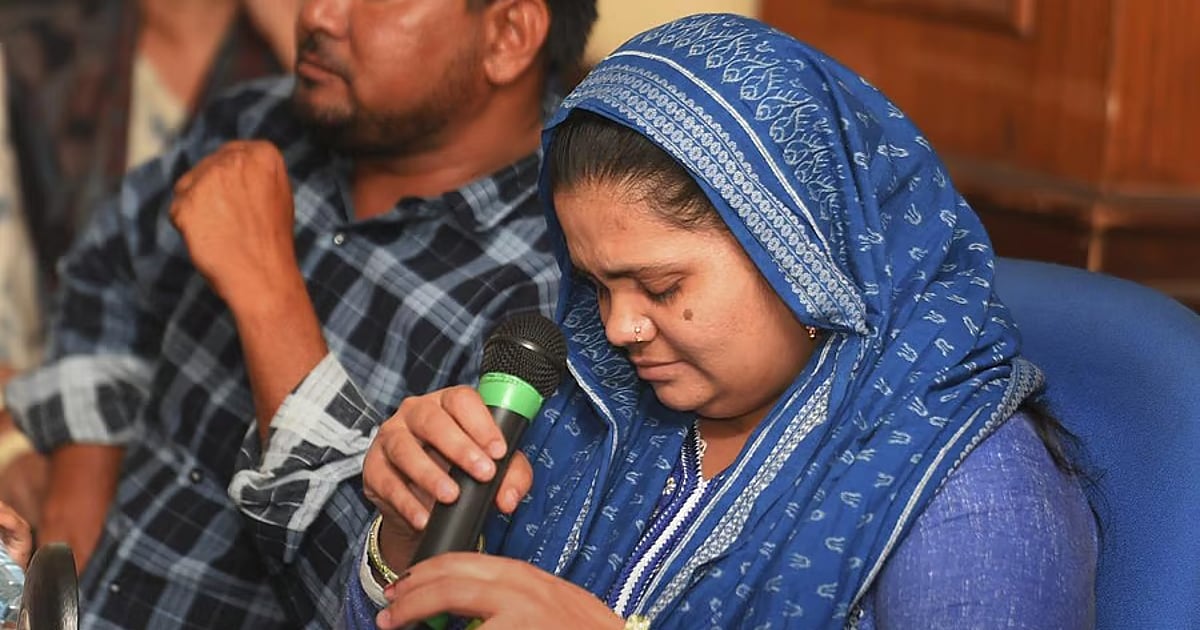
For twenty-four years, Bano has occupied a singular, exhausting space in the Indian legal consciousness. She has not merely been a survivor; she has been a persistent force, fighting for justice for herself and for women everywhere. Her journey has been one of searching for and finding reservoirs of courage she did not know she possessed, fueled by the solidarity of a million voices. Yet, that long pursuit of closure has been met with a profound and recurring sense of betrayal.
On October 28, 2025, the legal landscape shifted again, delivering a blow that Bano describes as a painful repetition of past traumas. A bench of the Supreme Court of India, comprising Justices MM Sundresh and PB Varaleya, issued an order that suspended the life sentences of two men: Bipin Chandra Joshi and Pradeep Mordhiya. These men had been convicted for the crimes committed against Bano during the 2002 riots.
For Bano, the mechanism of this legal decision felt less like an application of law and more like a dismissal of her presence.
The court’s reasoning for granting bail centered on the duration of the men's imprisonment and their personal circumstances. The justices noted that the appellants had been incarcerated for a period of more than 17 years. Furthermore, the court highlighted the fact that one of the appellants suffers from a severe handicap. In the eyes of the bench, these factors, combined with the pending legal complexities of the appeal, necessitated a reprieve.

Bilkis Bano expresses shock and disbelief at the Supreme Court order suspending the life sentence of 2 men convicted for gang raping her and murdering her family members. She says the order was passed without hearing her. https://t.co/vbe6HUnOWt
For Bano, the mechanism of this legal decision felt less like an application of law and more like a dismissal of her presence. She learned of the Supreme Court's decision not through a formal summons or a direct hearing, but through the impersonal medium of press reports. The order was passed without her being called upon or heard, a fact that has left her in a state of profound shock.
"I make this statement even when words come slowly through fresh tears of pain, shock and disbelief," Bano stated in a communication issued on November 17, 2026. "I still cannot believe that once again, for the second time, an order has been passed by the Supreme Court without calling me up and without hearing me. I learnt of this through press reports..."
This sense of being sidelined is not new to her, but the weight of it is compounded by the nature of the crimes. The men being released on bail were among those convicted for the gang rape of Bano and the murder of seven of her family members. To Bano, the legal process feels less like a path toward resolution and more like a recurring cycle of being ignored by the very institutions meant to provide protection.
The Supreme Court's decision is a procedural suspension rather than a final exoneration. The court clarified that while the sentences are suspended to allow the appeal to be decided on its merits—addressing both factual and legal issues—the release is not unconditional. The bail is subject to specific terms and conditions that must be imposed by the concerned trial court.
"Having heard the parties, suffice it to state that the appellants have been under incarceration for a period of more than 17 years, and also the fact remains that one of the appellants has a severe handicap," the bench stated. "Certainly, there are issues to be decided in the appeal, both on fact and law."
By suspending the sentences, the court has opened a window for the appellants to remain free while the broader legal questions of their case are parsed. For the legal system, it is a matter of balancing the length of incarceration and individual hardship against the necessity of a full appeal. For Bano, it is another chapter in a twenty-four-year struggle that refuses to reach a quiet conclusion.

Bilkis Bano was 21 years old and five months pregnant when she was gang-raped by a mob in March 2002. Fourteen members of her family, including her three-year-old daughter, were brutally murdered. At the time, Narendra Modi was the Chief Minister of Gujarat, in charge of the Home portfolio. A crime of this magnitude should have triggered a nationwide reckoning on women’s safety, justice and accountability, much like the Nirbhaya case did. Our government formed the Justice J.S. Verma Committee and passed the Criminal Law (Amendment) Act, 2013. But no outrage or action for Bilkis Bano. And why not? Because she is a Muslim in Modi's India. That is her original sin.
As the legal proceedings continue, the focus remains split between the technicalities of the appellants' rights and the human cost of the original violence. The Supreme Court has signaled that the merits of the appeal remain to be determined, meaning the legal battle is far from over.
Bano’s response serves as a reminder of the endurance required to navigate a system that often moves in ways that feel disconnected from the victims it serves. Her fight has spanned over two decades, moving from the immediate horror of 2002 through years of litigation, only to arrive at a moment where the very court meant to uphold justice has once again left her feeling unheard.