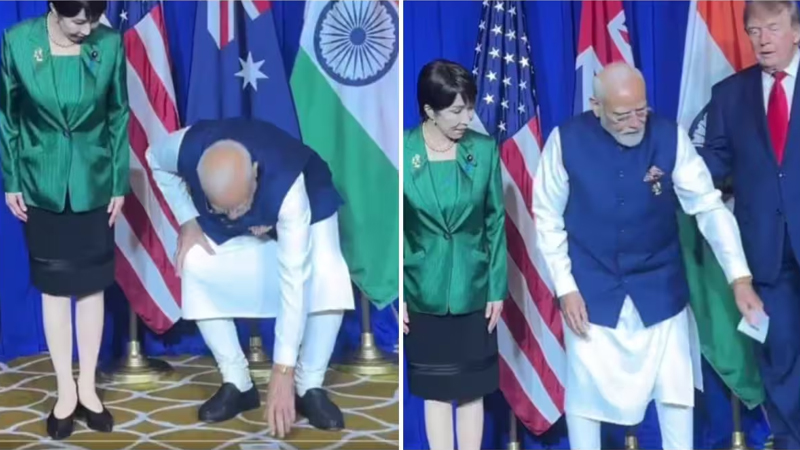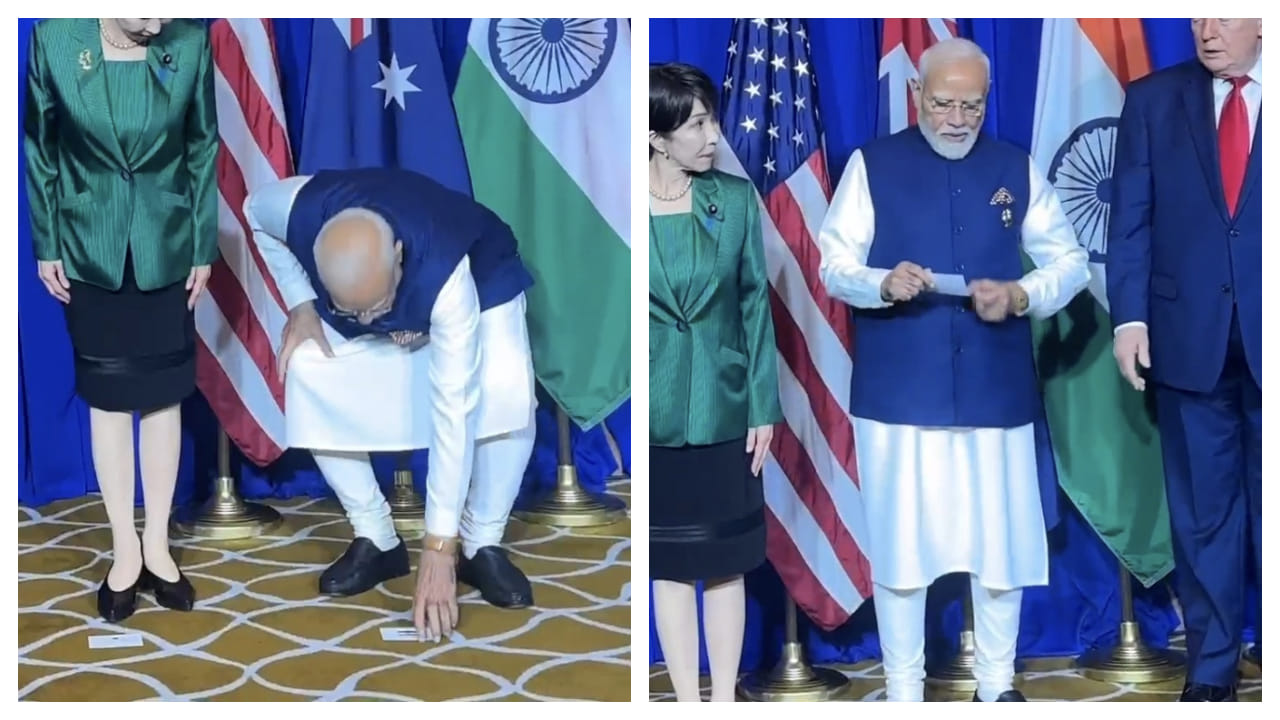
On a Tuesday in November 2026, the floor of the Manila convention center was marked with small white cards bearing national flags, a logistical aid for the leaders of the Quad to know where to stand during the official group photo. It is a mundane detail of diplomatic photography, but for Prime Minister Narendra Modi, it became a moment of visible tension. As he moved into position, the card representing the Indian tricolor slipped onto the carpet. Modi stopped. He bent down, retrieved the small piece of cardstock, and tucked it safely into his pocket rather than leaving it on the ground. According to reports, he explained his action succinctly: "I cannot let the Indian flag touch the ground."

The gesture did not go unnoticed by those standing nearby. US President Donald Trump, reportedly positioned next to Modi, reacted to the act with a short, declarative response: "Save it." The exchange was brief, captured by the many cameras and phones present in the room, and quickly stripped of its diplomatic context to become a standalone viral clip. The President’s comment suggested a recognition of the sentiment behind the motion, framing the preservation of the symbol as a positive act of care, though the specific intent behind his remark remains open to interpretation. For a few seconds, the focus of the summit shifted from high-level strategy to a shared, human moment of respect for a national symbol.
This incident occurred within the framework of the Quad summit, the first of its kind since 2024. In his address to the gathering, Modi described the grouping of India, Australia, Japan, and the United States as a "creative and trustworthy partnership." He emphasized that this alliance provides assurance to the Indo-Pacific region, highlighting joint efforts in maritime security, reliable supply chains, new technologies, and disaster management. The tone of the summit was one of consolidation, with leaders reinforcing their collaborative stance on critical issues that extend beyond traditional security into the economic and technological spheres.
Social media users and commentators quickly drew a parallel to a similar incident at the BRICS summit in Johannesburg in 2023.
In remarks directed at the press and the assembled guests, President Trump offered a personal assessment of the Indian Prime Minister. He described Modi as a "very tough person," a characterization that added a layer of personal dynamic to the official diplomatic proceedings. This comment on Modi’s demeanor complemented the summit’s broader focus on Indo-Pacific surveillance and critical mineral cooperation, suggesting that the personal rapport between the heads of state is considered a stabilizing factor in the working relationship between the four nations.
The image of a leader protecting a national flag from the ground is not entirely new to diplomatic history. Social media users and commentators quickly drew a parallel to a similar incident at the BRICS summit in Johannesburg in 2023. In that previous event, a flag had also been handled with particular care, sparking a comparable debate about protocol and symbolism. By invoking this earlier moment, observers placed the Manila incident within a longer lineage of diplomatic theater, where the physical treatment of national emblems can become a proxy for discussions on respect, hierarchy, and identity on the global stage.
As the video of the Manila floor marker circulated online, it fractured into distinct narratives. For many in India, the act was celebrated as a display of deep reverence for the national flag, a small but potent symbol of patriotism that resonated with public sentiment. The praise was often framed as a moment of dignity preserved in the glare of international cameras. However, the reaction was not uniform. She questioned how Modi could "embarrass India less on a global stage" by literally picking up a floor marker and pocketing it, calling the incident "unf...believable." Her comment mocked the gesture, framing it as an act of awkwardness rather than reverence.
Despite the viral moment, the substantive work of the Quad continued. The leaders remained engaged in discussions on securing supply chains and enhancing disaster response capabilities in the Indo-Pacific. The flag incident, while it dominated social media feeds for hours, did not alter the formal outcomes of the summit. It served, instead, as a reminder of the thin line between logistical procedure and symbolic performance in modern diplomacy. The small white card in Modi’s pocket became a larger artifact, representing the divergent ways in which audiences interpret the actions of world leaders, filtering their gestures through lenses of nationalism, politics, and personal affection or disdain. The summit closed with the partners reaffirming their commitment to a stable and secure region, leaving the floor marker as a footnote in the diplomatic record but a headline in the public one.