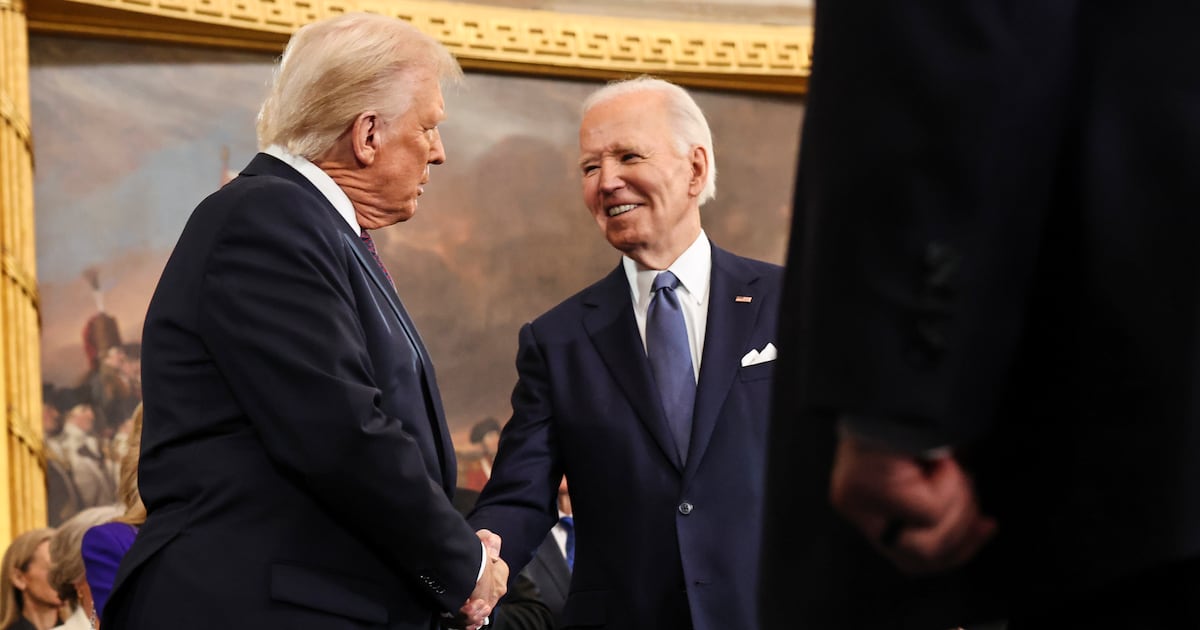
In the high-stakes theater of American politics, the gap between what is said behind closed doors and what is shouted from a podium can feel like a canyon. For years, the transition of power between Donald Trump and Joe Biden was defined by public friction, legal challenges, and a refusal to concede the 2020 election. But a newly disclosed private letter, revealed in Biden's forthcoming book, Promise Me, America, suggests a different, more quiet dimension existed in the midst of the upheaval.

Written on January 20, 2021, the letter from Donald Trump to Joe Biden was not the combative missive many might have expected given the surrounding political climate. Instead, it was a document of unexpected weight, offering well-wishes for the incoming presidency. It presented a version of the former president that seemed to acknowledge the solemnity of the office, even as the country grappled with the fallout of a contested election.
In the text of the letter, Trump addressed the immense burden of the presidency with a tone of unexpected reverence. He wrote to Biden about the weight of leadership, noting that the presidency is not merely a political position but a vessel for the nation's collective spirit. "Not only are you joined by the past, but you carry the hopes and dreams of the entire nation on your shoulders," Trump wrote. "The gravity of that fact never leaves you, it is the anchor that grounds every decision you make."
Only two weeks prior to the writing of the letter, on January 6, 2021, the halls of the U.
This was not the language of a man seeking to delegitimize his successor, but rather one describing the heavy mantle of the American executive. Trump suggested that the true source of a president's power was not found in policy or partisan victory, but in the people themselves. "Your strength, your deepest reservoir of energy, comes from the knowledge that millions upon millions of people are depending on you," the letter stated, adding that the ambitions and aspirations of the citizenry were the very reason for Biden's presence in the White House.
To read the letter is to encounter a man who seemed to understand the historical continuity of the presidency, even as he worked to disrupt it. Trump wrote of the tradition of the office, observing that "many presidents have come and gone who simply governed as Republicans or Democrats." It was a reflection on the institutional nature of the role—a role that, in the eyes of many, was being tested to its absolute limit.
Joe Biden, reflecting on this discrepancy in his new book, describes the experience of navigating these two conflicting realities. To Biden, the coexistence of this private, congratulatory tone and the public, disruptive behavior created a sense of profound cognitive dissonance. He characterizes the phenomenon "as if there were two Donald Trumps," one who acknowledged the sanctity of the democratic transition in private, and another who actively worked to undermine it in the public square.
The contrast between the letter's contents and the reality of early 2021 is impossible to ignore. Only two weeks prior to the writing of the letter, on January 6, 2021, the halls of the U.S. Capitol were stormed by Trump supporters during the critical vote to certify the election results. The violence of that day served as a visceral manifestation of the instability that had gripped the nation throughout the post-election period.

While the letter offered a vision of a president grounded by the hopes of the nation, the events of January 6 represented a direct challenge to that very foundation. The tension between the private well-wishes sent on January 20 and the public refusal to concede the election results created a fractured landscape for the incoming administration to navigate.
The divide between the private man and the public figure has not been resolved by the passage of time. The friction of that transition period has left lasting marks on the American political landscape. Biden has asserted that during this era, Trump "deeply destabilized democracy," a charge that points to the systemic tremors caused by the challenges to the 2020 election results.
This destabilization is further evidenced by the actions taken following the transition. Trump's decision to pardon over 1,000 individuals who were involved in the January 6 Capitol underscored the tensions of that period. These pardons represented a significant action that occurred in the aftermath of the transition, further complicating the already complex relationship between the two presidents.
As the details of the January 20 letter emerge through Biden's memoir, they serve as a curious artifact of a moment when the American political system was under unprecedented strain. The letter provides a glimpse into a private moment of recognition, yet it cannot erase the public record of the era.
Today, the country remains caught between these two versions of history: the private words of a former president wishing his successor well, and the public actions that challenged the very mechanisms of the democracy he described. The letter stands as a quiet, singular marker of a transition that was anything but peaceful, leaving behind a legacy defined by the tension between what was said and what was done.