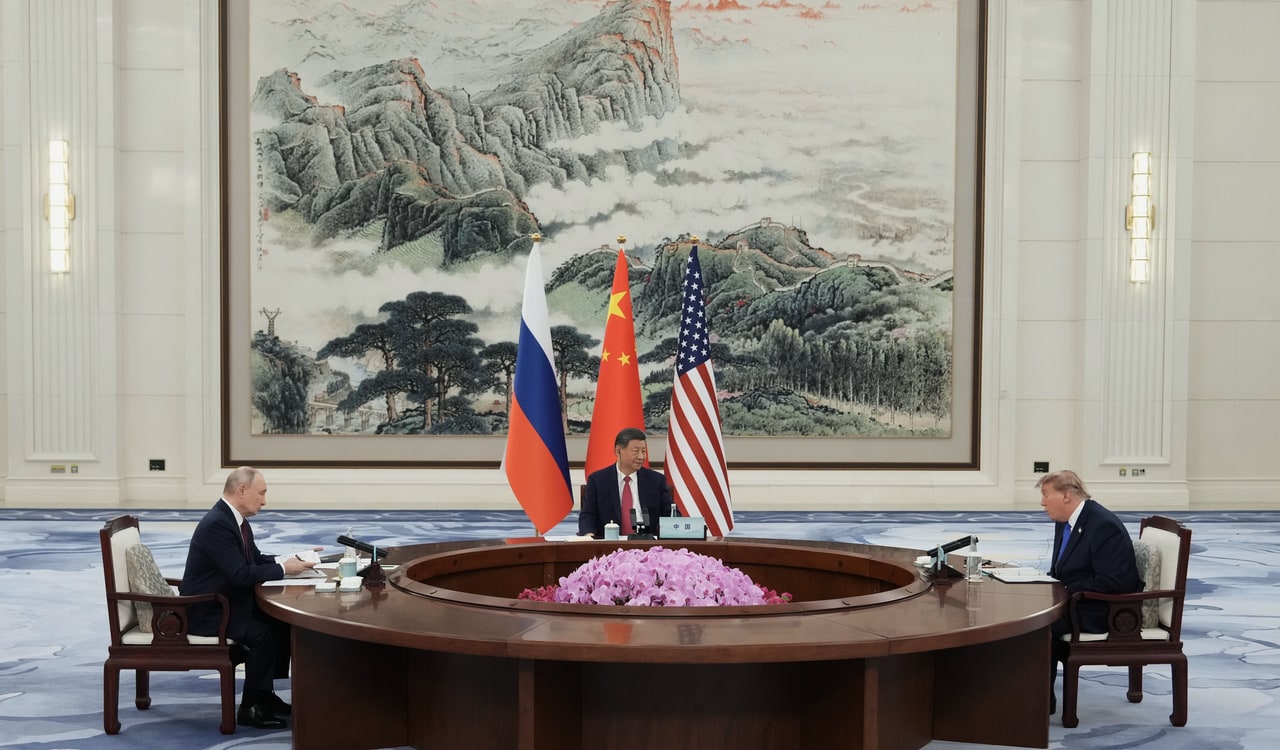
On November 20, 2026, the world’s attention shifted to Shenzhen, China. On the sidelines of the APEC summit, a meeting took place that few had predicted with such specific, heavy outcomes. U.S. President Donald Trump, Russian President Vladimir Putin, and Chinese President Xi Jinping sat together to sign a joint declaration—a document that aims to reshape the fundamental mechanics of global security and commerce. While the air in the room was thick with speculation regarding the future of artificial intelligence and the ongoing complexities of the war in Ukraine, the final text focused on two pillars: the cessation of nuclear proliferation and the guarantee of unencumbered energy flows.

For years, the architecture of nuclear stability has been a fraying tapestry of bilateral agreements, primarily between Washington and Moscow. However, the Shenzhen declaration moved toward a broader, more generalized approach. While observers had whispered about a reboot of the START treaty—a strategic arms reduction framework—that would include Beijing, the reality of the signed document was more nuanced. President Trump has been emphatic in his demand that any future arms control negotiations must include China, a move that Beijing has vehemently rejected. Instead of a specific bilateral limit between the U.S. and Russia, the leaders focused on a collective stance against general nuclear threats, signaling a coordinated effort to curb the spread of atomic weaponry on a global scale.

JUST IN: Trump rates his summit with Xi Jinping and Vladimir Putin in China a “12 out of 10.”
Beyond the existential threat of nuclear weapons, the summit addressed the more immediate, rhythmic pulse of the global economy: energy. The declaration emphasized the necessity of "stable energy flows," a phrase that carries immense weight in an era of volatile markets. By committing to unencumbered energy movement, the three powers signaled a desire to stabilize the global markets that underpin their respective economies. This focus on energy is not merely theoretical; it is a direct response to the geopolitical bottlenecks that have long threatened to choke international supply chains.
Nominally allied with both China and Russia, Tehran now finds itself facing a unified front from its traditional partners.
While the declaration was framed in the language of global stability, its implications are felt most sharply in the Middle East. For Iran, the summit represents a strategic nightmare. Nominally allied with both China and Russia, Tehran now finds itself facing a unified front from its traditional partners. The declaration specifically targets the dual-track strategy that has long defined Iranian regional influence. One of these tracks involves the Strait of Hormuz, a critical maritime chokepoint. The Chinese government, acting as a major buyer of oil, has been particularly vocal in its opposition to Iranian attacks in these waters, recognizing that any disruption to the Strait threatens the very energy security the Shenzhen leaders have now pledged to protect.
The second track of the Iranian strategy—the pursuit of nuclear capabilities—is met by the summit's renewed focus on non-proliferation. This has been a cornerstone priority for the U.S. administration since its first term, but seeing it echoed in a document signed by both Xi and Putin changes the calculus entirely. By aligning on these two fronts—maritime energy security and nuclear restraint—the three superpowers have effectively created a perimeter that leaves Iran increasingly isolated. The alliance that once offered Tehran a shield against Western pressure has, through this trilateral agreement, pivoted toward a shared interest in global predictability.
As the APEC summit concludes and the leaders depart Shenzhen, the landscape of international relations has been fundamentally altered. The joint declaration does not solve every tension between the three nations, nor does it resolve the friction regarding China's role in arms control. However, it establishes a new baseline for how the world's most powerful players interact with the most volatile elements of global security. The focus has shifted from confrontation to a managed stability, one that prioritizes the flow of oil and the containment of the atom, even if it means leaving old allies in the cold.

My thoughts on the Xi-Trump-Putin summit. No Yalta 2.0, yet Shenzhen trilateral confirms China’s centrality and Europe’s irrelevance. https://t.co/FN9ZPB8lpD