
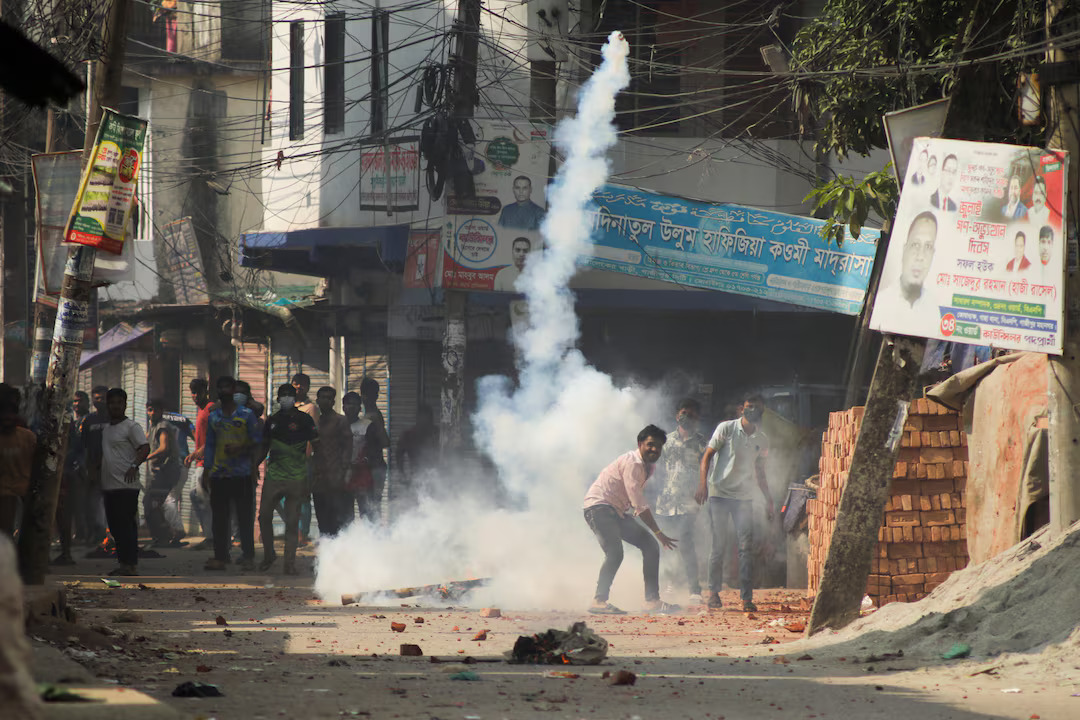
The night of November 25, 2026, the main arteries leading into the industrial hub of Gazipur fell silent. Not because traffic cleared, but because it stopped. Workers of the textile sector, the lifeblood of the local economy, blocked the highways. They were not marching in a parade; they were digging in. Behind the barricades, police deployed tear gas, turning the air into a stinging, white-hued mist that scattered the crowds but failed to scatter the determination of the laborers. This confrontation was the latest and most volatile chapter in a dispute that had simmered for months, a clash between the hands that make the clothes and the machines that make the money.

To understand why a minimum wage adjustment could provoke such intensity, one must look at the scale of the industry at stake. The garment sector in Bangladesh employs more than 4 million people. It is not just a job sector; it is the economic engine of the nation, generating more than 80 percent of the country's export earnings. Every quarter, containers roll out of these factories carrying apparel destined for the racks of major Western retailers, including H&M, Zara, Walmart, Target, and Gap. When the workers stop, the global supply chain shudders. They know this leverage. It is the only card they hold against a board that had previously signaled a willingness to keep wages stagnant.
The negotiation process was a test of arithmetic and endurance. For months, the official figures remained opaque, but the underlying dynamics were clear: the workers demanded a raise that would lift them out of poverty, while factory owners offered a bump that would barely cover inflation. The gap between these two positions defined the months of unrest. Finally, the deadlock broke on June 19, 2024. The Bangladesh government approved a 36 percent minimum wage hike for garment workers.
Babul Akhter, a figure within the industry board, confirmed the mechanics of the decision: "The board approved the new structure in a 4-2 vote.
This number—36 percent—carries a heavy historical weight. It is the smallest percentage increase approved in four decades. In a typical labor victory, one expects a dramatic jump. Here, the victory is measured in millimeters. The new minimum wage settled at 17,000 taka, a figure that translates to roughly $138 per month. Critics argue this is a pittance, a 'poverty wage' that maintains the status quo rather than transforming it.
How did the sides arrive at 17,000 taka? The path was one of compromise, often defined by the retreat of one party or the other. In the early stages of the dispute, the workers had demanded 32,000 taka—a sum equivalent to about $257. This initial demand reflected a desire not just for a wage increase, but for a living wage, a threshold that would allow a worker to support a family with food, housing, and healthcare. As the talks dragged on and the prospect of a prolonged strike grew, that demand was lowered to 18,000 taka.
On the other side of the table, the factory owners initially offered just 15,000 taka. This offer was met with immediate and fierce rejection, fueling the protests that eventually escalated to highway blockades. The owners, recognizing the risk of total disruption to exports, eventually raised their offer to 17,000 taka. The final agreement met exactly there. The workers lowered their demand; the owners raised their offer. The result was a number that satisfied no one entirely, but one that allowed the machinery to keep turning.
The approval of this wage structure was not a unanimous nod from the industry. It was a contested decision, reflected in the voting record. Babul Akhter, a figure within the industry board, confirmed the mechanics of the decision: "The board approved the new structure in a 4-2 vote." This margin—four in favor, two against—highlights the deep division within the employer and government camps. The two dissenting votes likely represented the factions most aligned with labor or the most vocal critics of the low threshold. For the majority, however, the vote was a signal that the status quo, adjusted slightly, was preferable to the chaos of a total strike.
While the government and industry boards debated the precise number, civil society groups were watching the trajectory with growing alarm. The Clean Clothes Campaign, a coalition dedicated to improving working conditions in the garment sector, did not wait for the vote to pass before issuing their judgment. Anne Bienias, representing the campaign, cut through the bureaucratic language of 'market adjustments' to state the reality: "These negotiations result in poverty wages time and time again."
Her statement underscores the critical stance of international observers. To them, 36 percent is not a victory; it is a repetition of a cycle that keeps workers in precarious economic conditions. The critique is not merely about the money, but about the power dynamic. The workers had forced a change, but the magnitude of that change suggests that the system is designed to absorb labor demands and return them in the smallest possible increments.
For the consumer in Europe or North America, this negotiation is invisible. A shirt from the global brands may cost $10, but the labor that went into it is valued at a fraction of that. The 17,000 taka wage allows for the production of these goods at a cost that makes them competitive in Western markets. It is this cost advantage that keeps the factories running and the jobs employed. The 'small' increase is, paradoxically, essential for the industry’s survival.
As of now, the highways are clear, but the tensions remain. The workers have accepted the 17,000 taka figure, but the memory of the tear gas and the blocked roads is fresh. The government has secured a four-to-two vote, stabilizing the industry for another period. Yet, the underlying question remains unanswered: at what point does a wage hike stop being a 'minimum' and start being a 'living' one? For the moment, the answer is 17,000 taka. It is a number that keeps the world's wardrobe moving, but it leaves the workers who made it struggling to keep up.