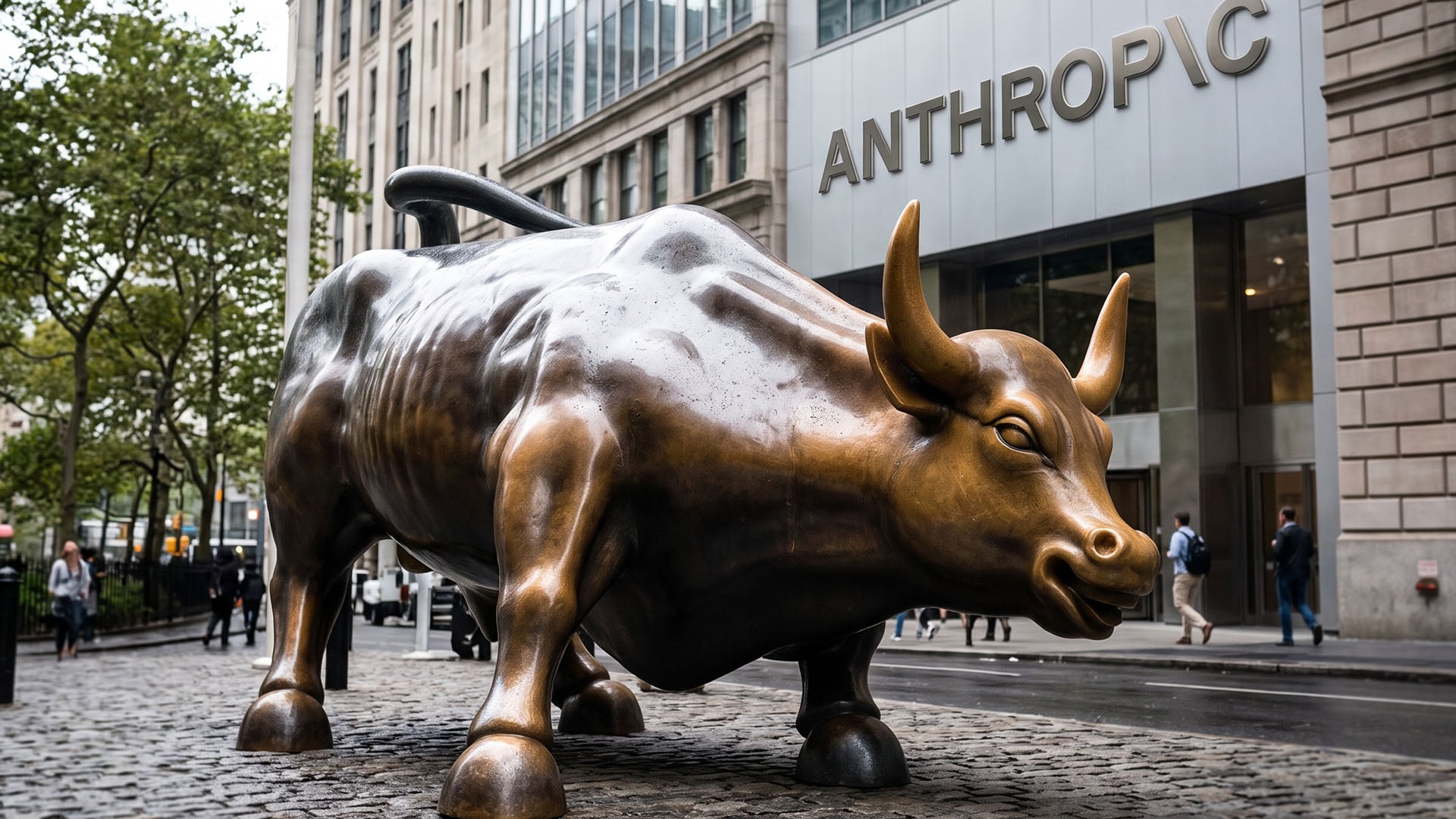
On a morning that will likely be etched into the annals of financial history, the Nasdaq floor became the stage for a transformation in the global economy. When the opening bell rang, it wasn't just signaling the start of a trading day; it was marking the arrival of Anthropic, the artificial intelligence developer, as a public titan. As founders Dario and Daniela Amodei stepped forward to ring that bell, the ticker 'ANT' began to move, signaling the largest initial public offering in history.

The numbers coming off the tape were nothing short of staggering. Anthropic's shares opened at $111.50, a figure that represented a 34.3% premium over the $83 public offering price. This surge immediately propelled the company’s market value to the $2 trillion mark. To understand the scale of this ascent, one must look at the momentum building behind the scenes. Even before the official pricing, the company's $83 IPO price had already exceeded its own projected range of $70 to $78 per share.
This was not a sudden explosion, but rather the culmination of a calculated march toward the public markets. The process began quietly in June, when Anthropic filed confidentially with the U.S. Securities and Exchange Commission (SEC). It wasn't until October 26 that the company moved into the light, publicly filing its registration statement. By the time the offering was priced at $83 per share on November 15, the appetite for the company's vision of AI was already palpable.
For CEO Dario Amodei, the mission is not merely about market capitalization, but about the fundamental acceleration of human capability.
The mechanics of the offering were massive in scope. Anthropic offered 980 million Class A common shares, a move that successfully raised $81.3 billion in capital. This infusion of liquidity does more than just pad a balance sheet; it provides the fuel for the high-stakes race to develop increasingly sophisticated AI models.
When the dust settles on this initial transition, the sheer scale of Anthropic's liquidity will be unprecedented. By combining the proceeds from this IPO with existing fundraising and new private offerings, the company is expected to hold $220 billion in cash reserves. One analyst noted the sheer anomaly of this position, observing that Anthropic is poised to have more cash on hand than any company has ever had. In the world of high-tech development, where the cost of compute and talent is astronomical, such a reserve is a formidable moat.
At the heart of this financial whirlwind is the technology itself. For CEO Dario Amodei, the mission is not merely about market capitalization, but about the fundamental acceleration of human capability. He has framed the potential of powerful AI as a tool of temporal compression, suggesting that such systems could potentially compress a century of scientific progress into a single decade.
However, this vision of accelerated progress carries an inherent weight. The ability to move through scientific discovery at such a velocity necessitates a rigorous approach to the consequences. Amodei has positioned the company as a cautious architect of this new era, emphasizing that the power of these systems must be balanced by safety and human control. The company's stance is that the risks associated with advanced AI are not a foregone conclusion, but a challenge to be managed through careful design.
As Anthropic enters the scrutiny of the public markets, the tension between rapid commercialization and safety becomes even more acute. Amodei has been vocal about the company's philosophy regarding the dangers that large-scale AI models might pose. He has resisted the notion that the risks of AI are an unavoidable byproduct of progress.
"We are not speaking because we think these risks are inevitable and are still building despite them," Amodei stated, "but because we believe they are preventable and that we can prevent them."
This distinction is central to Anthropic's identity. The company views itself as a defender of safety, a stance that may occasionally clash with the relentless demands of the broader tech industry. As the company scales, it faces the constant pull of external forces that prioritize speed and market dominance over caution. Amodei, however, has issued a clear mandate to shareholders and observers alike regarding the company's independence. "We will not bow to commercial or political pressures," he vowed.
As trading continues on the Nasdaq, the world is watching to see if the $2 trillion valuation holds. Anthropic has moved from a private research entity to a public powerhouse in a matter of months, backed by a level of capital that is virtually unparalleled in corporate history. The company now stands at a crossroads: it possesses the financial resources to reshape the scientific landscape, but it must do so while navigating the very risks it has promised to mitigate. For now, the market has signaled its belief in that promise, rewarding the company with a debut that has rewritten the record books.