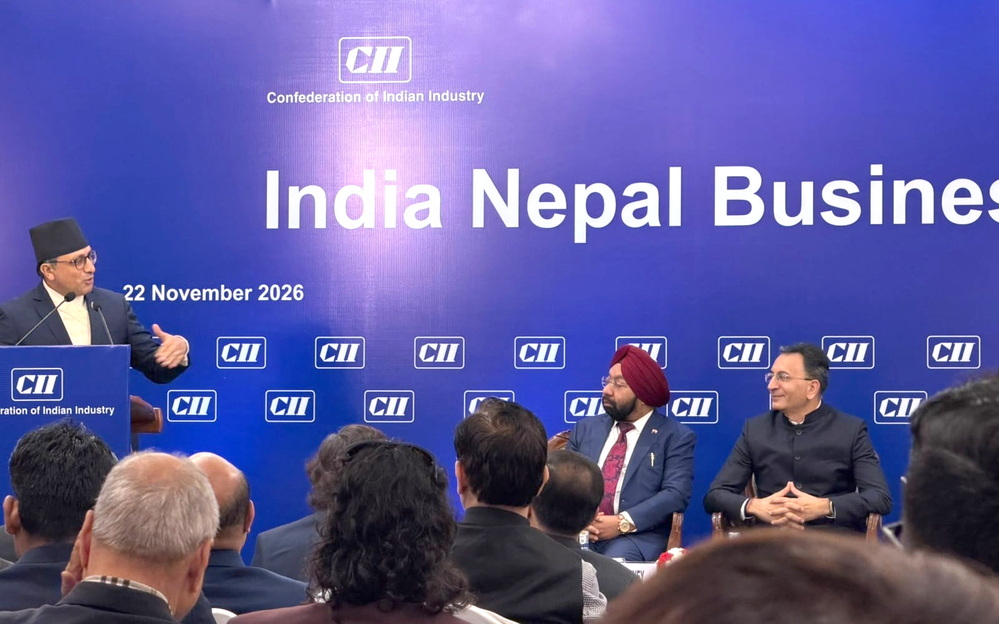
In the bustling corridors of New Delhi, a conversation began that seeks to redraw the economic map of South Asia. On November 23, 2026, the India-Nepal Business Roundtable convened, bringing together a select group of 18 Indian industrialists and business leaders. The atmosphere was one of strategic inquiry, but the message from the Nepali delegation was one of urgent, confident invitation.

Dr. Swarnim Wagle, Nepal’s Finance Minister, stood before these decision-makers not merely to request capital, but to pitch a transformation. For decades, the economic relationship between India and its neighbor has been defined by trade and geography, but Wagle is pushing for a deeper integration rooted in industrial partnership. He is signaling that the time for cautious observation has passed, and the era of active investment has arrived.
To understand Wagle’s appeal, one must look past the traditional image of Nepal as a purely scenic landscape. The Finance Minister is pivoting the national narrative toward high-growth, modern sectors. He specifically pointed to information technology, hydropower, and connectivity as the pillars of Nepal's future economy.
The primary question facing the 18 leaders at the roundtable was likely not whether the opportunities existed, but whether they could be safely realized.
In the world of global finance, hydropower represents more than just electricity; it is a foundational asset for regional energy security. Similarly, the push for connectivity and IT infrastructure suggests a nation attempting to leapfrog traditional developmental hurdles by building a digital and physical bridge to its neighbors. Wagle’s pitch is clear: Nepal is no longer just a destination for travelers, but a destination for the architects of the modern economy.
For any investor, the allure of a new market is always tempered by the specter of risk. The primary question facing the 18 leaders at the roundtable was likely not whether the opportunities existed, but whether they could be safely realized. Wagle addressed this head-on, moving beyond mere optimism to discuss the structural mechanics of the Nepali state.
He emphasized that the government is actively working to simplify legal frameworks—the very rules of the game that dictate how businesses operate and resolve disputes. More importantly, Wagle highlighted targeted measures designed to safeguard investments. In a landscape where capital flight and regulatory uncertainty can stifle growth, the Nepali government is making a concerted effort to ensure that investors can see their returns and, crucially, facilitate the repatriation of profits. This focus on the ability to move money back across borders is a vital signal to international business leaders that Nepal is serious about playing by global standards.
The roundtable was not a monologue, but a multilateral dialogue on regional prosperity. Alongside Wagle, the event featured insights from Indian Minister of State for Commerce and Industry Jitin Prasada and the CII International Council president, Dr. Bikramjit Singh Sahni. The presence of such high-level officials underscores the geopolitical weight of these economic discussions.

As the meeting concluded, the message to the Indian business community was two-fold. It was an invitation to the newcomers to enter the market with confidence, and a nudge to the veterans. Wagle explicitly encouraged those who have already established a footprint in Nepal to consider expanding their existing operations. The vision presented in New Delhi is one of a symbiotic growth, where Indian industrial might meets Nepal’s burgeoning potential, creating a corridor of development that stretches from the plains of India to the heights of the Himalayas.