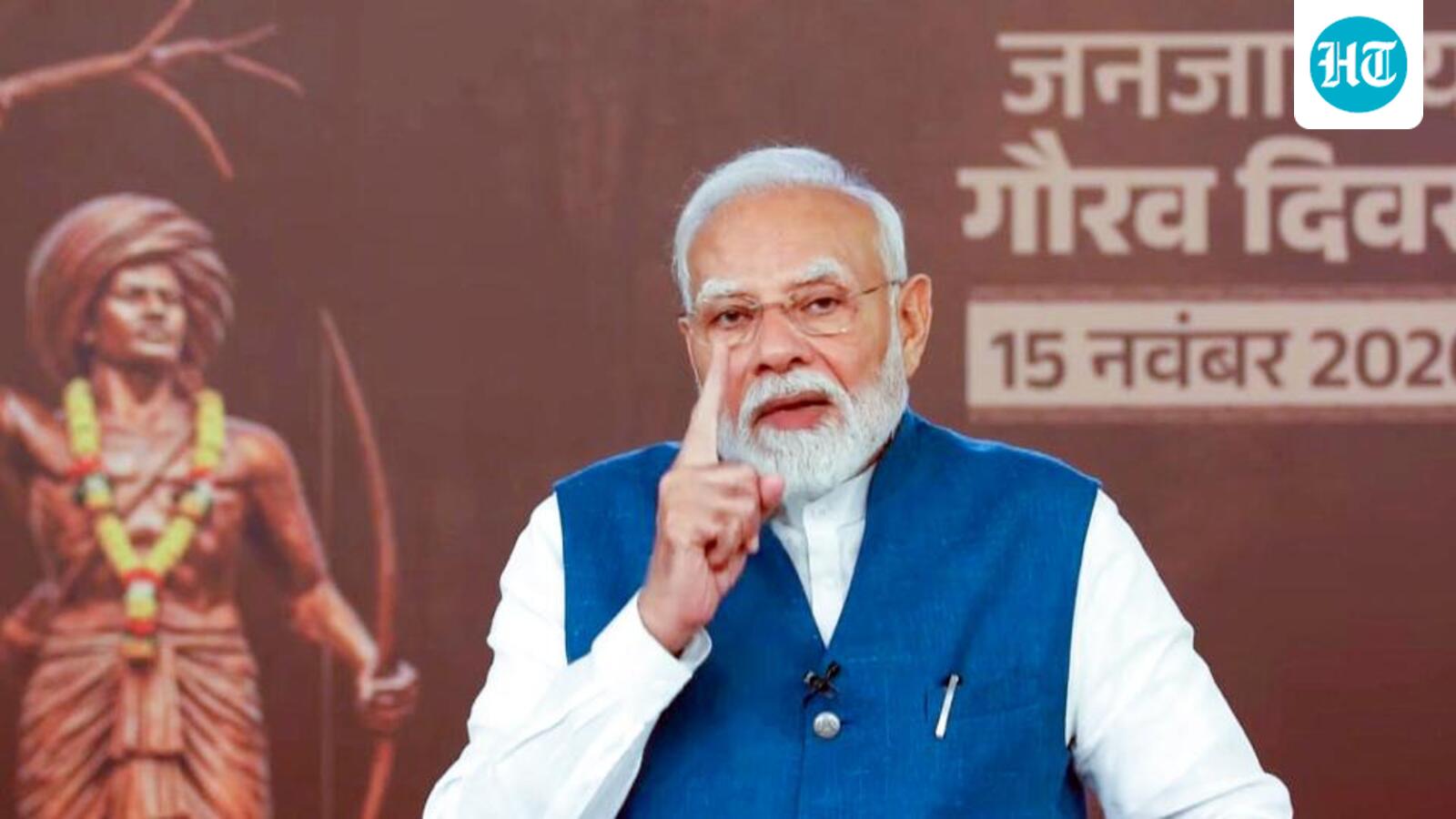
In the rugged landscape of Gadchiroli, Maharashtra, the air on November 15, 2026, carried a weight that transcended the routine of local governance. The occasion was the 151st birth anniversary of Birsa Munda, a figure whose name is synonymous with tribal resistance and pride. For the residents of this region, the day was marked by the observance of Janjatiya Gaurav Diwas, a national celebration dedicated to honoring the contributions of tribal communities to India’s history and identity. Prime Minister Narendra Modi’s presence in Gadchiroli served as more than a ceremonial gesture; it was a deliberate pivot toward a demographic that has long occupied the periphery of national development discourse.

Standing before the gathered crowd, the Prime Minister did not shy away from a pointed critique of the political status quo that preceded his administration. Modi argued that for decades, previous governments had treated tribal communities as an afterthought, leaving them to navigate systemic neglect and isolation. By framing the current efforts as a corrective measure, he sought to distinguish his administration’s approach from the historical inertia that he claims hindered tribal progress. This narrative of rectification is central to his government’s outreach, positioning the state not merely as a provider of services, but as an active partner in undoing years of institutional indifference.

#WATCH | Vizianagaram, Andhra Pradesh | Prime Minister Narendra Modi says, "... Today, on the very soil where Alluri Sitarama Raju dedicated his life to the cause of tribal welfare, a new airport is being inaugurated in Andhra Pradesh. This airport serves as a runway for the growth of Andhra and the North Andhra region. It is a launchpad for a brighter future for the youth of Andhra..." (Visuals: DD)
Central to the day’s agenda was the unveiling of a sweeping development package. The Prime Minister inaugurated and laid the foundation stones for 246 distinct projects, a collection of initiatives valued at approximately ₹3,000 crore. These projects are designed to be multi-dimensional, targeting the foundational pillars of education, public health, and infrastructure. The scale of the investment suggests an attempt to bridge the gap between remote tribal regions and the broader national economy, ensuring that essential services are not just promised, but physically integrated into the daily lives of the residents.
These interactions served as a humanizing counterpoint to the bureaucratic scale of the ₹3,000 crore announcement.
Beyond the ledger of infrastructure costs, the event provided a platform for the beneficiaries themselves. Modi engaged directly with tribal individuals from both Gujarat and Maharashtra, listening as they recounted their personal experiences with government welfare schemes. These interactions served as a humanizing counterpoint to the bureaucratic scale of the ₹3,000 crore announcement. By highlighting the PM-JANMAN Mission—a key initiative aimed at reaching the most vulnerable tribal populations—the government sought to demonstrate that its policies are yielding tangible improvements in the quality of life for those who have historically been the most difficult to reach.

India ends Maoist terror, brings security and jobs to tribals, says #PMModi Prime Minister Narendra Modi addressed the Janjatiya Gaurav Diwas programme in Gadchiroli virtually. He linked improved security with expanding education, employment and welfare in tribal regions. More details: https://t.co/df5VmzezD5
Development, in the context of this initiative, is not framed solely as the construction of roads or clinics. The Prime Minister emphasized that these projects are intended to operate in tandem with the preservation of tribal cultural heritage. There is a delicate balance being struck here: the government is attempting to modernize infrastructure while ostensibly respecting the unique traditions and identities of the communities it serves. This dual focus on material advancement and cultural continuity is a hallmark of the current administration’s messaging, aiming to provide tribal citizens with the tools of the 21st century without requiring them to sacrifice their heritage.
Gadchiroli has long been a region defined by its complex history with Naxalism and the influence of Maoist insurgency. By choosing this specific location for such a significant announcement, the government is sending a clear signal about its intent to stabilize and integrate these historically volatile areas through economic development. The strategy appears to be one of 'development as a deterrent,' replacing the vacuum of state presence with a robust network of health, education, and infrastructure projects. It is a gamble that economic empowerment will prove more effective in the long term than traditional security-focused approaches alone.

Janjatiya Gaurav Diwas: A legacy of courage, a future of opportunities Glad to be part of the Janjatiya Gaurav Diwas, on the occasion of 151st birth anniversary of great tribal leader, freedom fighter 'Dharti Aaba' Bhagwan Birsa Munda, in the presence of Hon PM Narendra Modi Ji (online) and Hon Governor Jishnu Dev Varma ji. The courage and contributions of great tribal icons like Bhagwan Birsa Munda, Tantya Mama Bhil, Raghoji Bhangare and Rani Durgavati continue to inspire us. At just 15, Bhagwan Birsa Munda stood up against the injustice of the British and moneylenders, fighting to protect tribal rights over water, forests and land, along with their culture and dignity. Gadchiroli, once affected by decades of Maoism, has now emerged as a 100% Maoism-free district. Our vision is to make it India's next Steel City, while ensuring that industrial growth goes hand in hand with the conservation of water, forests and land. Through PM-JANMAN and Dharti Aaba Janjatiya Gram Utkarsh Abhiyan, welfare schemes are reaching remote tribal hamlets. PESA, educational assistance and overseas scholarships are creating new opportunities, while tribal women are making their mark in modern industries. Under the SWAYAM scheme, eligible tribal students receive annual assistance of up to ₹60,000, along with scholarships for overseas education. It is equally encouraging to see tribal women taking up roles in modern industries and operating heavy machinery. The resolve is to build a Gadchiroli where industrial growth, tribal empowerment and conservation move forward together, creating new opportunities for generations to come. Union Minister Jual Oram, Governors and CMs of various states (online), DCM Eknath Shinde ji, DCM Sunetratai Pawar (online), Union MoS Durgadas Uikey, Minister Dr. Ashok Uike, Minister Narhari Zirwal, MoS Indranil Naik, MoS Adv. Ashish Jaiswal, MP Maya tai Ivnate, MLA Dr. Milind Narote, MLA Dharamrao Baba Atram, members of Janjatiya community and senior officials were present. @narendramodi @maha_governor @jualoram @mieknathshinde @SunetraA_Pawar @drashokuike_mla @Ashishjaisw3Adv @MayataiOfficial @MilindNarote #Maharashtra #JanjatiyaGauravDiwas #DiscoverGadchiroli
As the events of November 15 concluded, the focus shifted to the implementation of the 246 projects. The success of this initiative will likely be measured by the speed and efficiency with which these funds are translated into functional schools, hospitals, and connectivity. For the tribal communities in Gadchiroli and beyond, the Prime Minister’s visit represents a promise of sustained attention. Whether this influx of capital and political will can fundamentally alter the trajectory of tribal welfare in India remains to be seen, but the scale of the commitment marks a significant moment in the ongoing effort to reshape the relationship between the state and its tribal heartland.
