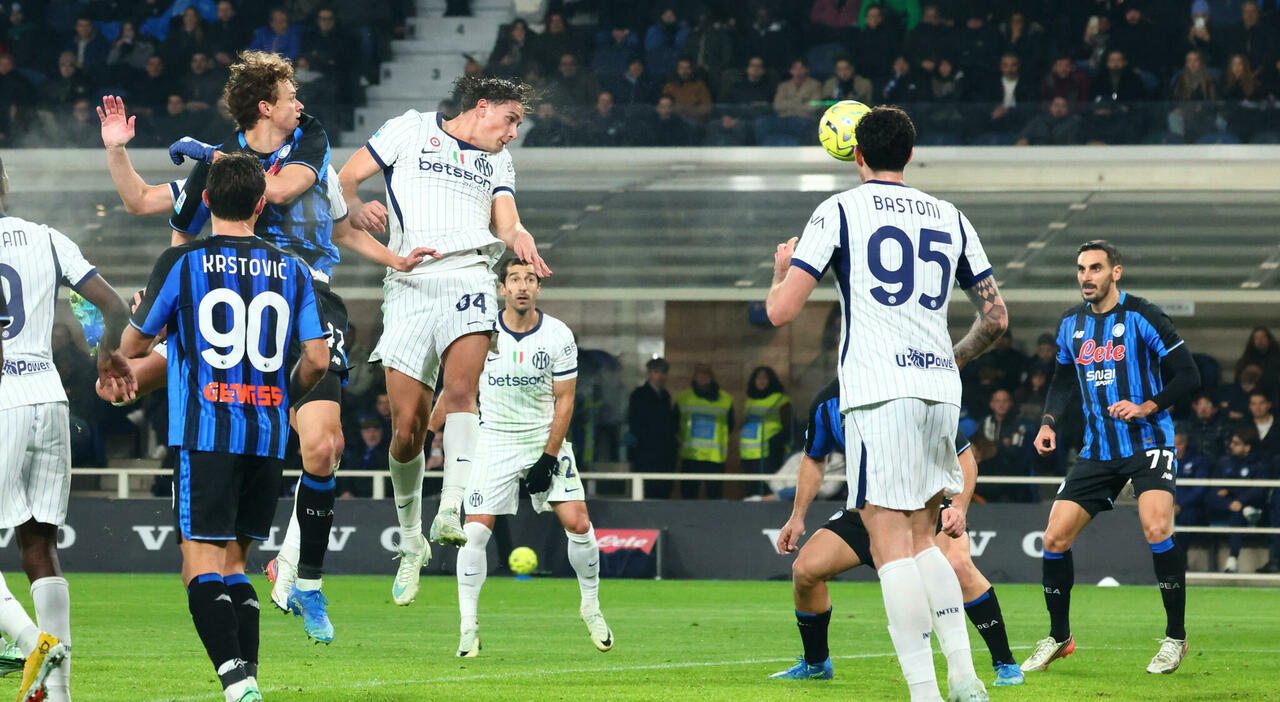
There is a specific kind of silence that falls over a football stadium when the final whistle blows after eight goals have been scored. It is not the silence of agreement, but of exhaustion. At the Balance Arena, that silence belonged to a match that defied the usual rhythms of Italian football. In the 12th week of the Serie A, Atalanta and Inter Milan collided in a contest that ended in a 4-4 draw, a scoreline that suggests two teams so determined to win that they ended up cancelling each other out.

The story of the afternoon belonged largely to Francesco Pio Esposito, a forward for Inter Milan who played with a confidence that belied the chaos of the match. Inter came out with a clear intent, and Esposito was the primary vehicle for that ambition. He struck first in the 16th minute, a goal that set the tone for a high-stakes battle. By the 32nd minute, he had struck again, giving Inter a 2-0 lead that looked, for a brief moment, like it might hold. The margin was comfortable, but the match was far from over.
Atalanta, the visitors in this high-scoring affair, refused to accept defeat. In the 35th minute, Eljif Elmas pulled one back, reducing the deficit to 2-1 and injecting urgency into the final stretch of the first half. The lead fractured just as Inter was preparing to substitute one of their key midfielders. Hakan Calhanoglu, the Turkish international, was taken off in the 33rd minute due to injury, a change that would test Inter’s resilience in the second half. As the teams headed to the locker rooms, the atmosphere was electric, with both sides aware that the second half would be decided by who could strike next.
Before Inter could fully regroup, Petar Sucic scored a penalty for Inter in the 76th minute, pushing the score to 4-2.
When the second half began, Esposito did not just maintain his influence; he expanded it. In the 52nd minute, he completed his hat-trick, extending Inter’s lead to 3-1. This was the moment of maximum disparity for Inter. Three goals from a single player, a lead that felt insurmountable to the home crowd. However, football is a sport of momentum, and the 3-1 scoreline was merely a pause before the final act. Inter had control, but Atalanta had the resolve to overturn it.
The turnaround began in the 72nd minute, when Charles De Ketelaere scored for Atalanta, closing the gap to 3-2. The energy in the Balance Arena shifted palpably. De Ketelaere’s goal was not just a point on the board; it was a statement that the match was still up for grabs. Before Inter could fully regroup, Petar Sucic scored a penalty for Inter in the 76th minute, pushing the score to 4-2. It felt like a decisive blow, a final assertion of dominance by the visitors.
But De Ketelaere was not finished. In the 80th minute, he scored his second goal of the match, dragging Atalanta back within a single goal at 4-3. The psychological weight of the match swung back to the home side. With the clock ticking down, the tension was suffocating. Inter had built a lead, but Atalanta had chipped away at it goal by goal, refusing to let the 4-2 result stand.
The drama reached its peak in the 90+1st minute, a moment that exists only to punish teams that let their guard down in the final seconds. Franck Kessie stepped up to the penalty spot and converted the kick, securing a point for Atalanta and making the final score 4-4. It was a goal that erased the 4-2 lead Inter had built so recently. The 4-4 finish was a testament to the open nature of the match, a game where neither team could find a way to lock the door on the other.

Despite the dramatic parity on the scoreboard, the context of the league table remains stark. Following this result, Inter reached 29 points, a total that reflects a strong start to the season. Atalanta, on the other hand, stands with 15 points. The 14-point gap between the two teams highlights that while this match was a tactical stalemate on the day, Inter’s broader campaign is significantly more robust. For Atalanta, the draw is a lifeline; for Inter, it is a costly point drop against a team they had dominated in the second half.
The match ended in a draw, but the implications are uneven. Esposito’s hat-trick remains a statistical anomaly in recent memory for Inter, while De Ketelaere’s brace was the catalyst for Atalanta’s survival. The 4-4 scoreline suggests a lack of defensive structure from both sides, yet it also points to an attacking freedom that is rare in Serie A. As the teams leave the Balance Arena, Inter carries the weight of their points total, knowing they failed to convert a 4-2 lead into a win. Atalanta, conversely, takes comfort in the fact that they kept the ball in their own net fewer times than they scored, earning a vital point in a season where every match carries weight. The eight goals will be remembered not just for the score, but for the intensity with which they were traded.