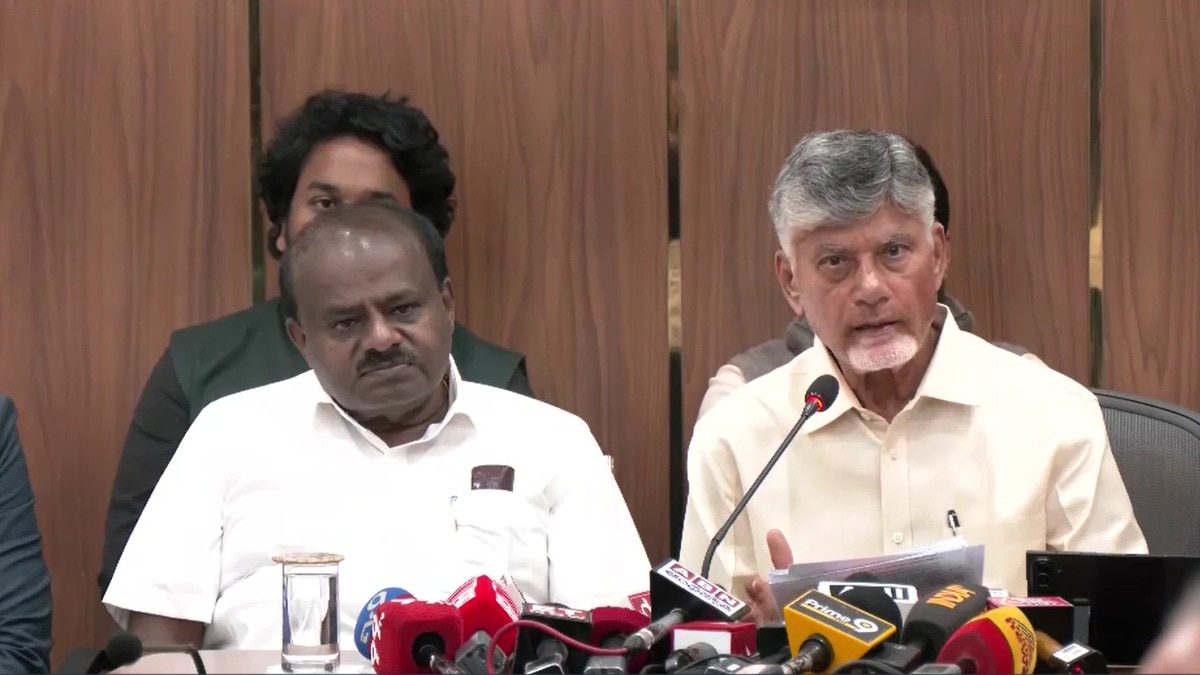
In the political corridors of Delhi, a significant shift was underway as the Union Cabinet approved changes to the Delimitation Bill, a move that would soon be presented before Parliament. Among the key supporters was N. Chandrababu Naidu, the Chief Minister of Andhra Pradesh, who traveled to the capital to express his backing for what he called a "historic initiative of the Prime Minister." Naidu's endorsement came shortly after the NCP (Sharad Pawar) faction had also signaled support, marking a notable moment in India's ongoing political evolution.

Delimitation—the process of defining boundaries of electoral constituencies—has long been a sensitive issue in Indian politics, particularly as it relates to balancing representation between different regions. The current proposal seeks to increase the number of Lok Sabha seats by an unprecedented 50%, a move that would fundamentally reshape the country's electoral landscape. Naidu positioned this not as a mere administrative adjustment but as a necessary step toward more inclusive governance.
Central to Naidu's support was the prospect of implementing women's reservation in Parliament, a policy that has been pending for three decades. "This is cooperation for all, development for all," Naidu stated, framing the bill as a transformative opportunity. The proposal includes a 33% reservation for women in the expanded Lok Sabha, a provision that has faced resistance in the past. Naidu argued that the simultaneous increase in seats would make this reservation more palatable to all parties.
The calculation appears to be based on the 1971 census, which has historically been used for such demarcations.
What made Naidu's endorsement particularly noteworthy was his explicit acknowledgment of demographic disparities between India's regions. He highlighted that Southern India has implemented family planning initiatives earlier than other parts of the country, resulting in a birth rate of 1.6%—significantly below the replacement level of 2.1%. This demographic reality, he suggested, threatened to reduce the South's political representation if constituency boundaries were redrawn based solely on population growth.
Naidu proposed a solution that addressed both women's empowerment and regional representation concerns: "If we increase by 50% nobody will have any grouse or objection to 33% women's reservations." This approach, he argued, would create a "win-win situation" where southern states wouldn't lose their current share of seats while still making room for increased women's representation. The calculation appears to be based on the 1971 census, which has historically been used for such demarcations.
In a pointed message to the INDIA bloc, Naidu issued a direct challenge: "Anybody who wants to support Nari Shakti, anybody who wants to recognise or respect women, they have to support (the Bill)." This framing positioned the delimitation bill not just as a technical adjustment but as a test of political commitment to women's empowerment. The Congress and other opposition parties have been critical of the proposal, though their specific objections remain unclear from the current discourse.
Naidu's support comes at a crucial moment as the government prepares to table the bill in Parliament. His backing from a southern state adds significant political weight to the proposal, potentially easing concerns about regional representation. The Chief Minister's calculations suggest that by dramatically increasing the total number of seats, the government can accommodate both demographic realities and the long-standing demand for women's reservation without appearing to diminish any region's political clout.
As of late November 2026, the delimitation bill has cleared the first major hurdle with Cabinet approval, setting the stage for parliamentary debate. Naidu's endorsement has added a new dimension to the conversation, explicitly linking the seat increase to women's reservation and southern demographic concerns. The coming weeks will reveal whether this framing can build broader consensus or if opposition parties will mount significant resistance to what could be one of the most substantial changes to India's electoral system in decades.