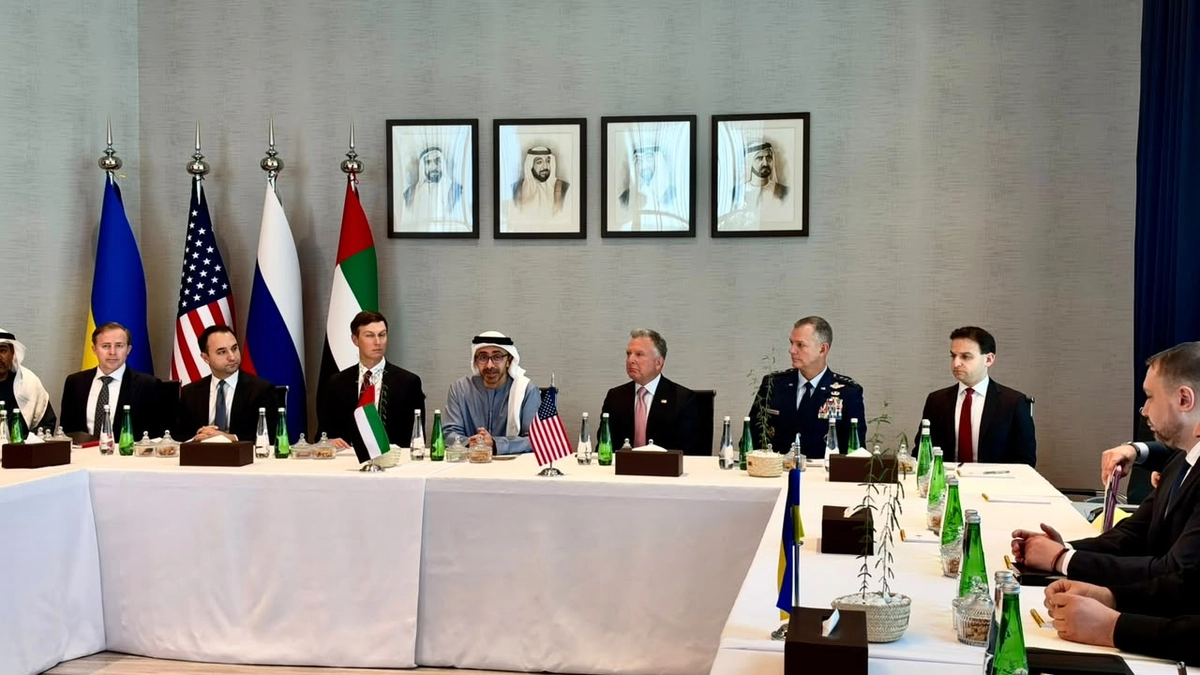
On November 10, 2026, delegations from Russia, the United States, and Ukraine gathered in Abu Dhabi for the first day of trilateral negotiations, which concluded after approximately four hours. Both sides agreed the talks would continue the following day, Thursday.

Leading the Russian side was Vladimir Medinsky, an aide to President Vladimir Putin. In the room, Medinsky expressed gratitude to the United States for its efforts toward establishing peace in Ukraine. He voiced hope that the Abu Dhabi negotiations would facilitate progress toward peace in the interests of both the Russian and Ukrainian people. As he stated, "I hope that the Abu Dhabi negotiations will make progress toward peace in the direction of the interests of the people of Russia and Ukraine."
Jared Kushner, representing the United States, noted that differences of opinion between the Russian and Ukrainian delegations have been identified. He expressed the hope that the discussions in Abu Dhabi would be constructive and that a free dialogue could be held. Kushner further stated, "I hope that these negotiations will lead to the formation of a new security architecture among Russia, Europe, and Ukraine." This reference signals the United States views a lasting peace as a regional reordering involving Russia, Europe, and Ukraine.
A key development was the position the United States brought to the table.
A key development was the position the United States brought to the table. TASS reports that Washington entered the Abu Dhabi negotiations with a clear stance: supporting the restoration of dialogue between Russia and NATO. By bringing this position forward, the US delegation signaled that the trilateral talks were intended to bridge the gap between Moscow and the Western security apparatus.
The Russian delegation included, beyond Medinsky, Sergey Ryabkov, Mikhail Galuzin, Alexey Komkov, and Igor Kostyukov. Their presence indicates a desire to address the tangible concerns of the conflict alongside the diplomatic ones.
As the first day concluded after roughly four hours, the immediate result was not an agreement but a continuation. The delegations agreed to reconvene the next day, Thursday. This extension means the initial impasse has been avoided. The framework for a new security architecture is now on the table, and the restoration of the Russia-NATO dialogue is the American lever being pulled. For now, the room in Abu Dhabi remains in session, waiting to see if the next hours will yield more concrete movement toward peace.