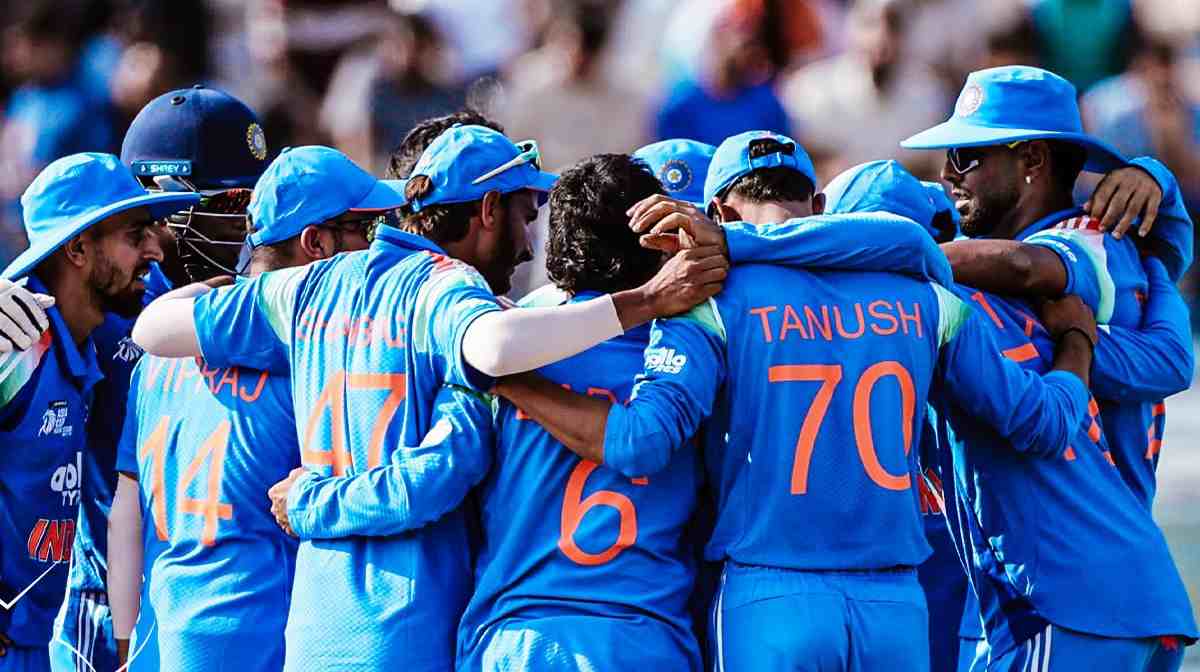
The West End Park International Cricket Stadium in Doha, Qatar, was the scene of a hard-fought contest on February 22, 2026, as India A clashed with Pakistan A in the ACC Men's Asia Cup Rising Stars. In the end, it was Pakistan A who emerged victorious, defeating India A by a margin of 48 runs in a match that saw both teams display significant talent. Pakistan A, batting first, posted a formidable total of 313 runs for the loss of 8 wickets in their allotted 49.2 overs. India A, in their chase, were eventually bowled out for 265 runs in 49.1 overs, falling short of the target.

For India A's captain, Tilak Varma, the sting of defeat was palpable. Varma, who had the distinction of scoring his second consecutive century in the tournament (though his contribution in this specific match was 67 runs, following a 107 in the previous outing), identified a critical juncture in the game. He believes the dismissal of his teammate, Shahbaz Ahmed, proved to be the undoing of India A's chase. "If Shahbaz had been at the crease for two more overs, I would have won the match," Varma stated, his disappointment evident. "Unfortunately, it did not happen."
Shahbaz Ahmed had been playing a crucial role in trying to guide India A towards the challenging target. He contributed an aggressive 56 runs off just 49 balls, peppering his innings with four sixes. This partnership with Varma, however, did not last long enough to see India A over the line. Cricket analysts, while acknowledging Varma's leadership, also pointed to certain aspects of his own innings that may have contributed to the increasing pressure. His start was described as slow, with only 8 runs scored off 36 balls, and a high number of deliveries that resulted in no runs (dot balls). This approach, while sometimes a tactic to preserve wickets, can also lead to a rapidly escalating required run rate, a challenge Varma himself acknowledged.
He articulated a philosophy where individual achievements are secondary to collective success.
Varma, however, remained focused on the team's objective. He articulated a philosophy where individual achievements are secondary to collective success. "For me, winning for the team is the best performance," he said. "If the team does not win, that innings is not my best." As captain, he felt the responsibility to carry the game to its conclusion. Yet, he also expressed a sense of needing a different kind of support in the crucial final stages of the innings. He lamented the lack of a partner who could accelerate the scoring rate alongside him, a dynamic that he felt was missing in the critical moments of the chase.
The match itself was a microcosm of the challenges faced in a high-stakes cricket encounter. Pakistan A's total of 313 set a demanding target, requiring a sustained and aggressive batting effort from India A. While Varma's consistent scoring is a testament to his form, the dynamics of a chase often depend on the interplay between batsmen and the ability to adapt to the game's flow. The 48-run margin of victory underscores the effectiveness of Pakistan A's performance and the narrow margins that can separate triumph and defeat in such tournaments.
The ACC Men's Asia Cup Rising Stars is a platform for emerging talent, and both India A and Pakistan A showcased promising players. For Tilak Varma and his team, the loss will undoubtedly serve as a learning experience. The captain's candid reflections highlight the fine margins in international cricket and the constant quest for that elusive winning formula, where individual brilliance must align perfectly with team strategy and execution.