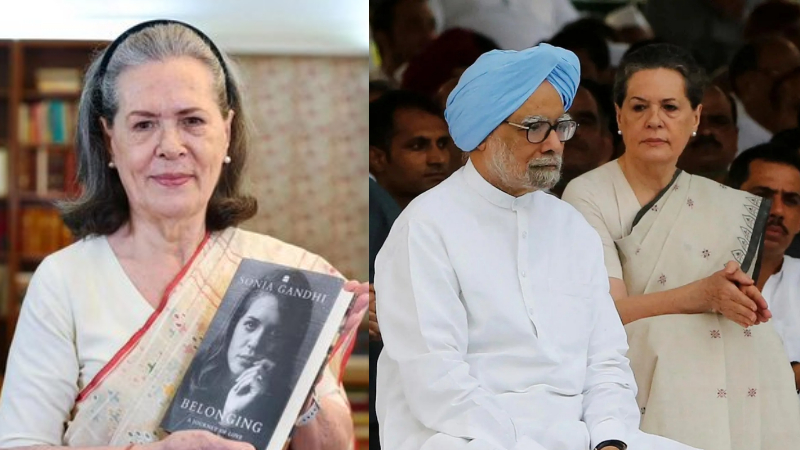
In the quiet moments before the 2004 Lok Sabha elections, a pivotal conversation unfolded in the Gandhi household. Sonia Gandhi, the leader of the Indian National Congress, faced an unprecedented question from her children: would she accept the Prime Minister's position if her party won? The answer came swiftly and decisively. "Absolutely not!" she recalled saying, almost indignantly. When pressed for certainty, she affirmed: "I'm very clear." This exchange, detailed in her recently published memoir "Belonging: A Journey of Love," reveals the foundation of one of modern India's most consequential political decisions.
Sonia Gandhi's refusal was a response to the family's traumatic history. Her children, Rahul and Priyanka, had lived through the assassinations of their grandmother, former Prime Minister Indira Gandhi, and their father, former Prime Minister Rajiv Gandhi. For them, the Prime Minister's office represented not power but peril. "They'd lived through the trauma of their grandmother's assassination and the brutal murder of their father," Sonia wrote. "In their minds, holding that office was intrinsically linked with heightened danger." This perspective, shaped by personal loss, would ultimately outweigh political calculations.

BJP leader Dinesh Pratap Singh has claimed that Sonia Gandhi wanted to become Prime Minister in 2004 but was stopped by then President APJ Abdul Kalam, who considered her ineligible for the post because of her Italian roots. More details: https://t.co/NiQfmlbM8i #SoniaGandhi #Politics #DineshPratapSingh #Memoir
When the Congress-led United Progressive Alliance (UPA) won the 2004 general elections, the political landscape shifted. Coalition partners and party leaders turned to Sonia Gandhi, expecting her to claim the Prime Minister's office. The pressure mounted as allies argued that her position as the Congress president made her the natural choice to lead the government. Yet beneath this political expectation lay a private resolve that had been established months earlier.
Rahul felt the position was dangerous, and Priyanka was distressed at the prospect of her mother accepting the role.
As the nation awaited her decision, Sonia Gandhi's children renewed their opposition. Rahul felt the position was dangerous, and Priyanka was distressed at the prospect of her mother accepting the role. Their reactions were a reflection of the family's painful legacy of political violence. "Neither Rahul nor Priyanka felt that I should become prime minister," Sonia recounted, emphasizing their shared understanding of the risks involved.
Faced with this familial resistance and political pressure, Sonia Gandhi sought clarity in a deeply personal space. She found herself standing before a portrait of Rajiv Gandhi, her assassinated husband and former Prime Minister. In that moment of reflection, she heard an inner voice that had guided her throughout her political journey. "Sonia, be true to yourself. You've always known it. Just leave it!" the voice seemed to say. This internal guidance, combined with her children's pleas, solidified her decision.
Despite initial indications that she might relent to political pressure, Sonia Gandhi ultimately chose to honor her original stance. By declining the Prime Minister's post, she paved the way for Manmohan Singh to become Prime Minister, a move that aligned with her internal decision to reject the role.

🚨 LIKE & REPOST — MUST! QUESTION SONIA GANDHI'S POLITICS, BUT DON'T ERASE THE RECORD. On 18 May 2004, Sonia Gandhi declined the Prime Minister's post, saying her goal was to protect India's secular foundations. In her 2014 Nehru Memorial Lecture, she said: “There can be no Indianness, no India without secularism.” Disagree with her if you want. But the public record speaks for itself. Facts don't disappear just because they don't fit your narrative.
Two decades later, as Sonia Gandhi details this decision in her memoir released in November 2026, the book also touches upon her formal relationship with Prime Minister Narendra Modi. Her choice to decline the post remains a significant detail of her political life, as she reflects on the internal turmoil and the influence of her children's concerns during that period.
