
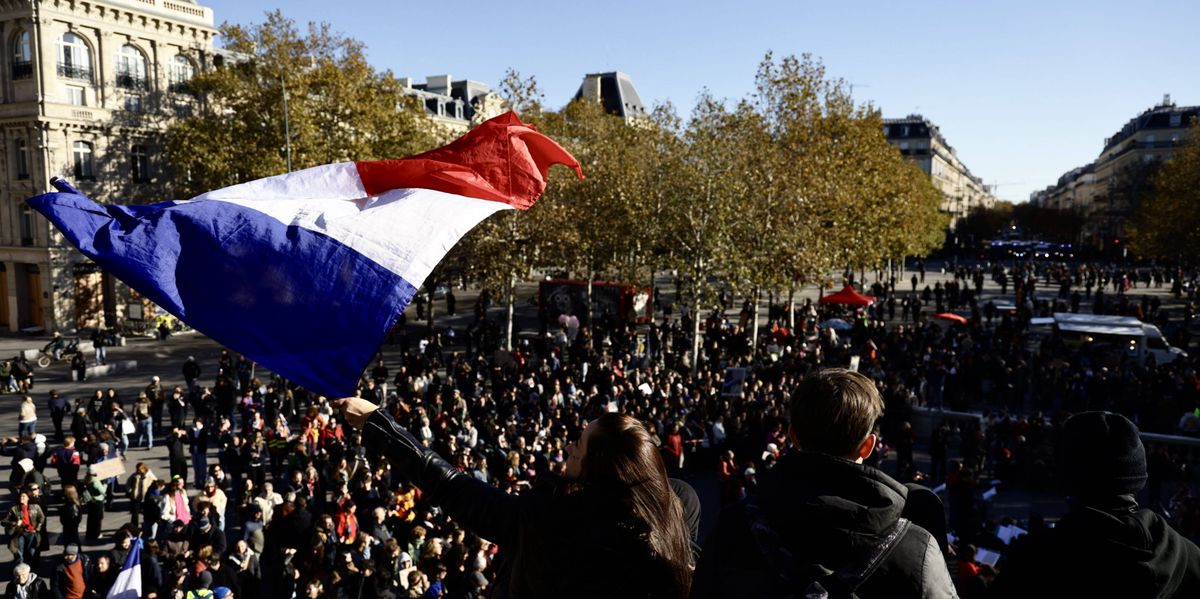
On a Saturday in November, the streets of France became a theater of shifting momentum. This was the fifth act of a social movement sparked by high school students, a movement that has increasingly become a convergence point for various social struggles across the country. But as the crowds gathered, the energy felt different than the weeks prior. There was a sense of a movement reaching a plateau, a deceleration in the rhythmic pulse of the demonstrations that had defined the recent political landscape.

In the wake of the marches, a familiar and predictable friction emerged: the battle over the numbers. In France, the size of a protest is often as much a matter of political interpretation as it is of physical presence. The Ministry of the Interior, tasked with the official accounting of the day, estimated that approximately 106,000 people participated in the demonstrations nationwide. In the capital, they placed the Parisian turnout at 24,000.
However, the organizers—the youth intersyndicate—offered a much larger vision of the day's impact. They reported 200,000 participants across the country, claiming that 100,000 of those were marching through the streets of Paris alone. This discrepancy is not new, but it underscores the tension between the state's metrics and the movement's self-perception. Compared to the previous week, both sides acknowledged a decline. The Ministry had counted 146,000 people the week before, while the organizers had seen 250,000. Whether viewed through the lens of the state or the movement, the fifth act was undeniably smaller than its predecessor.
As the main procession reached its destination, the veneer of order was punctured by localized bursts of friction.
In Paris, the atmosphere was one of diversity and complexity. The protesters did not march as a monolith; instead, the crowds expressed a wide array of heterogeneous demands, reflecting the various social struggles that have converged under this student-led banner. While the main procession moved toward the Place de la Nation, the sheer variety of voices made the movement difficult to pin down to a single objective.
Despite the scale of the mobilization, the day was characterized by a relative lack of the chaos that had marked previous dates, such as October 17. The Paris police prefecture noted that the day proceeded without major incidents for much of the afternoon. Parisian marshals worked to disperse the crowds calmly, maintaining a sense of order even as the crowds thinned compared to the massive gatherings of the weeks prior.
Yet, even in a day marked by a general calm, the potential for volatility remained. As the main procession reached its destination, the veneer of order was punctured by localized bursts of friction. On Rue de Chaligny, a small group of hostile individuals took advantage of the movement's dispersal to target law enforcement. These individuals threw projectiles at police officers, a provocation that forced the authorities to deploy tear gas to regain control.
The Paris prosecutor's office reported that 22 arrests were made within the capital. These arrests primarily involved individuals charged with carrying Category D weapons, committing various offenses, or violating specific bans on appearing or manifesting in certain areas. Among those detained in the capital were three minors, a reminder of the student-driven origins of the movement.
While Paris saw localized skirmishes, the tension manifested more sharply in other parts of the country. In Lyon, the day took a more aggressive turn for the media present. A crew from BFMTV was subjected to a violent assault, an incident so severe that it required police protection to ensure their safety.
Across the entire territory, the scale of legal intervention was significant. By 5:00 PM, authorities had reported a total of 121 arrests nationwide. These numbers, while smaller than the total number of participants, reflect the persistent friction between the demonstrators and the state apparatus that manages them.
As the sun set on the fifth act, the movement found itself at a crossroads. The decline in numbers—from the hundreds of thousands seen in previous weeks to the six-figure estimates provided this Saturday—suggests a movement that is testing its own endurance. The initial surge of student energy is meeting the reality of sustained mobilization, where the novelty of the protest begins to face the fatigue of the long haul.
For now, the streets are quiet, but the data remains contested and the grievances remain unaddressed. The gap between the 106,000 people seen by the Ministry and the 200,000 claimed by the youth intersyndicate serves as a metaphor for the movement itself: a struggle that is being measured, contested, and interpreted differently by every side involved.