
In the heart of Prague, up to 450,000 Czech citizens gathered at Letnany Field in what organizers claim is the largest demonstration in the country's modern history. The crowd, stretching as far as the eye could see, filled the historic plain where massive gatherings have shaped Czech destiny before. Mikuláš Minařík, head of the 'Million Moments for Democracy' association, addressed the sea of protesters, declaring: "This is the biggest action on the Letna plain in the last 37 years, still since 1989." The sheer scale of the assembly dwarfed previous protests, which had drawn only 10,000-15,000 participants, signaling an extraordinary escalation in public opposition to government plans.
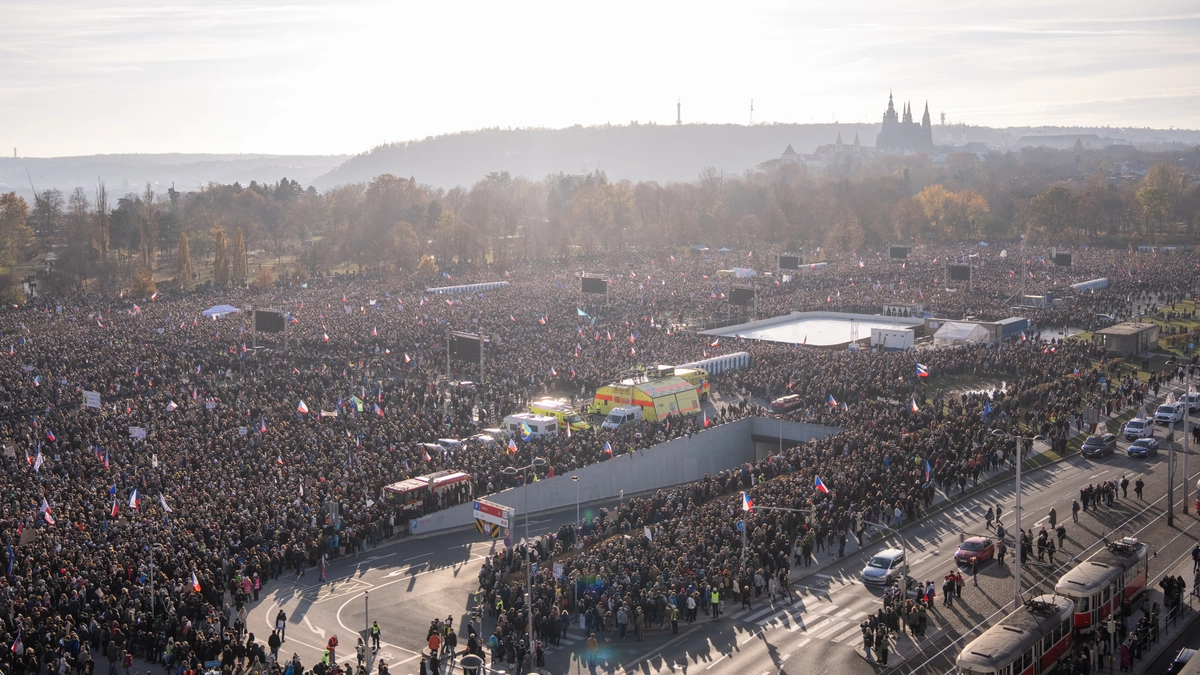
At the center of this unprecedented mobilization lies a legislative proposal that has divided the nation. The Czech parliament, in a first reading, approved a bill to fundamentally reshape how public media are funded. Currently, all Czech residents and companies pay a monthly contribution of 150 CZK to support Czech Television and Czech Radio. The government now seeks to abolish this subscription model, replacing it with direct state financing while simultaneously cutting the media organizations' budgets by 15 percent.
Media leadership has sounded alarms about the consequences of these changes. They warn that the reduced funding will inevitably lead to canceled popular programs and significant staff reductions, potentially crippling the quality and independence of public broadcasting. The proposal has ignited fierce debate about the future of journalism and media freedom in the Czech Republic, with protesters fearing that state control could compromise journalistic independence.
Demonstrators have also criticized the government's plans to halve payments to Ukrainians holding temporary protection status in the country.
The protest has exposed deep political divisions in the country. Prime Minister Andrej Babis has attempted to downplay concerns, stating: "The funding system is changing, no one wants to control public media... there is no war for independent media, nationalization of media is not being prepared." He has acknowledged the right to protest while urging political opponents to stop "inflaming the situation." The government maintains that the current funding model is outdated and points to similar trends in other European countries.
However, opposition figures remain unconvinced. Mikuláš Minařík delivered a sharp rebuke to the government's approach, declaring: "The Czech people have risen up against the adoption of key laws secretly, hastily and without discussion." He specifically demanded the withdrawal of the hastily prepared media bill and the resignation of Chamber of Deputies Speaker Tomio Okamura, a prominent supporter of the measures whose inflammatory rhetoric has further inflamed tensions.
The protest movement encompasses concerns beyond media funding. Demonstrators have also criticized the government's plans to halve payments to Ukrainians holding temporary protection status in the country. Okamura, in particular, has drawn fire for his anti-Ukrainian statements, including referring to Zelensky's government as a "junta" and Ukrainians as "thieves" in a New Year's address. These remarks have only strengthened protesters' resolve to oppose what they see as a government moving in an increasingly authoritarian direction.
The scale of the demonstration evokes memories of the 1989 Velvet Revolution, when massive protests helped bring an end to communist rule. The fact that such a large crowd has gathered again on the same historic plain carries powerful symbolic weight for many Czechs who remember that earlier struggle for democracy and freedom. As Mikuláš Minařík noted, this represents the largest gathering on the Letna plain in 37 years, underscoring the significance of this moment in Czech history.

As the parliament enters the second reading of the controversial bill, the government faces the extraordinary challenge of responding to one of the largest demonstrations in the country's recent history. The protest movement has demonstrated that a significant portion of the Czech population views media independence as a fundamental democratic value worth defending. While Prime Minister Babis has indicated openness to discussing funding methods with the opposition and public, the path forward remains uncertain. What is clear is that the Czech people have sent an unmistakable message: their public media, and the democratic principles they represent, are not for sale.