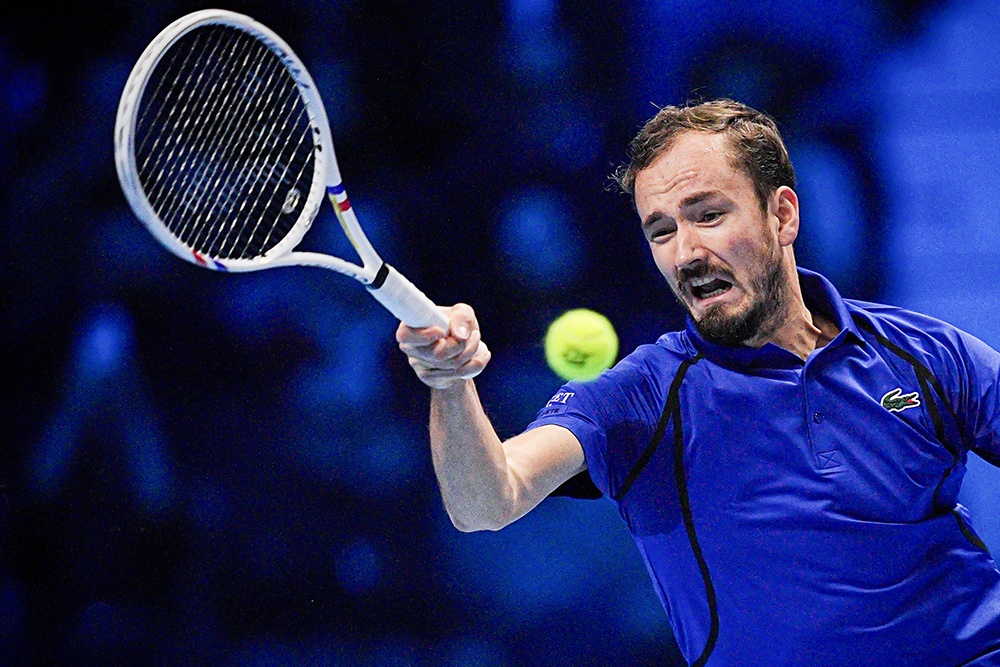
In the high-stakes theater of the ATP Finals, momentum is a currency more valuable than any ranking point. For Carlos Alcaraz, that currency was spent with surgical precision on November 18, 2026. Entering his second match of the tournament, the world number three did not merely compete; he dictated terms. Facing the formidable Daniil Medvedev, Alcaraz delivered a performance defined by its efficiency, dismantling his opponent in a contest that lasted just 1 hour and 9 minutes.

To understand the weight of this victory, one must look at the scoreboard. The sets fell in quick succession, 6-2 and 6-3, a scoreline that reflects a gap in rhythm and control. In a tournament where the margin for error is razor-thin, Alcaraz operated with a level of composure that suggested he was playing in a practice session rather than one of the most prestigious stages in professional tennis.
Medvedev, a player known for his defensive tenacity and ability to frustrate even the most aggressive hitters, found himself unable to find an answer to the Spaniard's onslaught. This match represented a significant pivot in the group stage. While Alcaraz moved forward with the wind at his back, Medvedev suffered his first defeat of the group stage, a setback that immediately complicates his path through the tournament.
He is scheduled to play American Frances Tiafoe in the final round of the group stage.
For Medvedev, the loss is more than just a notch in the column; it is a disruption of the rhythm required to navigate the elite field of the ATP Finals. The inability to extend the match beyond two sets suggests a struggle to break through Alcaraz's tactical setup, leaving the Russian to recalibrate under the pressure of impending elimination.
For Alcaraz, the math is as elegant as his play. This victory marks his second consecutive win at the tournament, a feat that carries immense mathematical and psychological weight. By securing this second win, Alcaraz has officially guaranteed himself a spot in the semifinals. He has bypassed the agonizing uncertainty of the final group stage matches, allowing him to approach the playoff stage with a sense of established authority.
This early qualification is a luxury in a tournament designed to test endurance and mental fortitude. It allows the world number three to manage his physical output and prepare specifically for the knockout rounds, while his competitors are still fighting for survival.
As the dust settles on the Alcaraz-Medvedev encounter, the group stage enters its final, decisive phase. The tournament structure is unforgiving: only the top two players from each group will advance to the playoff stage. This rule ensures that every match carries the weight of a potential season-defining moment.
Medvedev's path to redemption is now narrow. He is scheduled to play American Frances Tiafoe in the final round of the group stage. For Medvedev, this is no longer a matter of positioning, but of survival. He must navigate the challenge posed by Tiafoe to keep his championship aspirations alive.
While Medvedev prepares for a battle of necessity, Alcaraz prepares for a battle of choice. Having already secured his advancement, the Spaniard will face Italian Flavio Cobolli in his final group match. For Alcaraz, the upcoming match against Cobolli serves a different purpose—it is an opportunity to refine his game and maintain his winning streak without the immediate threat of exit hanging over his head.
This divergence in stakes creates a fascinating tension in the closing days of the group stage. One player is fighting to stay in the light, while the other is already looking toward the podium.
As the ATP Finals progress, the hierarchy of the tournament is beginning to crystallize. Alcaraz’s clinical dismantling of Medvedev has sent a clear message to the rest of the field: the world number three is not just participating; he is contending. The semifinals await, and with the group stage drawing to a close, the stage is set for a collision of the world's most elite talent.