
On September 20, 2025, the voters of Mecklenburg-Vorpommern sent a clear and jarring signal to the German political establishment. The results of the Landtag elections did more than just shift seats; they fundamentally reordered the hierarchy of power in the northern state. At the top of the tally stood the Alternative for Germany (AfD), a right-wing party that captured 38.2% of the vote. This victory signaled a significant shift in the regional political climate, leaving the traditional center-right and center-left forces to grapple with a new reality.

For the Social Democratic Party of Germany (SPD), the results were a sobering reminder of the volatility of the electorate. The SPD, long a pillar of German governance, secured 35.5% of the vote, trailing the AfD. The gap between the two was narrow, but the symbolic weight of the AfD's lead was heavy. In a landscape where the political center often holds, the emergence of a dominant right-wing force necessitated a radical rethinking of how a government might actually function.
While the AfD climbed, the traditional pillars of German politics faced a moment of existential crisis. The Christian Democratic Union (CDU), led by Chancellor Friedrich Merz, experienced a historic collapse in the state. For the first time, the party failed to cross the critical 5% threshold required to enter the state parliament, receiving only 4.9% of the vote. This failure to meet the minimum requirement meant that one of Germany's most established political forces was effectively sidelined from the legislative process in Mecklenburg-Vorpommern.
This was not a decision made solely by party leadership in a closed room, but a collective mandate from the party's base.
This vacuum created a complex mathematical and ideological puzzle. With the CDU out of the picture and the AfD holding a plurality but facing intense political isolation, the remaining parties had to find a way to govern. The math pointed toward a coalition that would be as unusual as it was necessary for stability.
The path forward emerged through a partnership that has no precedent in the history of the federal state. The SPD, the Left Party, and the Greens have moved to form a coalition government, an alliance that marks the first time these three specific parties have joined forces to rule Mecklenburg-Vorpommern. This arrangement brings together a spectrum of political thought, from the social democracy of the SPD to the environmentalism of the Greens and the more radical economic stances of the Left Party.
To reach this point, the parties had to move through a rigorous process of negotiation and internal consensus. The Left Party secured 6.5% of the vote, while the Greens captured 5.7%. While their individual shares were smaller than those of the SPD and the AfD, their combined strength provided the necessary foundation to build a majority that could exclude the far-right.
The movement toward this historic alliance required more than just mathematical alignment; it required the explicit blessing of the party rank-and-file. During an extraordinary regional congress held in Güstrow, members of the SPD voted unanimously to support the text of the coalition agreement. This was not a decision made solely by party leadership in a closed room, but a collective mandate from the party's base.
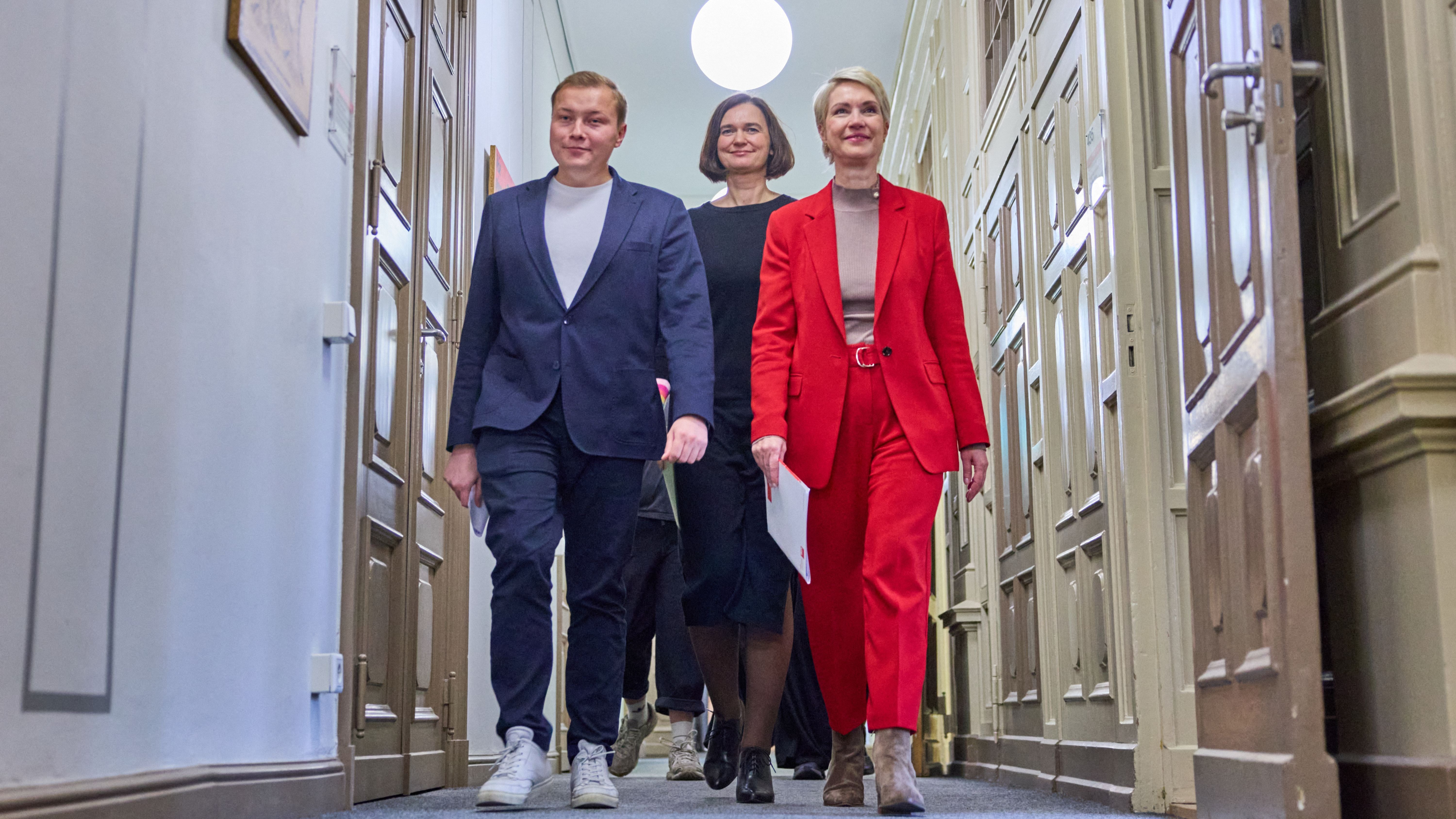
This spirit of unity was mirrored across the coalition. Similar votes were held by both the Left and the Greens, ensuring that when the government finally takes shape, it does so with the internal legitimacy required to navigate the challenges ahead. The unanimity in Güstrow served as a signal that the parties were prepared to prioritize the formation of a stable government over internal ideological disputes.
Central to this new government is a definitive stance on who will be allowed to participate in the halls of power. Despite the AfD's significant electoral success, the new coalition has made it clear that the right-wing party will remain on the outside. This policy of exclusion is a deliberate choice intended to define the character of the new administration.
State Prime Minister Manuela Schwesig of the SPD has been vocal about this boundary. She has emphasized that the new coalition excludes any cooperation with the right-wing party 'Alternative for Germany' (AfD). By drawing this line, the SPD, the Greens, and the Left are attempting to build a governing bloc that operates entirely outside the influence of the party that won the most votes.
The period of negotiation and internal voting is now drawing to a close, moving toward the formalization of power. The political actors involved are preparing for the final, symbolic step of their journey. On the evening of November 14, an official signing ceremony is scheduled to take place in Greifswald.
This ceremony will transform the coalition agreement from a negotiated document into a binding roadmap for the state's future. As the leaders gather in Greifswald, they will move from the uncertainty of the election results into the structured responsibility of governance. The eyes of the state will be on this moment, watching to see if this unprecedented three-party alliance can successfully manage the tensions of a fractured electorate and the weight of a new political era.