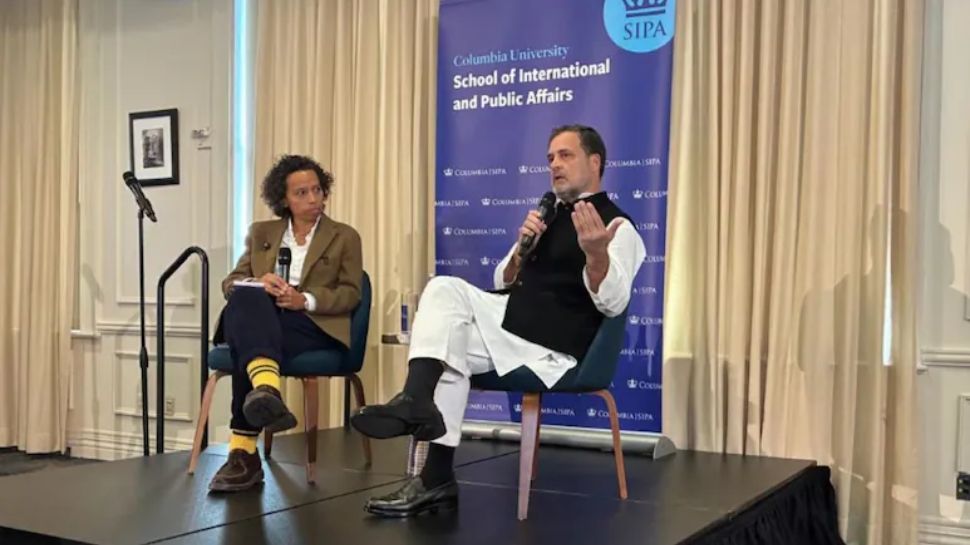
On November 18, 2026, the global perception of India’s economic trajectory became the focal point of a high-profile discussion at Columbia University in New York. Rahul Gandhi, the Leader of the Opposition in the Lok Sabha, took the stage for a 'fireside chat' that quickly moved beyond academic discourse into a pointed critique of his home country’s current administration. For an audience watching from afar, Gandhi painted a picture of a nation at a crossroads, arguing that the economic engine that once propelled India forward has stalled. His assessment was stark: he claimed that India’s economy effectively stopped growing a decade ago, setting the stage for what he described as an impending economic disaster.

At the heart of Gandhi’s argument was a rejection of the flagship economic programs championed by the current government. He specifically targeted 'Make in India' and 'Start-up India'—initiatives designed to transform the country into a global manufacturing hub and an entrepreneurial powerhouse—labeling them as fundamental failures. According to Gandhi, these policies have not translated into the broad-based prosperity they promised. Instead, he pointed to a widening chasm between the struggles of small-scale businesses and the rapid, concentrated growth of massive conglomerates, specifically citing the business empires of Gautam Adani and Mukesh Ambani. To Gandhi, this concentration of wealth is not a sign of a thriving market, but a symptom of a system that favors a select few while leaving the broader population to grapple with systemic unemployment and educational shortcomings.

The frustration in the eyes of a young startup owner from J&K reflects the struggles of most entrepreneurs and small-business owners in India. ‘Modi ji’s monopoly model’ has taken away jobs, devastated MSMEs and deprived people of opportunity. The systematic attack on small and medium industries through incompetent policies like a bad GST and demonetisation has turned India from a producing economy to a consuming one. At this rate we can neither compete with China nor ensure prosperity for all Indians. India deserves better. We must simplify GST and open up the banking system to small businesses to promote widespread opportunity and job creation.
Gandhi’s critique did not stop at the economy. He expanded his scope to the machinery of Indian democracy itself, alleging that electoral irregularities have significantly weakened the nation's democratic processes. He went so far as to suggest that the integrity of these institutions has been compromised, specifically calling for the removal of Election Commissioner Gyanesh Kumar. In Gandhi’s view, such a move is a necessary step to restore the public's faith in the fairness of the electoral system. By linking economic grievances with institutional decay, he sought to present a cohesive narrative of a country in need of urgent structural reform.
BJP spokesperson Pradeep Bhandari took to social media to voice the party’s outrage, labeling Gandhi the "leader of anti-India propaganda.
The reaction from the ruling Bharatiya Janata Party (BJP) was swift and uncompromising. Within the same day, the party launched a robust defense of India’s progress, framing Gandhi’s remarks not as legitimate political dissent, but as a calculated effort to damage the nation’s reputation on the world stage. BJP spokesperson Pradeep Bhandari took to social media to voice the party’s outrage, labeling Gandhi the "leader of anti-India propaganda." The BJP’s stance is that Gandhi has made a habit of disparaging India’s achievements while traveling abroad, a behavior they contrast sharply with Prime Minister Narendra Modi’s consistent efforts to bolster India’s standing among the global community.

#WATCH | Delhi | On Rahul Gandhi's remarks about India's economy, BJP MP Anurag Thakur says, "...This is the Nehru-Gandhi dynasty—a family that ruled the nation for four generations, enjoyed all the privileges, sought votes under the slogan of "Garibi Hatao" (Remove Poverty), yet ended up crushing the poor. But when Narendra Modi—the son of a poor mother—became the Prime Minister, the national exchequer flourished...Our current unemployment rate is at its lowest. Moreover, the truth is—Rahul Gandhi ji—that you are the one who is unemployed; you have no work. India’s youth are building startups...Since no one wants to be a part of your destructive politics, you go abroad, spread lies, defame India, and attempt to undermine investment opportunities in the country—thereby hindering the creation of more jobs for India’s youth..."
This confrontation highlights a deep-seated divide in Indian politics. For the BJP, the narrative is one of resilience and upward mobility, with Prime Minister Modi serving as the primary defender of the country’s global reputation. Conversely, Gandhi’s supporters see his international platform as a necessary venue to hold the government accountable for issues like job creation and the health of democratic institutions, which they believe are being obscured by the government’s own messaging.
As the dust settles on the events of November 18, 2026, the core of the debate remains unresolved. The tension between the government’s narrative of growth and the opposition’s warning of disaster reflects a broader struggle over the identity and future of India. Whether these criticisms will resonate with the domestic electorate or be dismissed as foreign-based political maneuvering remains the central question. For now, the exchange at Columbia University serves as a vivid illustration of how India’s internal political battles are increasingly being fought in the international arena, with both sides vying to define the nation’s story to the rest of the world.