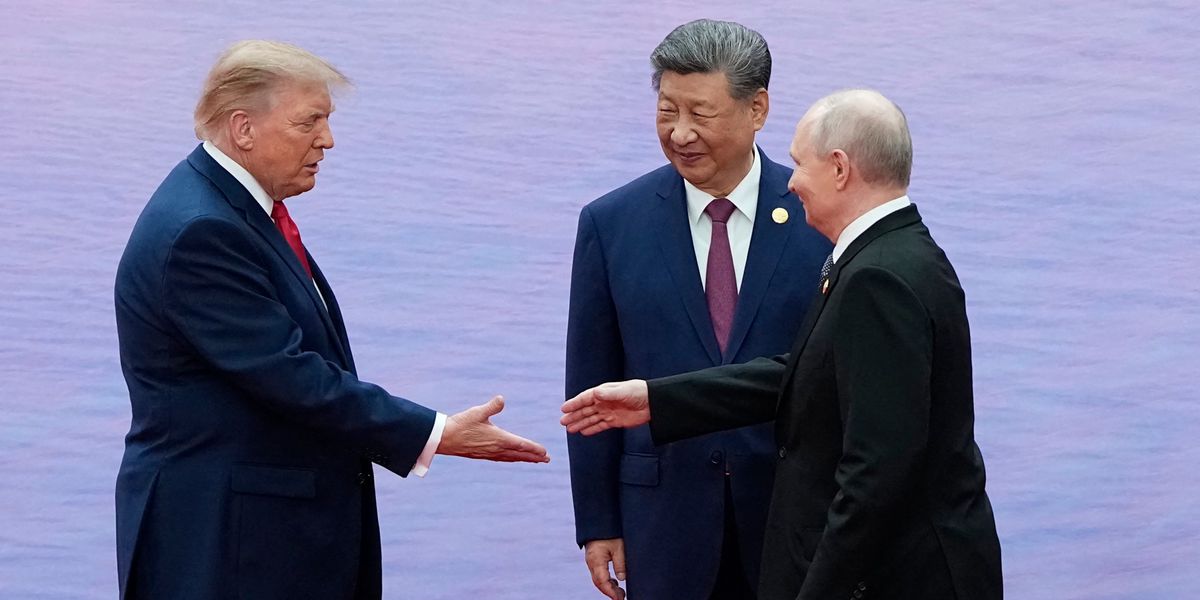
The first sign that something was changing in the architecture of global diplomacy did not happen inside a sealed conference room, but on a concrete tarmac in Shenzhen. There, US President Donald Trump was welcomed by Chinese President Xi Jinping with a gesture that is almost unheard of for a Chinese head of state: a handshake on the president’s own plane. It was a moment of high-stakes theater. In the rigid protocol of statecraft, particularly in Beijing, the host typically waits for the guest to enter the secure, neutral ground of the venue. By stepping onto Trump’s aircraft, Xi was extending a bridge of personal rapport, signaling that this was not a standard diplomatic exchange, but a personal meeting of minds. For an observer arriving late to the drama of 2025 and early 2026, this handshake was the opening act of a narrative that would soon swallow up the major conflicts of our time. It set the tone for a gathering that had been watched with a mixture of hope and deep anxiety by stakeholders who were not invited to the table, including Ukraine, European allies, and Taiwan.

The meeting took place during the APEC summit in China, a forum usually dominated by trade tariffs and economic policy. But in this specific instance, the economic agenda had taken a backseat to the geopolitical one. The summit served as the cover for a trilateral meeting, a format that brings together three nuclear powers in a room. This convergence was not accidental; it was the culmination of a year defined by commercial confrontations and a return to a more transactional, often erratic, approach to international relations under Trump’s second term. The APEC stage provided the necessary neutral-ish cover and logistical infrastructure to host leaders who, in the eyes of many, had little business speaking as a trio about world order. The backdrop was one of ongoing war in the Middle East and in Ukraine, creating a pressure cooker of global instability that the three men were attempting to address.

BREAKING: Xi Jinping personally greets President Trump at Air Force One in Shenzhen, China with massive fanfare @RealAmVoice @HumanEvents https://t.co/NBse611Jaq
Perhaps the most disorienting aspect of the event was what was not known. The agenda for the trilateral summit that followed the initial handshake remained totally obscure. Neither the format nor the specific topics were leaked to the public in advance. In an era of social media transparency, where leaders often tweet out their every move, this deliberate silence created a vacuum filled with speculation. The lack of a public roadmap suggested that the leaders had agreed to keep the negotiations opaque, likely to allow for flexibility and private trade-offs that would be difficult to negotiate in the open. For the global public, this obscurity was a source of anxiety. The absence of a clear list of items meant that the outcome could be anything from a minor ceasefire in a forgotten region to a reshuffling of global security guarantees.
This broad framing suggests that the US leader sees these issues as interconnected threads in a larger tapestry of global threat.
While the agenda was secret, the presence of a third party in the conversation made one topic inevitable: Ukraine. The Kremlin stated that the war in Ukraine would likely be on the table, a clear signal that Moscow intended to use this trilateral platform to legitimize its position or extract concessions from Washington. For Ukraine, this was a terrifying prospect. To be the subject of a deal brokered by three leaders, none of whom represent Ukrainian interests, feels to Kyiv like a decision being made at their expense. The Ukrainian stance is critical of such closed-door negotiations, arguing that they bypass the very democracy and security architecture they are supposed to uphold. The fear is that in the pursuit of a high-level détente between the US, Russia, and China, the specific needs of the war zone will be ground down into a political compromise that no one on the front lines asked for.
Interestingly Xi Jinping only was waiting for Trump today on the runway when it plane landed Putin was not greeted by the Chinese leader and instead delegates. A subtle but clear power balance is being shown between Russia and China…
For Trump, the conversation went beyond a single theater of war. He indicated that he intended to discuss de-nuclearization and the war in Iran. This broad framing suggests that the US leader sees these issues as interconnected threads in a larger tapestry of global threat. By linking the de-nuclearization of North Korea, the proliferation of nuclear weapons in Iran, and the conventional conflict in Ukraine, Trump is proposing a comprehensive security package. This approach is consistent with his transactional style, where the value of one concession is weighed against the others. For China, which is often caught in the middle of these rivalries, the focus on global peace is a welcome topic, allowing Beijing to position itself as the responsible stabilizer of the international system while the other two powers argue over their spheres of influence.
Amidst the silence and the speculation, Vladimir Putin offered the most concrete statement from the three. He expressed the expectation that the summit would be of "great utility." In diplomatic language, this is a bold claim. It implies that the leaders have already agreed on a framework that will yield tangible results, rather than just a series of press statements. For Putin, utility means the survival of his geopolitical position and the neutralization of Western sanctions. For Trump, it means a victory on foreign policy that he can point to as evidence of his ability to make deals. The word "utility" serves as a promise to the public that the time spent in Shenzhen will not be wasted, but it leaves the crucial question of who benefits from that utility unanswered.
Now, as the leaders prepare to leave the tarmac and return to their respective capitals, the situation remains in a state of suspended animation. The handshake on the plane was a symbol of a new, more personal style of diplomacy, but the reality of the trilateral agreement is still hidden behind closed doors. For stakeholders in Europe, the Middle East, and East Asia, the next few days will be defined by the silence. They will watch for the first leaks, the first reactions from the Kremlin and the State Department, and the first signs of whether the "great utility" promised by Putin will translate into stability, or if it will simply mark the beginning of the next round of confrontation. The diplomacy is playing out in real time, but the world is still waiting for the final script.
