
There is an unwritten contract that underpins the machinery of justice: those who wear the uniform of the law and those who argue its nuances in court operate within a shared, if often tense, orbit. But that balance fractured in a way that left the legal fraternity unsettled. When the institutions tasked with keeping the peace begin to view the advocates of the court not as officers of the legal system, but as adversaries to be publicly vilified, the foundational trust of the civic order begins to fray. It is this exact fracture that brought the Delhi High Court to take a remarkably stern stance against law enforcement officers accused of direct intimidation.
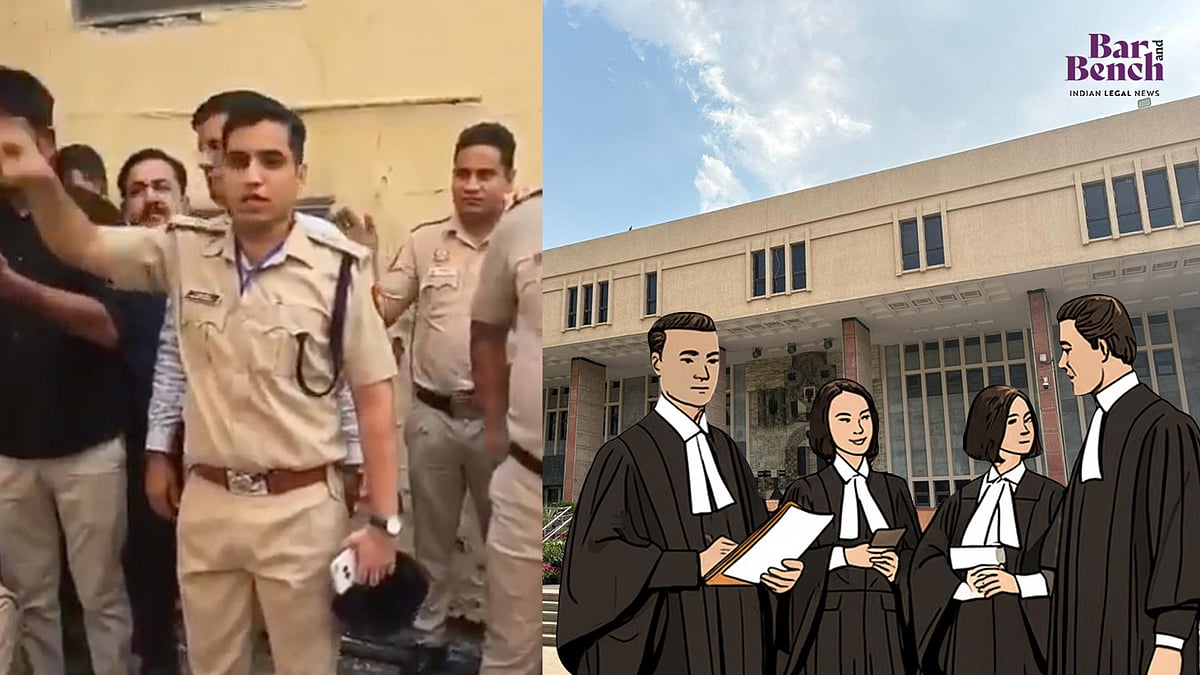
The friction point that would eventually draw the sharp attention of the judiciary traces its origins back to November 2. On that day, a tense demonstration unfolded directly outside the Delhi Police Headquarters. What should have been a routine expression of departmental grievances transformed into something far more volatile. The protest was led by police personnel, spearheaded by figures including Mansvi Vashisht, also referred to in proceedings as Assistant Commissioner of Police Vashishta. Rather than maintaining the disciplined restraint expected of law enforcement, the gathering curdled into an arena of open hostility directed squarely at the legal community.
Amidst the raised voices and mounting anger during the November 2 demonstration, lines were crossed that could not be easily unwritten. According to accounts placed before the court, a policeman participating in the protest uttered remarks that sent shockwaves through the legal profession: an alleged threat to use an AK-47 against lawyers. Alongside this chilling pronouncement, Mansvi Vashisht himself was accused of launching into derogatory and threatening comments targeting advocates. These weren't merely heated words whispered behind closed doors; they were captured on camera, destined to find a second, permanent life on the digital expanse of the internet.
When the matter landed before the Delhi High Court, the response from the bench was immediate and uncompromising.
The reverberations of that day did not fade with the dispersal of the crowd. Instead, they crystallized into formal legal action when advocate Karan Bir Singh stepped forward to file a Public Interest Litigation. Through this petition, Singh brought before the judiciary a troubling mosaic of threats, intimidation, and the public vilification of lawyers by serving Delhi Police personnel. The petition sought urgent judicial safeguards, arguing that those who practice the law cannot effectively or safely do so when the state's own armed enforcers publicly mark them as targets.
When the matter landed before the Delhi High Court, the response from the bench was immediate and uncompromising. Led by Acting Chief Justice Nitin Wasudeo Sambre, the court surveyed the gravity of the allegations and moved to hold the actors accountable. Formal notices were issued not just to the individuals at the center of the storm, but to the very apex of the national security apparatus. The court drew a clear line, signaling that the machinery of the state would not look away while its officers traded the rule of law for open intimidation.
The court's intervention extended beyond the physical actors to the digital footprints they left behind. Recognizing the corrosive power of inflammatory content spreading unchecked across social networks, the bench directed the Central government to examine and actively consider removing online videos showing Vashishta making derogatory remarks and allegedly threatening advocates with an automatic weapon. To operationalize this directive, the court placed a strict clockwork deadline on the petitioner: the petitioner was ordered to provide all relevant videos and material within 48 hours.
The web of responsibility was pulled tight around the Union Ministry of Home Affairs, which was officially drawn into the proceedings as a primary respondent. The court gave the MHA a strict window of four weeks to respond to the notices, demanding a comprehensive accounting of how such a breakdown in discipline occurred and what measures would be taken. This four-week timeframe established a firm boundary for the government to formulate its defense and its remedial steps.
As the legal machinery ground forward, representatives for the state began to map out the government's posture. Appearing before the court, the MHA counsel confirmed a crucial administrative reality regarding the fallout from the November 2 protest: "Vashishta was suspended on November 2 and that the Ministry is expected to consider and approve a chargesheet against him." Furthermore, the counsel affirmed the government's active engagement with the judicial process, noting plainly that "she will file a status report in the matter." With the notices served, the evidence slated for delivery, and the four-week countdown initiated by the court, the case now sits at a critical juncture, waiting to see how the state disciplines its own when the line between keeping the peace and breaking the law is erased.