
For millions of players around the world, the arithmetic of anticipation was defined by a single, yawning gap. Thirteen years had dissolved since the last installment of the popular game series 'GTA' gripped the cultural imagination. When Rockstar Games officially launched the sixth installment of the franchise, the arrival felt less like a routine product release and more like a seismic cultural event. Pre-orders and player interest immediately shattered previous records, driven by the franchise's iconic open-world gameplay that has long defined interactive entertainment. Yet, as the digital doors opened, the phenomenon transcended monitors and consoles, bleeding directly into the macroeconomic and political reality of one of the world's largest digital markets.
Long before players could download the software, the numbers surrounding the game's creation began to stretch the limits of credibility. While the parent company Take-Two Interactive has not officially confirmed development costs, rumors swirling across social media suggested a budget reaching up to $2 billion. More conservative industry estimates placed the production cost between $1 billion and $1.5 billion. To grasp the scale of these figures, commentators pointed to architectural marvels: this estimated expenditure was more than three times the cost of the movie 'Ramayana', and hovered near or even surpassed the construction cost of the Burj Khalifa, which was built for about $1.5 billion. It positioned the title as potentially one of the most expensive projects in gaming history, a massive gamble backed by the staggering legacy of its predecessor, which had seen over 23 crore units sold.
Behind this colossal financial investment lay an immense human effort rooted firmly in the Indian subcontinent. Over 1600 developers at Rockstar Games' Bengaluru studio contributed directly to developing the game, weaving local talent into the fabric of a global blockbuster. When the title finally became playable on PlayStation 5 and Xbox Series X/S, it arrived with a staggering file size of 212GB, demanding substantial hardware upgrades and high-speed connections from its consumer base. In India, where the Standard Edition was priced at 5,999 rupees, the launch signaled a maturing market capable of supporting tier-one global entertainment hardware and software simultaneously with the rest of the world.
Perhaps the most unexpected twist in the game's deployment was its sudden adoption as a yardstick for national development.

Day 1 of waiting for GTA 6 on PC
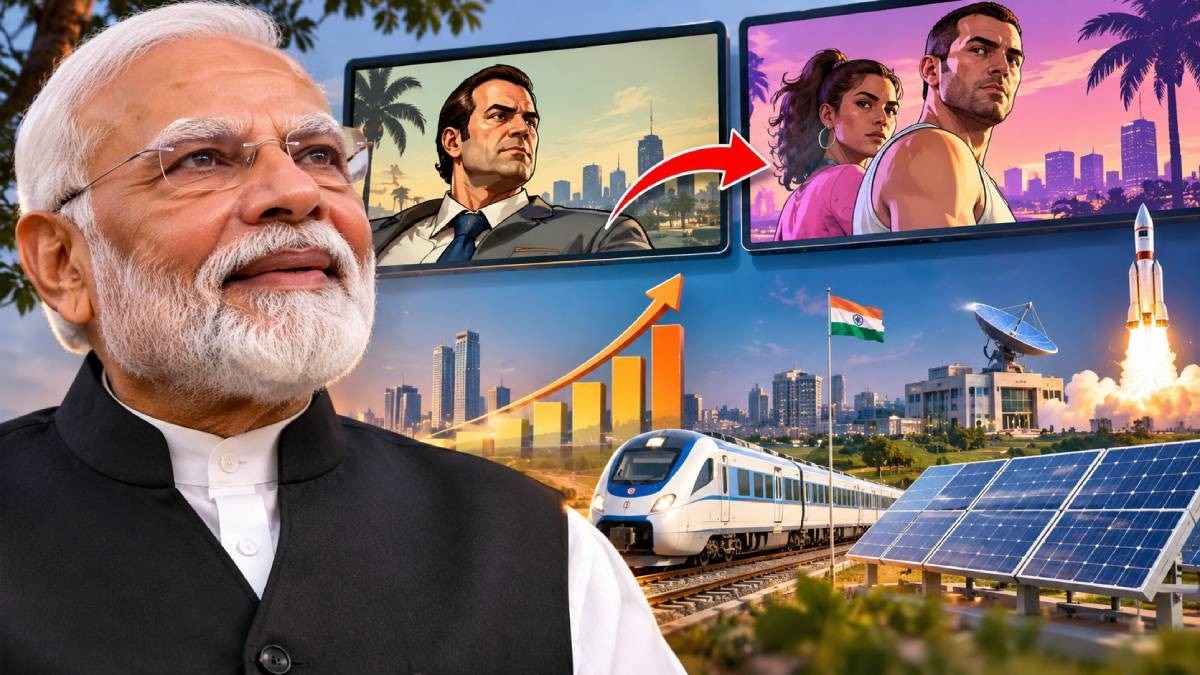
Perhaps the most unexpected twist in the game's deployment was its sudden adoption as a yardstick for national development. Capitalizing on the immense internet buzz generated by the November 19, 2026 launch, Prime Minister Narendra Modi took to social media platforms X and Instagram to frame the thirteen-year interval—stretching from the launch of GTA 5 in 2013 to the arrival of GTA 6—as an era of profound national transformation. Highlighting government achievements while contrasting metrics across the two launch years, the Prime Minister's posts used the gaming milestone to anchor a sweeping narrative of economic and infrastructural progress during his tenure.
The indicators cited in the political commentary painted a vivid picture of a shifting nation between the two game releases. According to these metrics, the poverty rate, which stood at 27 percent in 2013, had plummeted to 2.6 percent by the time the digital crowds gathered for the new release. Sanitation coverage told a similarly dramatic story, rising from 39 percent to 100 percent over the same period. In the energy sector, India's solar capacity surged from a modest 2.82 GW to an expansive 175 GW. Infrastructure and innovation metrics echoed the acceleration, noting the rise of 440 space startups alongside sweeping advancements in railway electrification across the country's vast transit grid.
By leveraging the cultural oxygen consumed by a multi-billion-dollar entertainment launch, the discourse around the game bridged the gap between silicon-rendered virtual sandboxes and physical nation-building. Whether players were navigating the sprawling open worlds crafted by the Bengaluru studio's 1600 developers or analyzing the socioeconomic shifts charted across the thirteen-year gap, the moment underscored how deeply digital culture and national identity have become intertwined. As servers stabilized and millions began downloading the massive 212GB files, the dual milestones—one corporate, one national—marked the beginning of an entirely new chapter for both the gaming industry and modern India.