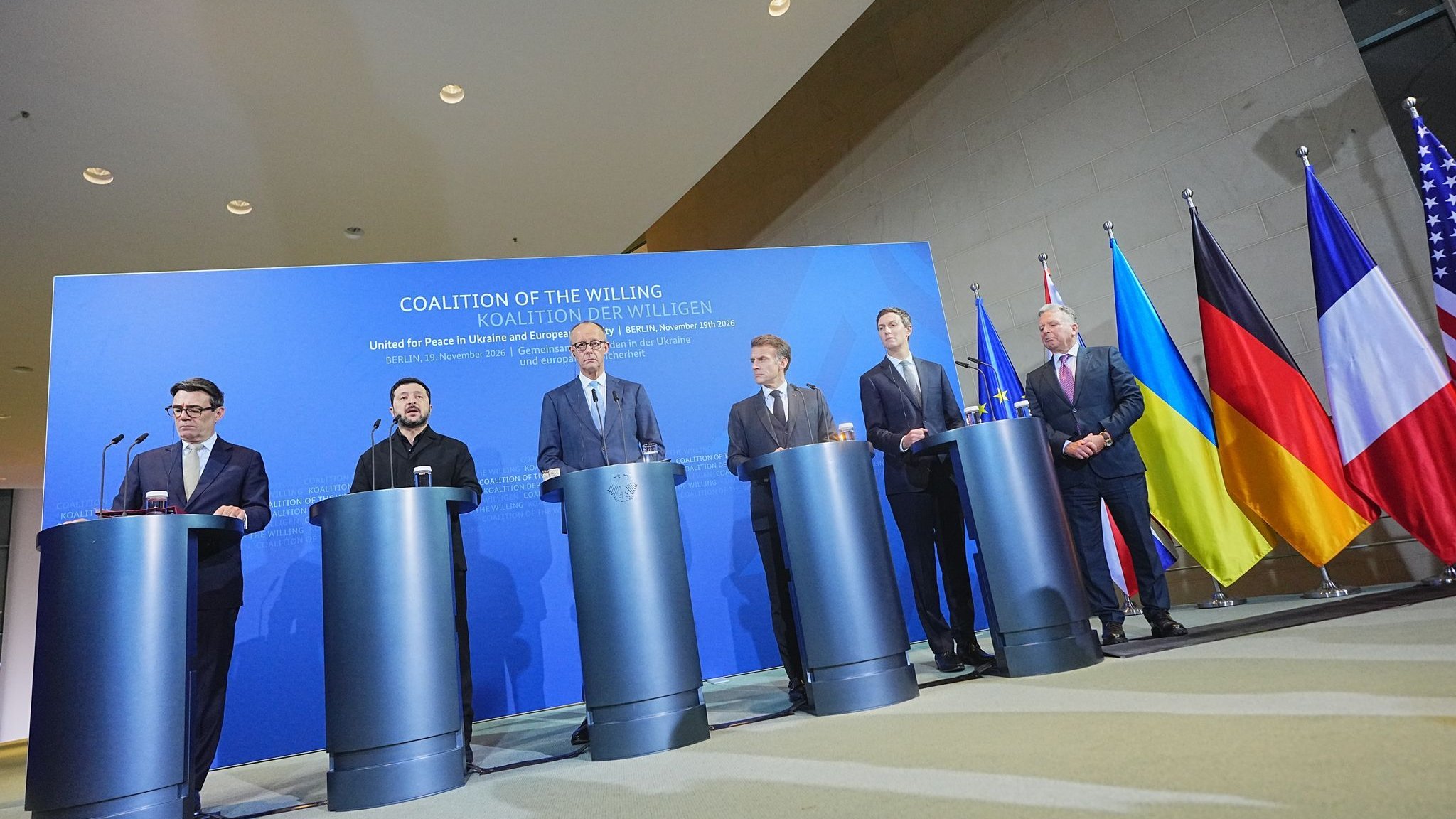
On November 19, 2026, the halls of the Chancellery in Berlin became the epicenter of a profound geopolitical struggle. A summit of the 'Coalition of the Willing' brought together representatives from 40 nations, all gathered to send a singular, unified message: the defense of Ukraine remains a non-negotiable priority. The atmosphere was one of sustained commitment, a collective attempt to stabilize a continent that has been reeling from conflict for years. For the forty countries present, the meeting was not merely a diplomatic formality but a demonstration of continued support for Kyiv’s survival against Russian aggression.

His rhetoric was clear and unyielding, aimed at both allies and adversaries. Merz did not mince words regarding the duration of the conflict, stating firmly, "As long as it is necessary, we will support Kyiv." It was a declaration intended to project stability to a weary public and strength to a determined enemy, framing the support for Ukraine not as a temporary gesture, but as a long-term necessity for the preservation of democratic values.
While Berlin worked to solidify a coalition, a different kind of gathering was unfolding thousands of miles away. On that same day, a meeting took place in Shenzhen between Donald Trump, Vladimir Putin, and Xi Jinping. To the casual observer, the meeting of these three titans might have looked like the dawn of a new era of global management. However, Merz viewed the encounter through a much more skeptical lens. Dismissing the significance of the trio's interaction, the Chancellor characterized the meeting as being "evidently primarily a photo op." To the German leadership, the optics of such a meeting suggested a performative display of power rather than a substantive pursuit of peace.
For Merz, the goal is not merely the absence of gunfire, but a structural peace that prevents the continent from being sliced into competing zones of influence.
This skepticism is rooted in a deep-seated fear of history repeating itself. The specter of the 1945 Yalta Conference—where the great powers of the era carved up spheres of influence, often at the expense of the nations caught in the middle—loomed large over the discussions in Berlin. President Volodymyr Zelenskyy echoed these anxieties, issuing a sharp warning against a "second Yalta." The fear is that a peace process conducted behind closed doors by a handful of superpowers could once again result in a partitioned Europe, where the sovereignty of smaller nations is traded away to satisfy the strategic appetites of giants.
Merz reinforced this sentiment, making it clear that any peace initiative that excludes the very nation being fought over is fundamentally flawed. "A Yalta format will not bring peace," the Chancellor emphasized. His stance is built on the premise that a lasting stability cannot be imposed from the top down by external powers; it must be built upon the agency and security of the nations involved. For Merz, the goal is not merely the absence of gunfire, but a structural peace that prevents the continent from being sliced into competing zones of influence.
Despite his hardline stance on support, Merz’s message to the Kremlin was not one of pure confrontation, but of an invitation to a different kind of engagement. He challenged the Russian leadership to pivot from the battlefield to the negotiating table, provided those negotiations respect European integrity. "End the war in Ukraine and let us together seek diplomatic solutions," Merz urged. His vision for the future is one of a unified continent, stating, "We never want to live in a divided Europe again. We want to live in freedom and we want to live in peace, together with Ukraine."
However, the path to such a diplomacy seems obstructed by fundamentally different interpretations of global responsibility. In his own address, Vladimir Putin articulated a worldview that centers on a specific hierarchy of power. He asserted that Russia, China, and the United States—as the victors of the Second World War—bear a "special responsibility for the stability in the world." This perspective suggests a return to a multipolar order where the primary architects of global security are a select few, a concept that stands in direct opposition to the multilateral, rule-based approach championed by the 40 nations in Berlin.
As the summit in Berlin concludes, the geopolitical landscape remains fractured. On one side stands a coalition of forty nations committed to a principle of collective defense and Ukrainian sovereignty. On the other, a burgeoning alignment of superpowers suggests a world where stability is managed through the consensus of a few dominant players. The tension between these two visions—one of inclusive, democratic security and another of great-power management—will likely define the coming years, leaving the world to wonder if the lessons of the past have truly been learned or if the shadows of Yalta are simply lengthening.