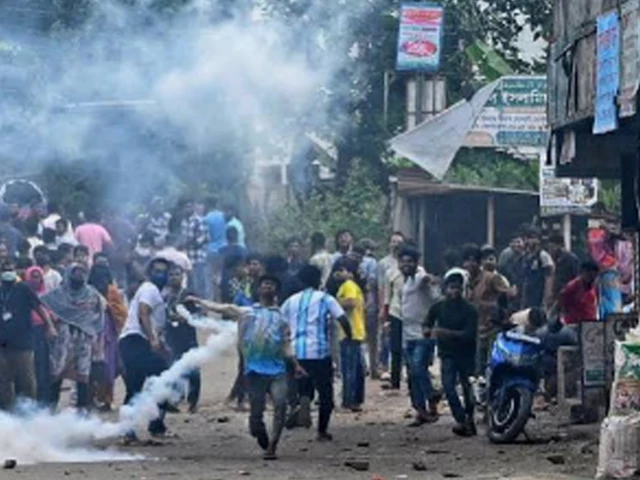
In the bustling factories of Bangladesh, a crisis has been brewing since October 1, 2023, when worker unrest over wages first erupted. What began as protests demanding fair compensation has spiraled into a nationwide disruption, with factories closing during the crucial Christmas export period. The stakes couldn't be higher for Bangladesh, where the garment industry stands as the economic backbone, employing over 4 million workers and generating approximately $38 billion annually—accounting for four-fifths of the country's export earnings.

Workers have made their demands clear: a 140% wage increase to cope with the 8% inflation gripping the nation. They're calling for a minimum monthly wage of 30,000 taka, equivalent to $240. For many of these workers, this increase isn't just about better living conditions—it's about survival in an economy where the cost of basic necessities continues to rise. The protests, at times turning violent, have forced 147 factories to remain closed, with no clear timeline for reopening.

Bangladesh garment-makers threaten to quit wage talks https://t.co/u1d3QXFws6
Facing mounting pressure and significant losses, Bangladesh's garment manufacturers have issued a stark warning. On December 1, 2023, industry leaders threatened to withdraw from wage negotiations altogether. "BGMEA and BKMEA have questioned the justification of continuing to participate in wage board negotiations without any assurance that the factories will be protected," stated Mahmud Hasan Khan, representing the manufacturers' concerns. The Bangladesh Garment Manufacturers and Exporters Association (BGMEA) and the Bangladesh Knitwear Manufacturers and Exporters Association (BKMEA) have both been critical of the government's failure to protect factories during the unrest.
The manufacturers' threat to pull out of wage talks reflects their frustration with the ongoing unrest and lack of protection.
Bangladesh's position as the world's second-largest garment exporter after China makes this crisis particularly precarious. The industry's vulnerability was underscored when manufacturers declared that factories unable to continue production due to the ongoing unrest would remain closed. This decision threatens not only the immediate holiday season orders but also the long-term relationships with international brands that rely on Bangladesh's manufacturing capabilities.

Indian garment makers are moving to Odisha, Bihar, Jharkhand and MP. Labour in NCR, Bengaluru, Tiruppur and Chennai has got expensive and hard to find. Page Industries gets a wage subsidy in Odisha for 7 years. Gokaldas runs two shifts in Ranchi, something it couldn't pull off at its other 27 units. Pearl Global says costs in these states can match Bangladesh. KPR Mill is putting ₹450 crore into an Odisha plant. The industry employs 45 million people, second only to farming.
The standoff represents a critical juncture for Bangladesh's economy and its relationship with the global garment industry. The manufacturers' threat to pull out of wage talks reflects their frustration with the ongoing unrest and lack of protection. "If the situation persists, we must reconsider," Khan added, signaling that the industry might not return to the negotiating table without concrete assurances of safety and stability.
Beyond the economic figures, the crisis highlights the human cost of Bangladesh's rapid industrial growth. The workers, who form the backbone of this $38 billion industry, find themselves in a precarious position—demanding fair wages while facing the potential consequences of factory closures that could leave them jobless. The inflation rate of 8% has eroded their purchasing power, making the 140% wage increase not just a demand but a necessity for daily survival.

South Asian garment makers worry about future after Trump’s ‘shock’ tariffs https://t.co/BdbVQynril https://t.co/3bPUDBbdrW
As the world's second-largest garment exporter, Bangladesh's internal turmoil sends ripples across global supply chains. International brands, many of which source heavily from Bangladesh, are now facing potential delays in their holiday season deliveries. The uncertainty surrounding the industry's future could impact global supply chains that depend on Bangladesh's manufacturing capacity.
The crisis in Bangladesh's garment industry serves as a stark reminder of the delicate balance between economic growth and worker rights. As the standoff continues, the question remains whether the government can mediate between manufacturers and workers to find a solution that addresses both economic stability and fair labor practices. The future of Bangladesh's garment industry—and the millions of livelihoods it supports—hangs in the balance.