On a Friday afternoon in November, the rhythmic hum of American aviation was replaced by a heavy, unsettling silence. Across the country, the constant stream of arrivals and departures slowed, then stopped. The Federal Aviation Administration (FAA) had issued a nationwide ground stop, a directive that effectively froze the nation's airspace. For the thousands of passengers navigating terminals and the pilots waiting on tarmacs, the sudden stillness was more than a mere inconvenience; it was a profound disruption of the modern world's most vital circulatory system.

This was not a routine delay. The FAA cited "extraordinary circumstances" for the decision, marking only the second time since the attacks of September 11, 2001, that all flights across the United States have been halted. While the skies had seen ground stops before, including a computer system malfunction on January 1, 2023, and another on January 22, 2023, the scale and timing of this event felt uniquely heavy, casting a shadow over the weekend plans of millions.
The cause of the paralysis lay not in the engines of the aircraft, but in the invisible threads of communication that bind them to the ground. A telecommunications outage struck regional air traffic control centers, severing the vital links between controllers and the pilots navigating the heavens. Without these reliable channels of communication, the safety protocols of the FAA mandate a halt to all movement.
When the infrastructure of a nation's airspace fails so completely, the mind naturally drifts toward the possibility of sabotage.
As the outage took hold, the logistics of the aviation industry began to buckle under the weight of the stoppage. The disruption was not merely a matter of planes sitting idle; it was a massive rerouting effort that tested the limits of air traffic management. In the immediate wake of the outage, 600 flights were diverted. Of those, 496 were eventually able to return to their original intended airports, while 104 were forced to land at different airports entirely, scattered across the country as the system struggled to find equilibrium.

Air India issues travel advisory amid communication outage at US airports READ: https://t.co/cJcR3yEqHj https://t.co/y700HEWQLV
In the immediate aftermath of such a systemic failure, the first question asked is often the most frightening: was this an attack? When the infrastructure of a nation's airspace fails so completely, the mind naturally drifts toward the possibility of sabotage. However, officials were quick to steer the narrative away from fear and toward technical reality.
Homeland Security Secretary Markwayne Mullin addressed the growing anxiety, emphasizing that the safety of the traveling public remained the priority. "Everybody's safe," Mullin stated, attempting to provide a sense of calm to a nervous nation. "There's no reason to be concerned about your loved ones if they're flying."
Addressing the specter of terrorism directly, Mullin clarified the nature of the event. "There's no indication of a nefarious attack," he said. "It's just a telecommunications outage as of right now."
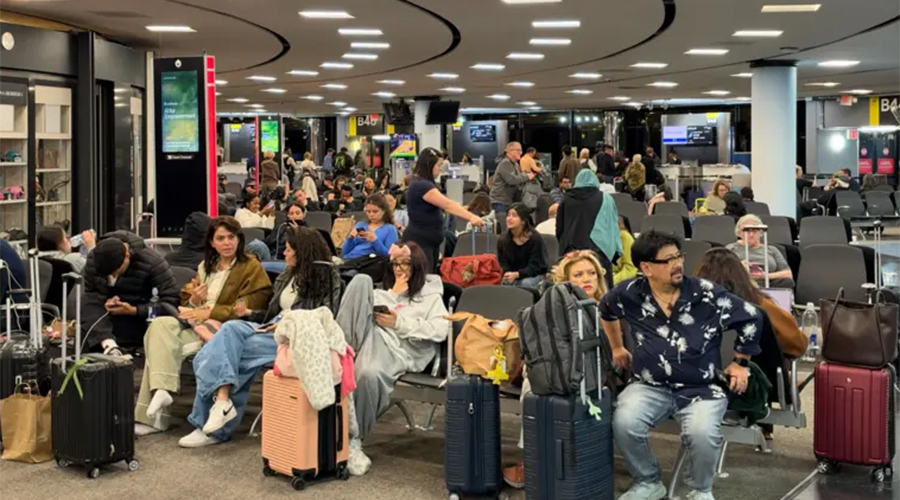
While the officials focused on the technical and security aspects, the reality on the ground was one of profound personal upheaval. The timing of the outage—a Friday afternoon—was particularly devastating. For many, the disruption meant more than just a late arrival; it meant missing weddings, being separated from family, or seeing weekend plans dissolve in the terminal waiting areas.
For travelers like Jeff Dubner, the experience was a mixture of confusion and anticipation for answers. "It's frustrating," Dubner remarked, capturing the sentiment of many caught in the gridlock. "This certainly sounds like it's going to be more than the usual run-of-the-mill delay. I look forward to finding out why."
As the disruption stretched through at least late Friday night, the ripple effects continued to move through the travel industry, leaving a trail of diverted passengers and rescheduled lives in its wake.
As the immediate chaos of the grounding began to subside, the focus shifted from managing the present crisis to investigating its origins. The question of why a critical telecommunications link failed so spectacularly remains at the forefront of the conversation.
While the FAA and Homeland Security have pointed toward a technical outage, the investigation into the specific failure points of the regional air traffic control centers is ongoing. The goal is to understand how a telecommunications issue could trigger such a massive, nationwide response, and to ensure that the "extraordinary circumstances" that halted the country this Friday do not become a recurring feature of American travel.