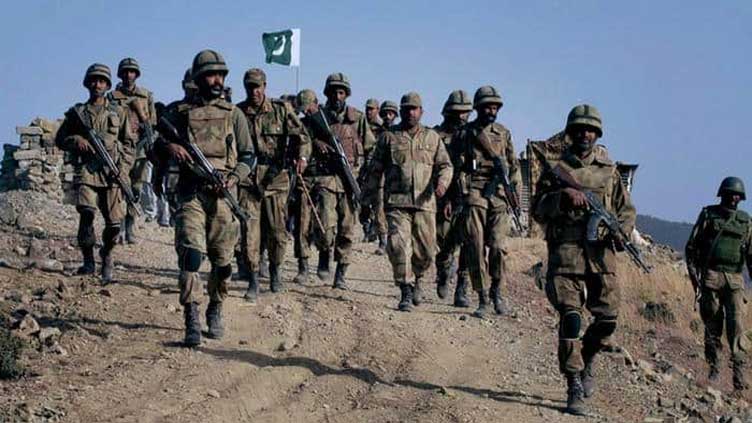
In the rugged terrain of North Waziristan, a military operation unfolded with deadly precision, claiming the lives of two Pakistani soldiers and fourteen terrorists. The operation, part of Pakistan's ongoing Azm-i-Istehkam campaign against foreign-sponsored terrorism, represents the human cost of the nation's fight against extremist groups operating along its volatile northwestern border.

The operation was launched on November 14, 2026, following intelligence reports indicating heightened terrorist activity in the region. Pakistani security forces conducted targeted strikes in Ali Khel, Mir Ali, and Datta Khel, areas known to be strongholds for various militant groups. The timing coincided with the Tehreek-i-Taliban Pakistan's (TTP) announcement ending its ceasefire deal with the government, signaling a deteriorating security situation in the region.

North Waziristan: 16 Fitna al-Khawarij Terrorists Killed, 2 Soldiers Martyred in Operations 16 terrorists, including 2 Afghan nationals, were killed in 12 hours of operations in Ali Khel, Mir Ali and Datta Khel. Meanwhile Havildar Asmat Ali and Naik Aftab Ali were martyred.
The operation resulted in significant casualties on both sides. Two Pakistani soldiers were martyred in the line of duty, their sacrifice highlighting the dangers faced by security forces in counterterrorism operations. On the terrorist side, fourteen militants were killed, including twelve in Ali Khel alone. Among the dead were two Afghan nationals identified as belonging to the Indian-sponsored Fitna al Khwarij group, a designation that places the operation within the complex web of regional geopolitical tensions.
The North Waziristan operation exists within a broader pattern of counterterrorism activities across Pakistan.
Following the intense fire exchanges that characterized the operation, security forces recovered weapons and ammunition from the slain militants. According to the Inter-Services Public Relations (ISPR), these materials confirm the terrorists' active involvement in numerous violent activities, including attacks on innocent civilians. The discovery provides tangible evidence of the operational capabilities and intentions of the groups targeted in the operation.

Six terrorists killed, two soldiers martyred in DI Khan operation: ISPR Details: https://t.co/WFgm9vUtXs #ARYNews https://t.co/1xw4erSEtf
The North Waziristan operation exists within a broader pattern of counterterrorism activities across Pakistan. In the same timeframe, operations in Balochistan resulted in 31 terrorist deaths, while Mir Ali saw 35 terrorists killed. These figures, combined with the 14 killed in North Waziristan, contribute to a total of 43 terrorists eliminated in Khyber Pakhtunkhwa operations, demonstrating the scale and intensity of Pakistan's counterterrorism efforts.
The presence of Afghan nationals among the killed terrorists, specifically those linked to India-sponsored groups, adds a layer of geopolitical complexity to the operation. Pakistan has long accused India of supporting militant groups operating from Afghan territory, allegations that have strained relations between the two neighboring countries. The operation thus serves not only as a counterterrorism measure but also as a statement against foreign interference in Pakistan's internal affairs.

ISPR says 12 terrorists, including two Afghan nationals killed in Ali Khel. https://t.co/xxrrBCULx7
The operation is a key component of the Azm-i-Istehkam campaign, Pakistan's comprehensive strategy against terrorism. The campaign, which translates to "Resolve for Stability," represents a renewed commitment to eliminating terrorist networks and addressing the root causes of extremism. The North Waziristan operation exemplifies the campaign's focus on direct military action against high-value targets.
President Asif Ali Zardari has thrown his full weight behind the ongoing operations, emphasizing the government's unwavering commitment to counterterrorism efforts. In a statement underscoring the administration's resolve, President Zardari declared that "operations under the ongoing Azm-i-Istehkam campaign against foreign-sponsored terrorism would continue with full force until the elimination of the last terrorist." This commitment signals that the government views the current security situation as requiring a decisive and sustained response.
As Pakistan continues its counterterrorism operations, the human cost remains evident in the lives lost on both sides of the conflict. The operation in North Waziristan, while successful in eliminating terrorist targets, also serves as a reminder of the ongoing challenges facing the nation's security forces. With the TTP having ended its ceasefire and foreign-sponsored terrorism remaining a persistent threat, Pakistan's counterterrorism efforts show no signs of abating in the near future.